
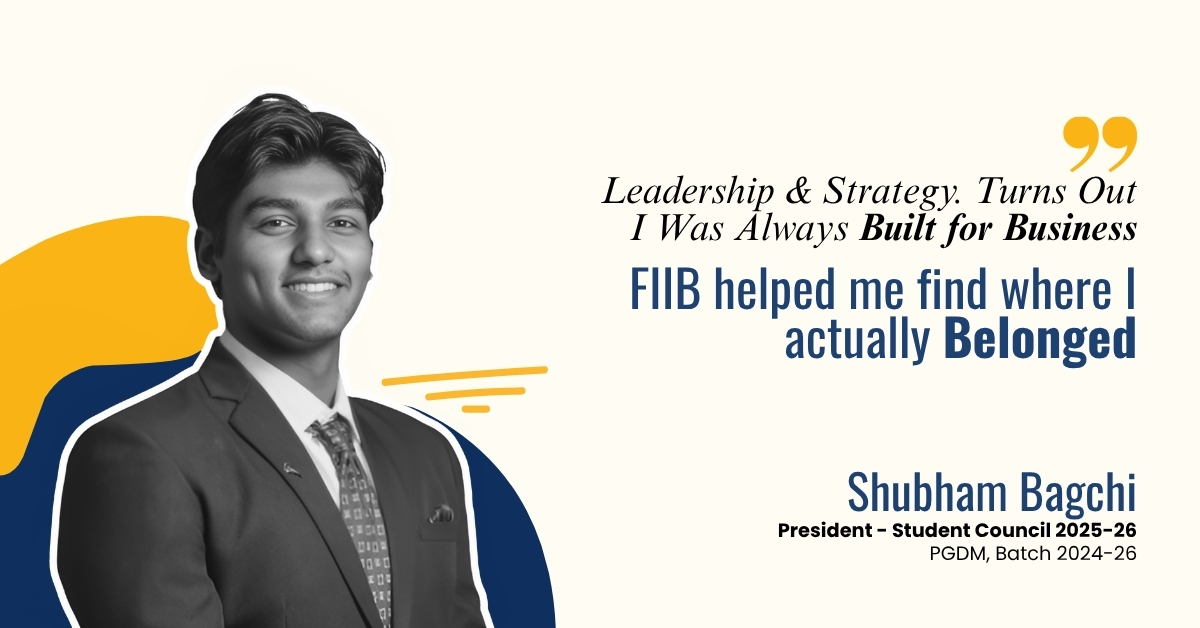
In conversation with the FIIB Newsdesk, Shubham Bagchi, PGDM 2024-26 | President – Student Council, reflects on how his journey from on-ground sales to pursuing an MBA after work experience helped him move from execution to strategy, with FIIB’s industry-integrated and AI-driven learning playing a defining role.
Q. You chose to pursue an MBA after work experience in sales. How did those early years shape your approach when you entered FIIB?
Choosing to pursue an MBA after work experience gave me a very different lens right from Day 1.
Before joining FIIB, I had spent close to four years working with organisations like WBIDC and Graphite India Ltd., where I handled the complete sales cycle—lead generation, client conversations, follow-ups, and closures. It was hands-on, fast-paced, and often unpredictable.
That experience teaches you something very early—business is not linear.
You can have the right product, the right pitch, and still not close a deal. And sometimes, a lead that seemed irrelevant at first ends up converting at the right moment. That unpredictability is something you only understand when you’ve worked in the field.
However, what I lacked before my MBA after work experience was structure. I knew what worked, but not always why it worked.
At FIIB, that changed. Through case-based learning with 60+ Harvard Business School case studies and simulations across strategy, marketing, finance, and operations, I could start connecting my experiences with frameworks. It helped me move from instinct-driven decisions to structured thinking.
That’s where an MBA after work experience becomes powerful—you don’t just learn concepts, you contextualise them.
Q. Can you share a real example where this shift—from experience to structured thinking—played out?
Yes, one of the most defining moments was during my internship at Castia.
There was a large pool of what the team called “inactive leads”—students who had stopped responding, exceeded budget, or simply didn’t seem worth pursuing. In most sales setups, these leads are deprioritised in favour of new ones.
But having prior sales experience before my MBA, I had seen patterns like this. So instead of ignoring them, I tried to understand the reason behind their inactivity.
At FIIB, we had been studying customer behaviour, segmentation, and decision-making processes. That helped me look at this segment differently—not as lost leads, but as delayed opportunities.
I started re-engaging them with better timing and more contextual communication—acknowledging changes like visa delays, financial approvals, or shifting preferences.
The results were quite telling:
- 9 out of 26 bookings came from these inactive leads
- At one stage, nearly 15% of total team bookings were driven by this segment
This was a turning point for me.
It reinforced a key insight:
growth doesn’t always come from expanding the funnel; often, it comes from optimising what already exists.
And this is exactly where an MBA after work experience, especially at a place like FIIB, makes a difference—you begin to apply frameworks to real situations, not hypothetical ones.
Q. FIIB emphasises experiential learning as a core part of its MBA. How did that influence your journey?
Experiential learning is not just a part of the program—it’s central to it.
At FIIB, nearly 40% of the MBA experience is built around live projects, internships, and simulations, which ensures that learning is always applied.
For someone pursuing an MBA after work experience, this becomes even more valuable. You’re not passively learning—you’re constantly testing and refining your understanding.
The two-internship model (Corporate Internship Program and Social Internship Program) adds another layer. While the corporate internship exposes you to real business challenges, the social internship brings in a completely different dimension—working with NGOs and understanding grassroots-level impact.
This combination builds both analytical thinking and empathy, which are critical for long-term leadership.
It also ensures that by the time you graduate, you’re not just academically prepared—you’re industry-ready.
Q. How has FIIB reshaped your understanding of go-to-market strategy after your sales experience?
Before my MBA after work experience, I viewed go-to-market (GTM) largely as execution—campaigns, outreach, and conversions.
But FIIB expanded that understanding significantly.
With exposure to AI tools, analytics, and structured frameworks, GTM becomes much more about insight than activity. We work with 25+ AI tools integrated into the curriculum, which makes decision-making far more data-driven.
Now, I see GTM as a combination of:
- Timing
- Segmentation
- Behavioural understanding
- And data-backed decision-making
The inactive leads example is a perfect illustration. The audience didn’t change—their context did.
That shift—from action to insight—is what defines the transition from sales execution to strategy.
Q. You also held a leadership role as Student Council President. How did FIIB shape your leadership journey?
Leadership at FIIB is very experiential, much like its academic approach.
As Student Council President, my role was not limited to representation—it involved execution, coordination, and decision-making across multiple stakeholders. You’re working with students, faculty, and administration simultaneously.
What stands out is that leadership opportunities are not restricted. Through:
- Student-led clubs
- Institutional platforms like TEDxFIIB and Samavesh
- Continuous student governance initiatives
you are constantly pushed to take ownership.
Coming into an MBA after work experience, I had managed tasks and teams. But FIIB helped me think at a broader level—aligning people, managing expectations, and delivering outcomes collectively.
Q. Industry exposure is often a deciding factor for MBA aspirants. How did FIIB deliver on that front?
Industry exposure at FIIB is not an add-on—it is embedded into the learning model.
For anyone considering an MBA after work experience, this is critical because you’re looking to accelerate your career, not pause it.
At FIIB:
- Over 600+ industry professionals engage with students annually
- Students interact with multiple mentors through structured programs
- There are continuous CXO sessions, bootcamps, and live projects
This constant interaction ensures that learning is always aligned with industry expectations.
For me, being part of the AACSB panel was a standout experience. It required representing student perspectives in front of global evaluators, which pushes you to think beyond individual roles and understand institutional and industry dynamics.
Q. FIIB is positioned as an AI+ business school. How relevant is that for someone pursuing an MBA after work experience?
It’s extremely relevant.
Today, businesses are increasingly data-driven and AI-enabled. FIIB integrates AI not as a subject, but as a capability across the MBA experience.
From:
- AI-based resume optimisation
- Simulated interviews with feedback
- Personalised AI learning tools
to analytics-driven coursework, AI becomes part of your daily workflow.
For someone coming in with work experience, this helps bridge the gap between traditional business understanding and modern, tech-enabled decision-making.
Importantly, FIIB also focuses on responsible AI usage, which ensures that students don’t just use tools—they understand their limitations as well.
Q. What advantage does pursuing an MBA after work experience offer, especially at FIIB?
The biggest advantage is relevance.
When you pursue an MBA after work experience, every concept connects faster because you’ve already seen similar situations. At FIIB, this is amplified through a structured employability framework, where career readiness is built step by step.
Instead of preparing only during placements, you’re continuously developing skills, receiving feedback, and improving.
This combination of:
- Prior experience
- Structured academic learning
- Continuous industry exposure
creates a much stronger learning curve.
Q. Finally, how do you define growth today, after this journey?
For me, growth is about identifying what others overlook.
It could be:
- A customer segment
- A market opportunity
- Or even a personal capability
What pursuing an MBA after work experience at FIIB has done is sharpen that instinct with structure.
Now, it’s not just about spotting potential—it’s about understanding it, validating it, and scaling it.









Leave a comment