

By Dr Sorabh Bajaj, Assistant Professor – General Management, FIIB
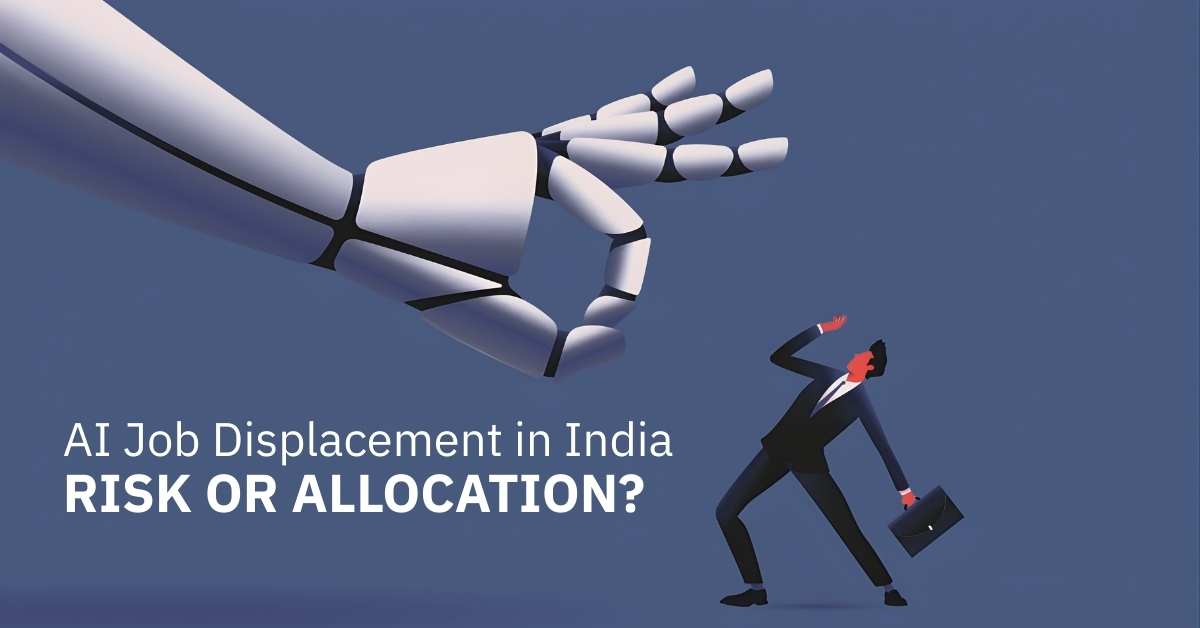
The anxiety around AI job displacement in India is real. The World Economic Forum estimates that AI-driven automation could displace up to 23% of India’s jobs by 2030, affecting more than 100 million workers. However, a recent ICRIER-OpenAI study across 650 IT firms shows a more nuanced trend: AI is not triggering mass layoffs — it is reshaping workflows, enhancing productivity, and transforming entry-level roles.
Having spent two decades in the IT/ITeS sector before entering academia, I have witnessed multiple technological disruptions. Each wave initially triggered fears of unemployment. Instead, what followed was labour reallocation and the creation of entirely new sectors.
AI will be no different. The real story is not job loss — it is infrastructure expansion.
The Data Centre Imperative: India’s Largest AI Opportunity
India generates nearly 20% of the world’s data but hosts only about 3% of global data centre capacity. This asymmetry represents one of the biggest infrastructure opportunities of this decade.
The India data centre market:
| Metric | Current | Projection |
|---|---|---|
| Market Size | USD 9.79 billion (2025) | USD 21.03 billion (2031) |
| CAGR | — | 13.59% |
| Investments Underway | USD 70 billion | + USD 90 billion announced |
| Current Capacity | ~1.5 GW | 9 GW by 2030 (4–5x growth) |
The Union Budget 2026–27 has further accelerated momentum by offering a tax holiday until 2047 for eligible foreign cloud providers operating via India-based infrastructure — a strong long-term signal to global investors.
Globally, data centres captured over USD 270 billion in greenfield FDI in 2025. McKinsey estimates USD 7 trillion in global data centre capex by 2030. India is strategically positioned to capture a meaningful share.
Power Sector: The Engine Behind AI Infrastructure
Every AI model runs on a computer. Every computer cluster requires massive power.
India’s renewable energy workforce currently stands at 1.2 million and is projected to reach 3 million by 2030. Renewable additions hit 49 GW in the first nine months of FY2026 alone.
With a national target of 500 GW non-fossil fuel capacity by 2030, the intersection of AI infrastructure and renewable energy could generate hundreds of thousands of new jobs in:
- Solar and wind installation
- Battery energy storage systems
- Grid modernisation
- Power distribution networks
AI is not just a software revolution — it is an energy revolution.
Cloud Computing: India’s Digital Workforce Multiplier
Cloud computing underpins AI, IoT, 5G, and enterprise digitisation.
According to NASSCOM, cloud could contribute 8% of India’s GDP by 2026 and generate 14 million jobs.
Major hyperscalers have committed substantial investments:
| Company | Investment Commitment | Focus Area |
| USD 15 billion | AI Hub & Cloud | |
| Microsoft | USD 17.5 billion | Cloud Infrastructure |
| Amazon | USD 35 billion (5 years) | AWS Expansion |
These investments translate into employment across engineering, operations, cybersecurity, cloud architecture, and managed services.
Internet Infrastructure: Connecting the AI Economy
India’s telecom market is projected to grow from USD 48.61 billion in FY24 to USD 76.16 billion by FY29.
Key infrastructure indicators:
- 700,000+ km optical fibre laid
- 830+ million internet subscribers
- 100,000 new fibre-related jobs expected within five years
- New submarine cable landing stations (Digha, Mumbai, Chennai)
AI requires bandwidth. Bandwidth requires infrastructure. Infrastructure creates jobs.
Construction: Building the Physical Backbone of Digital India
Data centre expansion is fundamentally a construction-led growth story.
In the US alone, data centre construction starts reached USD 77.7 billion in 2025 — a 190% YoY rise.
In India, states like Maharashtra, Telangana, Karnataka, and Tamil Nadu are offering:
- Dedicated land allocation
- Reduced power tariffs
- Fast-track approvals
Civil, mechanical, and electrical engineering jobs will expand alongside AI-driven infrastructure.
The Strategic Question: Can India Move Fast Enough?
Yes, AI will eliminate some roles. But the larger question is whether India can capture the infrastructure dividend AI demands.
Every AI model needs:
- Compute
- Power
- Cooling
- Connectivity
- Skilled professionals
India’s advantages include:
- Young workforce
- Competitive cost base
- 500 GW renewable target
- Long-term tax incentives until 2047
- Expanding digital infrastructure
The alignment of policy, capital, and demography is rare.
The opportunity is transformational.
The Strategic Opportunity: AI Job Displacement in India Is a Transition, Not a Collapse
The real question is not whether AI will eliminate some jobs — it will. The question is whether India can move fast enough to capture the infrastructure dividend that AI itself demands. Every AI model needs compute, every compute cluster needs power, every power line needs construction, and every cloud deployment needs skilled professionals. India’s competitive advantages — a young workforce, competitive costs, a 500 GW renewable energy ambition, and now a tax framework extending to 2047 — create a rare alignment of policy, capital, and demographic opportunity.
What India needs now is speed: faster land approvals, accelerated grid upgrades, and massive investment in skilling programmes across power engineering, cloud architecture, construction technology, and fibre optics. The global race for AI infrastructure dominance is on. India does not merely have to participate — it has the potential to lead.


















Leave a comment