

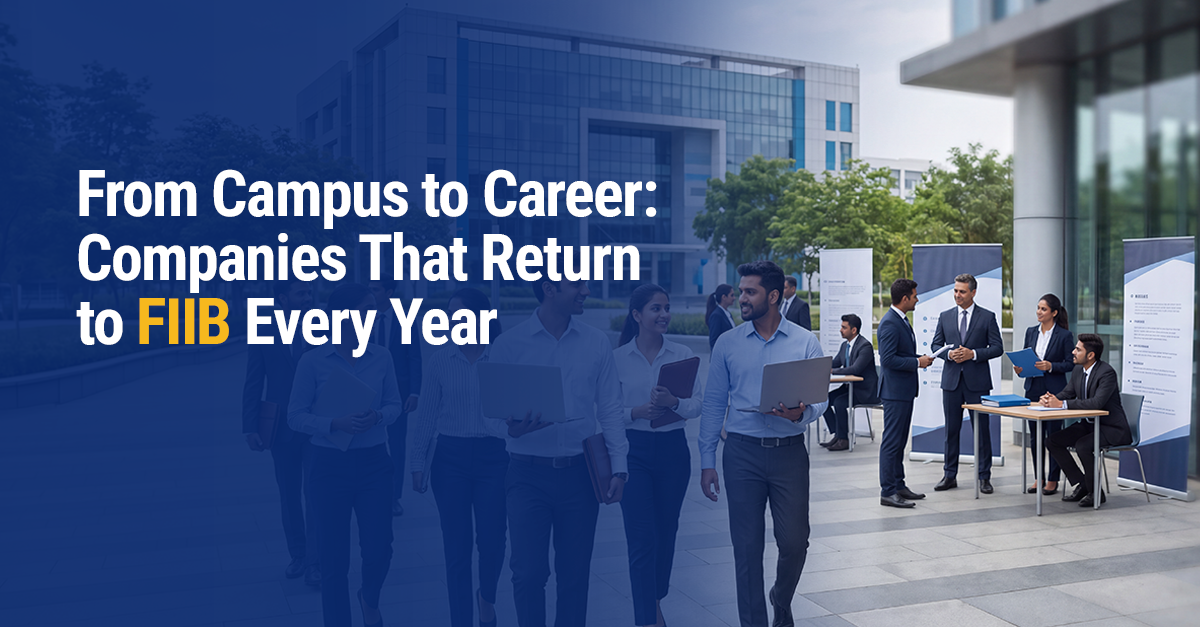
FIIB maintains recruiting relationships with 300+ companies across sectors including BFSI, consulting, FMCG, logistics, technology, and financial services. Companies that return for recruitment every year do so because the Corporate Internship Program (CIP) gives them direct experience with FIIB students before the final placement cycle, and because Career Pathway Simulation (CPS) ensures students arrive at the placement stage with relevant skills matched to specific
That number, 500+, is confirmed on FIIB’s recruit-and-partner page. What it does not tell you on its own is which sectors they represent, what roles they hire for, and what the experience is like for a student going through the placement cycle. That is what this post covers.
Why companies return for PGDM campus placement year after year
Recurring recruiters at B-schools are not a loyalty program. Companies return because the hire worked out: the graduate performed, the role got filled, and engaging with the campus was worth the time.
At FIIB, the mechanism that drives recruiter returns is the Corporate Internship Program (CIP).
- The CIP places students with companies for a 12-week structured internship during the program.
- A company that takes on a CIP intern gets to evaluate a student across a real project over three months, not a 30-minute interview on placement day.
- When a CIP intern performs well, many offers come through as Pre-Placement Offers (PPOs), before the formal placement cycle even opens. Companies that convert CIP students to PPOs are, by definition, recurring recruiters, since the process gave them a real view of the candidate.
The Summer Internship Program (SIP) works alongside the CIP across both years of the program. Between SIP and CIP, students build two distinct professional track records before placement. That continuity of industry contact is what makes FIIB’s recruiter relationships different from a campus that only engages companies during a single placement week.
What sectors do companies hiring from FIIB come from?
FIIB’s 500+ recruiting relationships span multiple sectors. The concentration reflects Delhi NCR’s corporate geography: a dense mix of BFSI, consulting, technology, FMCG, logistics, and financial services companies.
For students on different career tracks, the sector spread matters:
● Banking, financial services, and insurance (BFSI): consistent demand for management graduates across relationship management, credit analysis, retail banking, and operations roles.
● Consulting and professional services: project analyst, business analyst, and associate roles at management consulting and advisory firms.
● FMCG and consumer goods: sales, marketing, and trade marketing roles, often fast-moving hiring processes with volume recruitment.
● Technology and IT services: business analyst, product operations, and pre-sales roles, particularly relevant for students with analytical or digital marketing specializations.
● Logistics and supply chain: operations, procurement, and category management roles, a growing sector in Delhi NCR given the region’s logistics infrastructure.
● Financial services and fintech: a growing share of PGDM-FM recruiter visits, particularly for students targeting investment, wealth management, or financial analytics roles.
Career Pathway Simulation (CPS) is the process through which students map their career interests to specific sectors and roles across the two-year program. Students entering the placement cycle through CPS arrive with a defined target sector and role type, which makes the recruiter engagement more efficient for both sides.
Beyond placements: FIIB’s industry partner network
Placement recruiters are one part of FIIB’s industry relationship. The other is a network of organizations that collaborate with FIIB on training, consulting, and capability-building programs.
FIIB’s confirmed training and consulting collaborators include Genpact, FedEx, Wipro, Dabur, IndianOil, Standard Chartered, Bajaj Capital, Ola, Yamaha, ZF Group, BBC News, Asia Shipping, and UJVNL. These organizations work with FIIB through executive education partnerships, corporate training programs, and faculty-led consulting engagements.
For students, this network matters practically:
- Faculty who run consulting engagements with these organizations bring live organizational problems into the classroom.
- The ActionWorks™ methodology, FIIB’s applied learning framework, draws on these industry connections to ensure cases reflect real business conditions, not archived scenarios.
The overlap between the training partner network and the placement recruiter network also matters. Companies that have worked with FIIB’s faculty and experienced the institution’s academic standards are more likely to consider it as a placement campus. Industry relationships built through one channel strengthen the other over time.
Companies that hire PGDM graduates: what roles they recruit for
Placement companies visiting B-schools hire across two broad categories:
- Generalist management roles: management trainee programs, business development, and operations management positions, typically offered by large FMCG, BFSI, and logistics companies running structured graduate programs. These are volume recruiters that take multiple students per cycle and run them through standardized onboarding tracks.
- Specialist functional roles: financial analyst, HR business partner, digital marketing manager, supply chain analyst, and similar positions. These recruiters interview for specific skills. Students who have built a defined skill set through CPS and their CIP project are better positioned for these roles than students who present a generic management profile.
For finance-track students on the PGDM-FM program, the recruiter set skews toward BFSI, fintech, and financial services companies. The Global Immersion Semester (GIS) within PGDM-FM exposes students to international financial markets, relevant for companies with cross-border finance operations who look for that international exposure in candidates.
Recurring recruiters FIIB: what makes the relationship work
FIIB’s recruiter relationships are managed through the Career Management Center, which runs a sector-wise placement process rather than a single undifferentiated placement week. Recruiters who hire for finance roles engage with finance-track students, HR recruiters engage with HR-track students, and so on.
- For companies, sector-wise placement saves time: they are not sorting through 200 profiles to find 10 relevant candidates.
- For students, it means the interview pool they enter is actually matched to the sector they prepared for.
AlumVerse, FIIB’s alumni platform, creates a secondary recruiter channel. Alumni working at companies that have previously recruited from FIIB often facilitate introductions back to their organizations. Flash Mentoring connects current students to alumni practitioners for targeted career conversations, which sometimes leads to referral-based placement opportunities outside the formal placement cycle.
AACSB accreditation matters here too. Fewer than 6% of business schools globally hold it, and for multinationals evaluating which campuses to add, that is often the deciding factor that gets FIIB onto the list in the first place.
PGDM campus placement companies: what the process looks like for students
For a FIIB student, the placement journey does not start on placement day. It starts in the first trimester.
The sequence runs roughly like this:
● Year 1, Term 1-2: Career Pathway Simulation (CPS) begins. Students map interests to sectors and roles, identify skill gaps, and start building toward a specific career track.
● Year 1, Term 2-3: Summer Internship Program (SIP) runs. First structured industry exposure, assessed and integrated with the academic program.
● Year 2, Term 1: Corporate Internship Program (CIP) runs. 12 weeks with a company, real project, real assessment. PPO offers may come from CIP performance.
● Year 2, Term 2-3: Formal placement cycle opens. Students who did not receive PPOs enter the sector-wise placement process, already with a CIP track record and a defined profile.
Students who use the FIIBX™ framework across both years, which structures academic, professional, and personal development as interconnected tracks, tend to arrive at the placement stage with a clearer profile and a more convincing interview narrative than students who treat placement prep as a last-semester activity.
Companies visiting B-schools for placements: what they look for
A few things keep recruiters coming back. The process has to be predictable — a company sending a recruiter to campus is spending real time and budget, and they return when student quality holds up cycle after cycle. Communication matters just as much: companies that can reach the career management team directly and get pre-screened shortlists have a very different experience from ones left to manage the relationship themselves. And the skill match has to be real, not sold. Companies that hire through CIP have already run their own evaluation, so coming back isn’t a leap of faith.
For students, this means the companies most likely to hire you are the ones that already have a working relationship with FIIB. You are not cold-calling a company’s HR team. You are entering a recruiter relationship that has been maintained, assessed, and renewed over multiple placement cycles.
Role-Type Table
| Career Track | Typical Role Types Offered | Sector Examples |
| General Management | Management Trainee, Business Development, Operations Management | FMCG, Logistics, Retail, Manufacturing |
| Finance / PGDM-FM | Financial Analyst, FP&A Analyst, Investment Analyst, Relationship Manager | BFSI, Fintech, Consulting, Corporate Finance |
| Marketing | Brand Manager, Digital Marketing Analyst, Trade Marketing Executive | FMCG, Retail, E-commerce, Media |
| HR | HR Business Partner, Talent Acquisition, Learning & Development | IT Services, Consulting, BFSI, Manufacturing |
| Analytics / Technology | Business Analyst, Data Analyst, Product Operations | Technology, IT Services, E-commerce, Fintech |
| Supply Chain / Logistics | Category Manager, Procurement Analyst, Supply Chain Analyst | Logistics, FMCG, Retail, Manufacturing |
FAQs
Q: Which companies return to FIIB for recruitment every year?
FIIB maintains recruiting relationships with 500+ companies. A confirmed list of recurring recruiters by sector and role type is available in FIIB’s Placement Report. Companies return year after year primarily because the Corporate Internship Program (CIP) gives them a direct evaluation of students over 12 weeks, and because the sector-wise placement process run by FIIB’s Career Management Center makes the recruitment engagement efficient and well-matched.
Q: How many companies hire PGDM graduates from FIIB?
FIIB has recruiting relationships with 500+ companies across sectors including BFSI, consulting, FMCG, technology, logistics, and financial services. This figure covers the full recruiting relationship network, including companies that hire for final placements and those that engage through the Corporate Internship Program (CIP) and Summer Internship Program (SIP).
Q: What is the CIP at FIIB and how does it lead to placements?
The Corporate Internship Program (CIP) is FIIB’s 12-week structured corporate internship, integrated into the PGDM program in Year 2. Students work on real projects at companies, assessed formally. Companies that find strong CIP performers often extend Pre-Placement Offers (PPOs) before the formal placement cycle opens. The CIP is one of the primary reasons companies return to FIIB repeatedly: they have already evaluated the students they want to hire.
Q: What sectors do FIIB’s placement companies come from?
FIIB’s 500+ recruiting relationships span BFSI, consulting, FMCG, technology, logistics, and financial services, among others. For PGDM-FM students specifically, the recruiter set is weighted toward BFSI, fintech, and financial analytics companies. Career Pathway Simulation (CPS) helps students align their preparation to specific target sectors before the placement cycle begins.
Q: Does AACSB accreditation help with placements at FIIB?
AACSB accreditation, held by fewer than 6% of business schools globally, functions as an independently verifiable quality signal for companies evaluating which campuses to add to their recruiting list. Multinational companies and firms with international operations recognize AACSB accreditation as a meaningful differentiator. It is one factor that brings new companies to FIIB’s campus for the first time, and that supports the year-on-year recruiter return rate.
Q: What is the difference between top recruiters for PGDM and MBA placements?
In Delhi NCR’s corporate market, companies recruit from both PGDM and MBA programs. The credential label matters less than institutional quality, accreditation status, and the specific skills a student demonstrates. For finance roles specifically, companies look for applied financial analytics exposure, which FIIB’s PGDM-FM program builds through the ActionWorks™ methodology and the Corporate Internship Program.











Leave a comment