
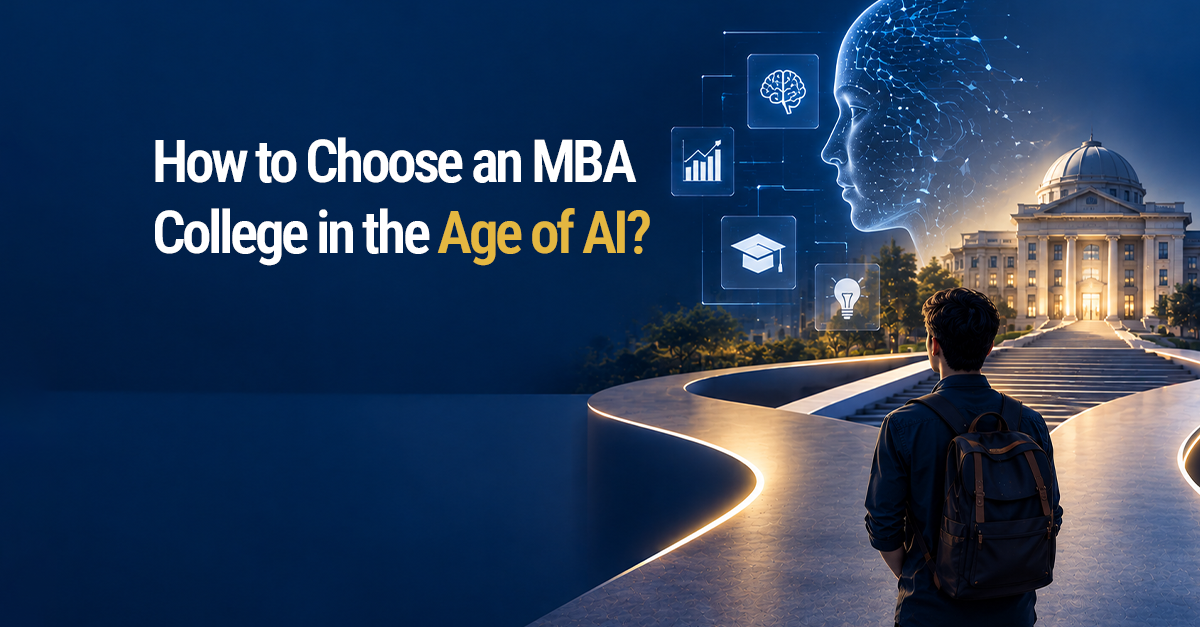
Choosing an MBA college used to mean comparing rankings, fees, and placement numbers. AI has added a new question: will the program prepare you for jobs where AI already does part of the work?
Employers now expect new graduates to use AI tools: 66% of leaders surveyed in Microsoft and LinkedIn’s 2024 Work Trend Index said they would not hire someone without AI skills (news.microsoft.com, May 2024). They also expect sound judgment, and the World Economic Forum’s Future of Jobs Report 2025 lists analytical thinking as the most sought-after core skill for employers. So the best choice is a college that teaches AI inside real business problems, backed by practitioners, live projects, and honest placement data. This guide gives you ten factors and a checklist to compare colleges on the same terms.
What Are AI-Ready MBA Colleges?
AI-ready MBA colleges are business schools whose curriculum, faculty, and assessment prepare students to work with AI tools while keeping human judgment in decisions. They pair analytics and AI practice with industry projects and career preparation. The label describes teaching and outcomes, not a ranking or an approval status.
Why Does AI Change How You Choose an MBA College?
AI changes how to choose an MBA college because employers now expect tool fluency and judgment from day one, not only subject knowledge.
Routine analysis, reporting, screening, and drafting are increasingly automated across finance, marketing, HR, and operations. Entry-level roles are moving toward questioning outputs, framing problems, and making decisions with incomplete data. A college that teaches AI as a separate elective prepares you differently from one that uses it inside every functional course.
Three shifts matter for your shortlist:
- Curriculum: Look for AI used in coursework and projects, not a single technology module.
- Evidence: Ask how a college measures what students can do, not only what they studied.
- Pace: Tools change yearly, so the college needs a way to update content, such as practitioner faculty and live industry briefs.
What Are the 10 Key MBA College Selection Factors?
Ten factors cover most of what separates one MBA or PGDM program from another, and each can be verified before you apply.
| # | Factor | What to check | Evidence to ask for |
| 1 | Accreditation and approvals | International accreditation such as AACSB, plus national approvals | Current listing on the accreditor’s site |
| 2 | Curriculum depth | Core courses plus specialization depth | Course outlines and syllabi |
| 3 | AI practice | AI tools used in coursework, not only taught as theory | Named tools and sample assignments |
| 4 | Faculty practice experience | Faculty who have held the roles they teach | Faculty profiles with industry history |
| 5 | Industry exposure | Weekly contact with practitioners, live briefs, internships | Share of teaching by practitioners; internship structure |
| 6 | Assessment rigor | Graded work that tests decisions, not recall | Sample case and project rubrics |
| 7 | Placement process design | How students are prepared, matched, and supported | Process description, not only headline figures |
| 8 | Alumni network reach | Alumni across roles, industries, and cities | Alumni count and where graduates work |
| 9 | Career pathways | Clear links from specialization to roles | Role maps and graduate journeys |
| 10 | Return on investment | Outcomes you can verify against two years of time and total cost | How placement figures are calculated |
How Do You Judge MBA Colleges With Industry Exposure?
MBA colleges with industry exposure show it in structure, not slogans. Ask how many weeks students spend in real work, who sets the project briefs, and whether practitioners teach core courses or only give guest talks.
How Do You Identify an AI-Ready B-School?
You identify an AI-ready B-school by testing its claims against four questions.
- Where does AI appear? An AI ready MBA program uses AI tools in finance, marketing, HR, and operations courses, not only in a standalone elective.
- What do students produce? Look for dashboards, models, and decisions built on real data, not exam answers about AI.
- Who teaches it? Practitioners who use these tools at work keep content current.
- How is judgment assessed? Strong programs grade the quality of decisions, including when a student overrides a tool’s output.
Be cautious when a website lists tools but no assignments, or promises outcomes without explaining the process behind them.
What Is the Difference Between MBA and PGDM?
An MBA is a degree awarded by a university, and a PGDM is a diploma awarded by an autonomous institute, usually with AICTE approval. Both are two-year postgraduate management programs.
| Dimension | MBA | PGDM |
| Awarded by | University or affiliated college | Autonomous institute |
| Curriculum updates | Follows university cycle | Institute can revise faster |
| Recognition | Degree | Diploma, AICTE-approved; AIU treats it as equivalent to an MBA |
| What to compare | Syllabus, faculty, exposure | Syllabus, faculty, exposure |
The title matters less than the curriculum, faculty, industry exposure, and approvals behind it.
Who Should Choose AI-Ready MBA Colleges?
AI-ready MBA colleges fit students and professionals who want to apply management skills in AI-shaped roles from the first year.
- Final-year undergraduates: You need a program that builds role-ready skills, not only theory.
- Working professionals: You need a way to add AI fluency and management depth without restarting your career.
- Parents: You need evidence of how outcomes are produced, not only the numbers.
| Dimension | Option A: lecture-led program | Option B: AI-ready, industry-immersed program | Best for |
| Learning model | Lectures and exams | Live projects, internships, practitioner teaching | B for role-ready skills |
| AI use | Elective or workshop | Inside functional courses | B for AI-shaped roles |
| Assessment | Recall and case answers | Decisions and project outputs | B for judgment |
| Flexibility | Often fixed | Often pathway-based | Depends on your goal |
Compare programs on curriculum depth, faculty practice experience, industry immersion structure, assessment rigor, placement process design, and alumni network reach. Do not compare on fees alone.
What Should Your MBA College Selection Checklist Include?
Use this checklist to compare any two or three colleges on the same terms.
- [ ] Accreditation and approvals are current and listed on the accreditor’s site.
- [ ] Curriculum names the AI tools used in coursework.
- [ ] Faculty profiles show industry roles held.
- [ ] Industry projects have named briefs and outcomes.
- [ ] Internship structure states duration and support.
- [ ] Assessment includes decisions, not only exams.
- [ ] Placement process is explained, not only reported.
- [ ] Alumni appear across industries and cities.
- [ ] You can name two roles you could target after graduation.
- [ ] You have asked how every placement figure is calculated.
How Does FIIB Build an AI-Ready MBA Experience?
FIIB is an AACSB-accredited business school in Delhi NCR that offers the PGDM and PGDM-FM, and it is Industry-First: outcomes are built around roles, not only subjects.
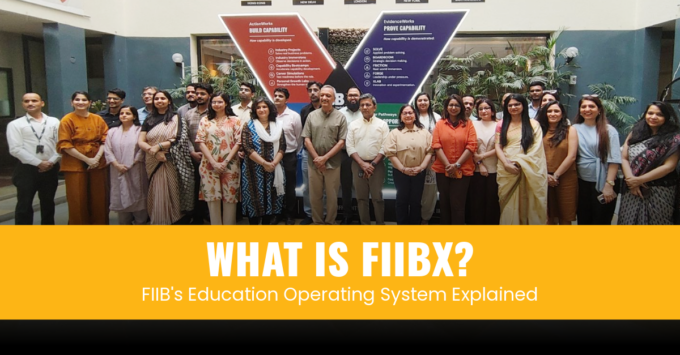
FIIBX™ is FIIB’s educational operating system that organizes the PGDM around four career pathways and an AI learning thread. The pathways cover Growth, Brand and Market Intelligence; People and Organization Intelligence; AI and Intelligent Operations; and Finance, Risk and Fintech. The AI learning thread runs through all four and moves from literacy to application, collaboration, and ethics.
Industry exposure is structural. Practitioners teach the programs, students work on Live Cases, and the Corporate Internship Program (CIP), FIIB’s required corporate internship built into the PGDM, runs for 12 weeks. Students use AI tools in coursework and projects.
Career Pathway Simulation (CPS), a structured exercise that maps your strengths to the pathways with growing demand, helps you choose before you commit. Finance-focused students can review the PGDM-FM curriculum and career paths. All other applicants can start with the PGDM program. The Alumni Network includes 3,800+ alumni across 25+ countries actively engaged with students.
Frequently Asked Questions
What are AI-ready MBA colleges?
AI-ready MBA colleges are business schools that teach students to use AI tools inside real business decisions while building judgment. They show it through coursework that uses named tools, faculty with practice experience, live industry projects, and assessment of decisions. The term describes teaching and outcomes. It is not a ranking or an official approval category.
How do I choose an MBA college?
Compare colleges on the same ten factors: accreditation, curriculum depth, AI practice, faculty experience, industry exposure, assessment rigor, placement process, alumni reach, career pathways, and verifiable return on investment. Ask each college for evidence, such as sample assignments, project briefs, and how placement figures are calculated. Choose the one whose evidence matches the roles you want.
How do I know if an MBA program is AI-ready?
An AI ready MBA program uses AI tools in functional courses such as finance, marketing, HR, and operations, not only in a standalone elective. Look for named tools, student projects built on real data, practitioners teaching the content, and assessment that tests decisions. If a program lists tools without assignments or outcomes, ask for samples.
What is the difference between MBA and PGDM?
An MBA is a degree awarded by a university or its affiliated colleges. A PGDM is a diploma awarded by an autonomous institute, usually with AICTE approval, and the institute can revise its curriculum more flexibly. Both run two years. Compare curriculum, faculty, industry exposure, and approvals rather than the title alone.
Is an MBA still worth it in the age of AI?
An MBA can still be worth it when the program builds judgment, role-specific skills, and AI tool fluency that employers cannot get from short courses alone. AI automates routine analysis, so the value shifts to framing problems and defending decisions. Check what the program teaches, how it assesses you, and how it supports your first roles.
How important is industry exposure when choosing an MBA college?
Industry exposure is one of the strongest signals of a program’s quality. It shows whether you will apply concepts to real problems before graduating. Look for practitioner-led teaching, live project briefs, internships with defined duration, and mentors from industry. Occasional guest lectures offer much less than a structure that puts you in real work each term.
Can working professionals choose an AI-ready MBA?
Yes. Working professionals use AI-ready programs to add management depth and AI fluency, often to move into a new function or a leadership role. Prior experience helps you apply concepts faster. Check the schedule, project structure, and whether the program supports career transitions before you choose.
What should parents check when choosing an MBA college?
Parents should check accreditation and approvals, how the college explains its placement process, the structure of internships and industry projects, and the alumni network’s reach. Ask how placement figures are calculated, and avoid decisions based on headline numbers alone. No college can guarantee an outcome, so evidence of process matters more than promises.








Leave a comment