

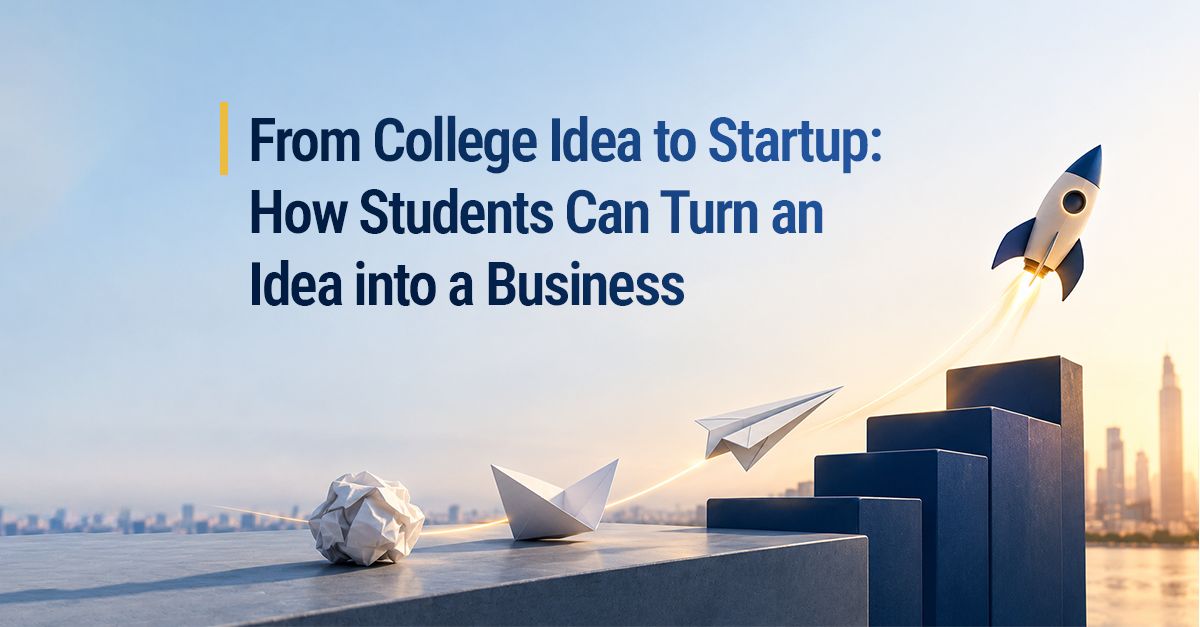
How Do You Turn a College Idea Into a Startup?
How to turn a college idea into a startup is a process question: you move from an untested concept to a business with a defined customer, a working offer, and early revenue. Students do it in stages, testing each assumption cheaply before spending money. Competitions, mentors, and incubators supply feedback along the way.
Why Student Entrepreneurship Matters in 2026
Student entrepreneurship matters because a campus lets you test an idea at low cost, before rent, salaries, and stock raise the price of being wrong. You have classmates who are customers, faculty who can challenge your numbers, and time to run a pilot.
The risk is a long gap between a good idea and evidence that anyone will pay for it. Knowing how to turn a college idea into a startup means closing that gap early. You get a clearer picture of the business, and proof that makes a competition panel or a mentor take the idea seriously.
Five Stages From College Idea to First Customer
You move from idea to business in five stages, and each one replaces an assumption with evidence. Finish a stage before you pay for the next.
1. Test the problem before the idea
Talk to people who face the problem and ask what they do today. Write down their words, not your solution. If nobody feels the problem strongly, change the problem before you build anything.
2. Define one customer and one offer
Name the person you serve and the one thing you give them. Many college startup ideas fail by trying to serve everyone. One customer and one offer let you test fast.
3. Build the smallest version
Make something a customer can try this month: a sample, a pilot, a landing page, or a manual service. The smallest version teaches you what customers use and ignore.
4. Prove it with paying customers
Take a pre-order or run a paid pilot. Then write a cost sheet that shows price, cost per sale, and what remains. That sheet is the finance skill every student founder needs, and PGDM-FM students practice it directly.
5. Pitch it and collect feedback
Present to people who will question you: mentors, investors, and competition jurors. At Meraki, the jury scores five things: problem-idea fit, market and competitive understanding, value proposition, business and financial viability, and impact and responsibility. Use that list to audit your own pitch.
A Real Journey: From Student Team to ₹40 Lakh+ in Monthly Sales
TGP Bioplastics began the way many student ventures do, as a team at Rajarambapu Institute of Technology in Maharashtra with a materials problem and no guarantee anyone wanted the answer. They worked on compostable, starch-based plastic that could match the performance of polythene, which is a hard thing to get right and an easy thing to claim.
What kept the idea alive was that they let buyers test it. Stretch films made from their material went to Mahindra and Aditya Birla for trials, and the product earned IS/ISO 17088 certification. In the five stages above, that is stages 3 and 4: a working product, then people who have a reason to say no.
Meraki 2025 came next. TGP was named a winner and received a ₹1.5 lakh fellowship, and a ₹20 lakh grant from NCL-Venture Center followed. Between March and December 2025, monthly sales grew from ₹5 lakh to above ₹40 lakh. The venture reported these figures in December 2025, and one winner’s path does not predict yours.
Picapool started smaller. This 2025 co-winner from IIT Hyderabad built a hyperlocal platform for group buying and ride-sharing, and it was live at Delhi University North Campus with about 600 active users. The two teams look different on paper, but both walked into the competition with something already built. That shaped the feedback they got, because judges could react to a real product instead of a plan.
How Competitions Become a Launchpad
A competition becomes a launchpad when you enter with evidence and leave with a next step. In student entrepreneurship, a contest entered as a resume line gives you a certificate. One entered as a test gives you feedback, contacts, and sometimes funding.
| Dimension | Competition as a resume line | Competition as a launchpad | Best for |
| Preparation | A plan written the week before | A pilot, a cost sheet, and customer quotes | Teams with something built |
| Use of feedback | Noted, then forgotten | Changes the next version | Founders who iterate |
| After the event | A certificate | Mentor contacts, grant applications, pilots | Students planning to continue |
| What it proves | That you took part | That the idea moved forward | Anyone building a track record |
Meraki 2027 at a glance
Meraki is FIIB‘s pitch competition for undergraduate and postgraduate founders, held in New Delhi. The 2027 edition runs in three phases.
| Detail | Meraki 2027 |
| Tracks | SDG and social impact, women founders, AI and tech |
| Who can apply | Solo founders or teams of four to six, with at least one member currently enrolled as a UG or PG student |
| Prizes per track | ₹2,00,000 winner, ₹1,50,000 first runner-up, ₹1,00,000 second runner-up |
| Registration fee | ₹1,000 for Indian residents, $50 for non-Indian participants |
| Applications | September 25 to November 10, 2026 |
| Screening | November 10 to 20, 2026 |
| Interview day | From November 21, 2026 |
| Meraki Weekend | February 25 to 27, 2027, New Delhi |
What mentorship and funding add to your startup
The prize is only part of what a student startup competition offers. Mentorship and funding change what you can do with an idea, and Meraki builds both into the program.
Mentorship gives you people who have seen similar ventures fail and succeed. Meraki brings together mentors, investors, and industry leaders who challenge your assumptions, and all 20 finalists receive mentorship hours. A mentor can tell you in one conversation that your pricing ignores delivery cost or that your first customer should be a different segment. Without one, you may find that out only after spending money.
Funding gives you room to act on that advice. Each track pays ₹2,00,000 to the winner, ₹1,50,000 to the first runner-up, and ₹1,00,000 to the second runner-up. All 20 finalists also receive incubation seats and media features, which lead to workspace, introductions, and visibility. TGP Bioplastics shows the pattern: a ₹1.5 lakh fellowship came first, and a ₹20 lakh grant followed.
Money without feedback buys a bigger version of an untested idea, and feedback without money leaves you with a plan you cannot afford to try. A program that offers both lets you test, learn, and build in sequence. Results are not guaranteed, and many teams do not win.
Read the rules and register on the Meraki page. For other contests and formats, see FIIB’s guide to startup competitions in India.
Frequently Asked Questions
How do I turn a college idea into a startup?
Move in five stages: test the problem with real people, define one customer and one offer, build the smallest version, prove it with paying customers, and pitch it for feedback. Spend little until a customer pays. Competitions, mentors, and incubators can speed up feedback, but evidence from customers carries more weight than a polished plan.
Do I need money to start a startup in college?
Not at the start. Many first versions need a phone, a laptop, and a few hours a week. Take pre-orders or run a pilot before you buy stock or tools, and write a cost sheet showing price, cost per sale, and margin. Funding, such as competition fellowships or grants, matters more once a customer has paid you.
Can I start a startup while studying?
Yes. Many students run an early venture alongside classes by choosing a small first version, setting fixed working hours, and pausing new orders in exam weeks. Check your college’s rules on commercial activity, and keep academics the priority. Competitions that accept teams with at least one enrolled student are built for this stage.
How do I know if my college startup idea is good?
Good college startup ideas show evidence from customers. Talk to people who have the problem, ask what they do today, and see whether anyone will pre-order or pay for a pilot. If several do, the idea has traction. If none will, change the offer or the customer before you build anything larger.
Are startup competitions worth it for students?
They are worth it for student entrepreneurship when you treat them as a feedback stage, not a certificate. Jurors question your assumptions, mentors sharpen the pitch, and winners may gain fellowships or introductions. Results are not guaranteed, and many teams do not win. Enter with a pilot or a cost sheet so the feedback changes your next version.
Who can apply to Meraki 2027?
Meraki 2027 is open worldwide to solo founders and to teams of four to six. At least one member must be currently enrolled as an undergraduate or postgraduate student. Each application covers one idea in one of three tracks: SDG and social impact, women founders, or AI and tech. The women founders track needs at least one woman founder.
Do I need to register a company before pitching?
Usually not. Most student competitions accept ideas and early prototypes without a registered company, and Meraki welcomes early-stage ideas and young ventures. Check each organizer’s rules, because some incubators and later-stage programs ask for a registered entity. Register a company when you are ready to take payments or accept a grant.
What do judges look for in a student startup pitch?
At Meraki, the jury scores five things: whether the problem and solution fit, how well you understand customers and competitors, why customers would choose you, whether the business is financially viable and scalable, and how you balance growth with social, environmental, and ethical impact. Back each point with evidence from real customers.
















Leave a comment