
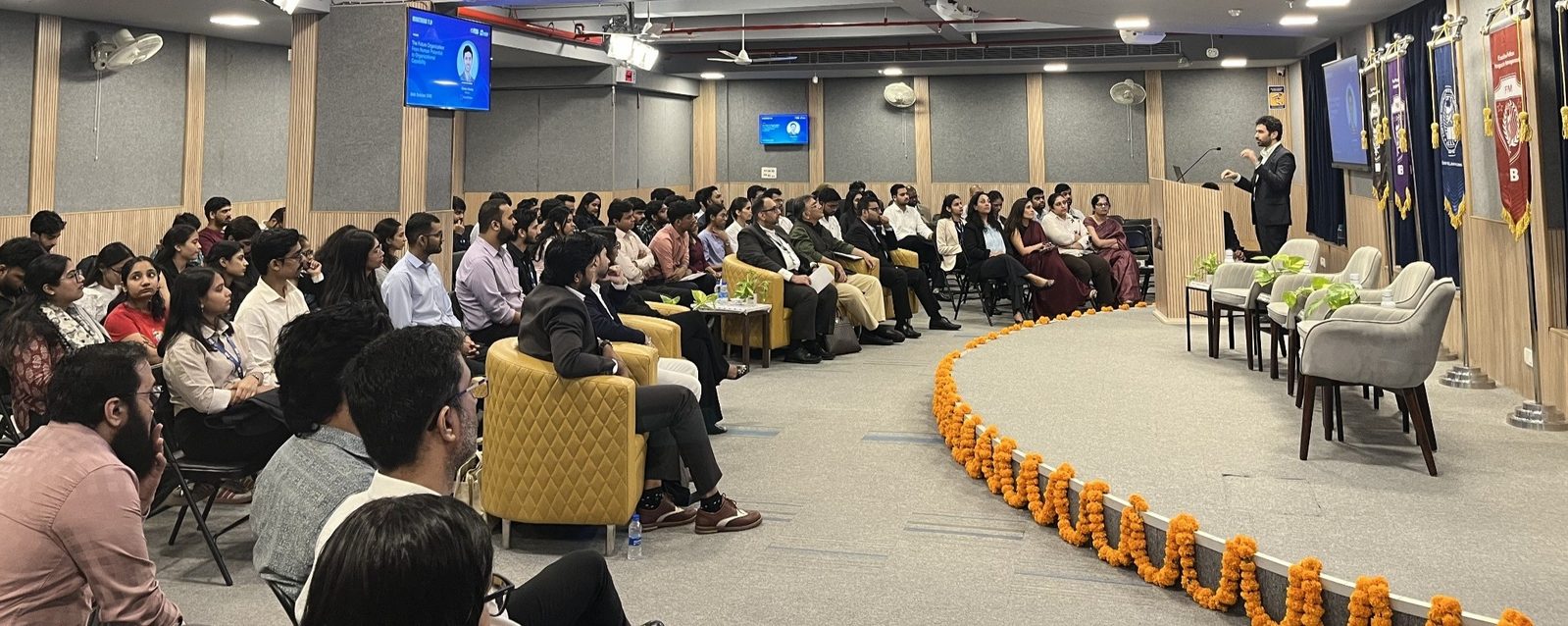
FIIB’s annual management conclave brought seven industry leaders face to face with students to examine how individual talent becomes organizational capability.
Organizations can adopt new technology in months. Building the people to run it takes far longer. That tension shaped Manthan 7.0, held on 24 October 2026 at the FIIB Auditorium in New Delhi, under the theme The Future Organization: From Human Potential to Organizational Capability.
“Potential for me is personal,” said Keynote Speaker Chetan Nanda, Director, Grant Thornton Bharat. “But my capability needs to be repeatable.“
Build on what you don’t know
Mr. Chetan, who leads a CRM transformation for his 13,000-person firm despite having no technology background, urged students to rethink what they build a career on.
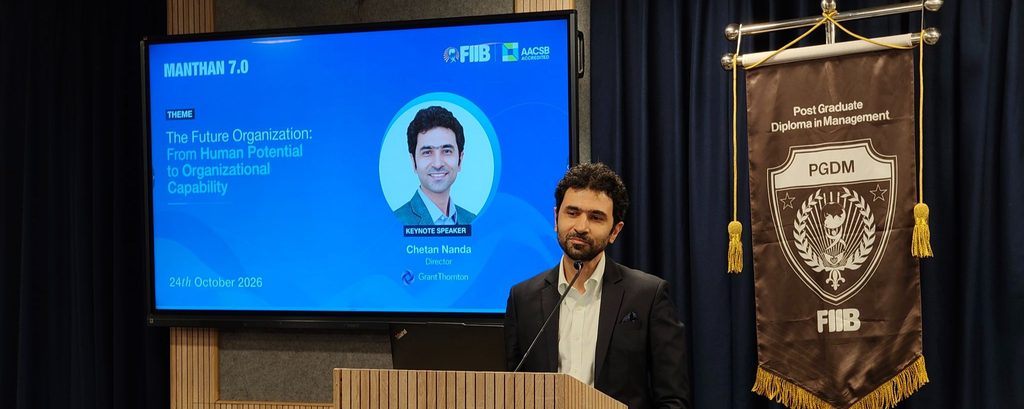
“Think about making a career out of what you don’t know best,” he said, “because what you know best might become obsolete in the blink of an eye.” He also described his own shift from taking pride in being indispensable to building a team that delivers without him. On AI, he said: “Keep judgment with yourself. AI can’t judge for you.”
People are not software updates
The first panel, moderated by Prof. Vibhor Kataria, asked whether people can keep pace with the organizations they work for.
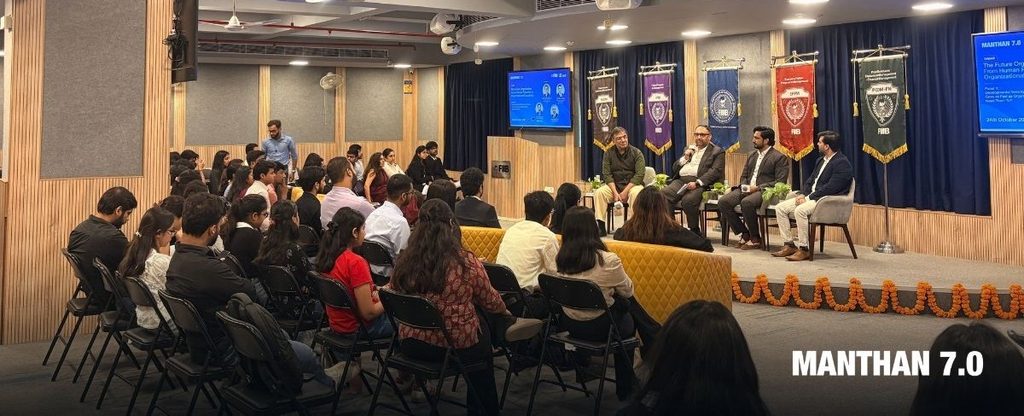
Gaurav Badhwar, Founder & CEO, Harry Cakes & Bakes LLP, said individuals rarely can on their own, but teams can. “People are not software updates,” he said. “If there is a cost of training people, there is a higher cost of not training them.“
Abhishek Tandon, Director, Marketing, Akraya, framed growth in terms of direction. “Velocity comes when speed joins direction,” he said. Ankush Agarwal, AVP Talent Consultant, Mettl, pointed out that organizations often count training hours and certifications without measuring whether capability actually improves.
The quiet cost of holding back
Panel 2 Faculty Moderator Dr. Ranjit Kaur opened the second panel with a provocation: having brilliant people does not necessarily mean having a brilliant organization. How people work together, she noted, matters more than simply having the smartest people in the room.
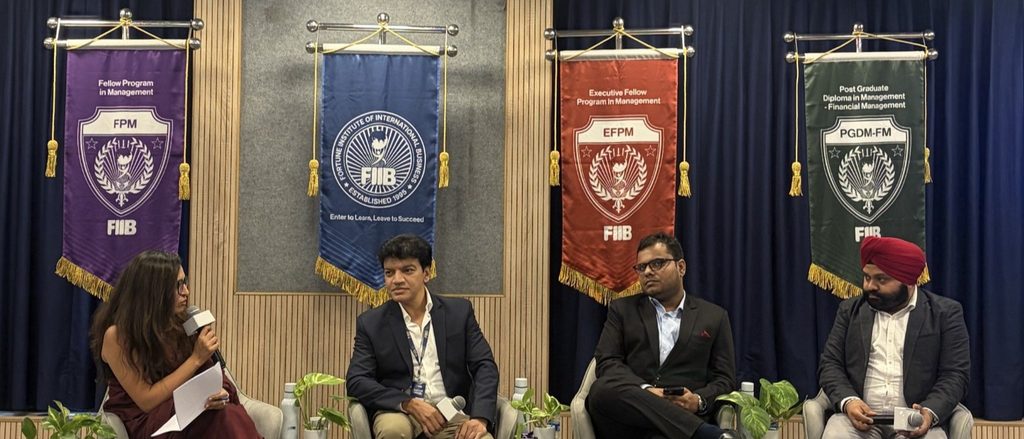
Divyae Sherry, Associate Director, Publicis Groupe, said the employees who worry him most are those who hold back information to make themselves indispensable. Swarnpreet Singh, AVP – Campus Hiring, ICICI Lombard, described a team practice in which every member speaks regularly about their own work. “If you cannot talk about your own work,” he asked, “who else would?“
Deepak Goel, CEO, Digitally Next, drew a line between responsibility and accountability. He also shared what the students he hired had in common: they knew the company, understood the job description and could map it to their own profile.
Students turn the questions around
When the floor opened, students pressed the speakers on the human cost of the conversation. One of the PGDM Students asked how leaders prevent burnout when people are expected to grow as fast as organizations demand. Mr. Gaurav pointed to the 70-20-10 model, in which most learning happens on the job, some through mentoring and peers, and a smaller share through formal programs. Mr. Ankush suggested finding the format in which you learn best, and teaching what you learn to someone else.
A first-year PGDM Finance student asked whether Gen Z, with its expectations of transparent, flexible and respectful workplaces, will redefine leadership. Mr. Deepak answered this question with “Gen Z has an abundance earlier generations never had, including AI”. If they use it well, it frees people for more intelligent work. And, if used as a substitute for thinking, it makes them replaceable.
Learning for a variable future
The theme of Manthan 7.0 grew out of the thinking behind FIIBX, FIIB’s redesigned learning philosophy, which starts from a simple premise: no fixed set of skills can prepare students for a future no one can predict. What lasts is the ability to interpret change, exercise judgment and keep learning.
That idea ran through every session. Can people grow as fast as organizations need them to? The speakers stopped short of a simple yes. They agreed instead on the conditions that make it possible: learning that shows up in the work, knowledge that is shared rather than guarded, and judgment that stays with people even as AI takes on more of the task.
For PGDM Second Year Students who are now weeks away from placements, Mr. Gaurav distilled it into one instruction: “Don’t look at your current skill sets,” he said. “Look at the skill sets you will need in a year or two, and start preparing for that.”









Leave a comment