

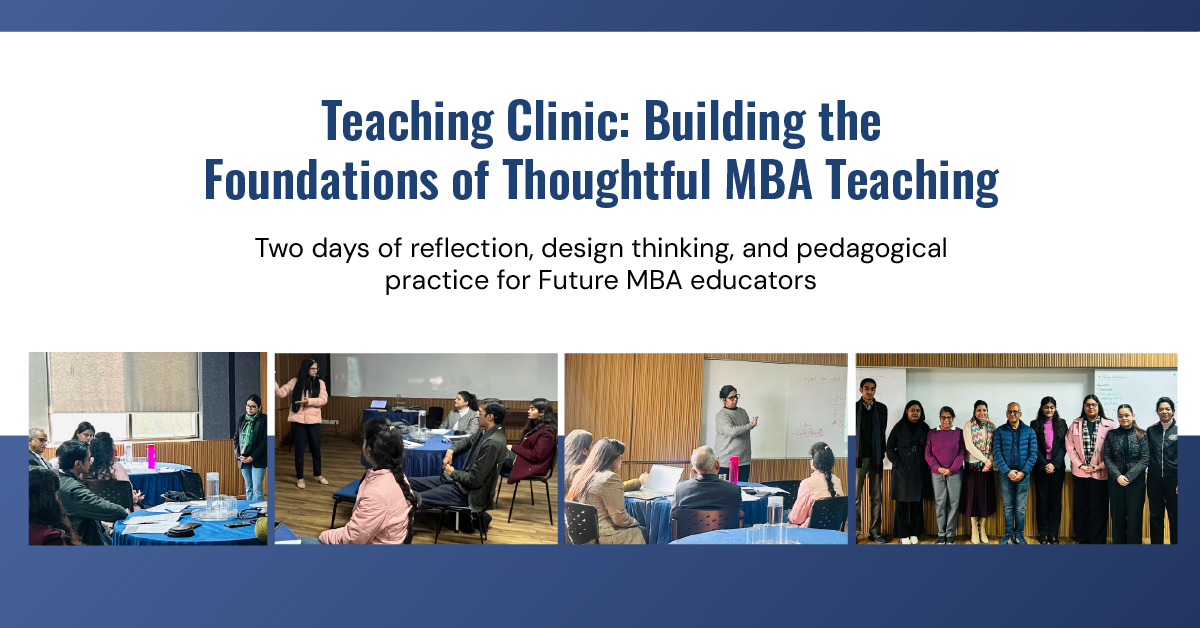
With this central premise, FIIB’s Teaching Clinic, held on 16–17 January at the FIIB campus, concluded after two intellectually rigorous days of reflection, design, and pedagogical practice. The clinic brought together doctoral scholars and early-career educators to engage deeply with the intellectual work of teaching in MBA classrooms.
Rather than treating teaching as an assumed skill acquired by observation or experience, the clinic positioned it as a research-informed craft—one that demands clarity of purpose, understanding of learners, and deliberate pedagogical choices. Across both days, participants explored how effective teaching is built through intention, structure, and reflective practice.
Day 1: Foundations of Teaching Practice
The first day focused on the why, who, and how of teaching, laying the conceptual foundations for thoughtful MBA pedagogy.
The clinic opened with a session on Teaching Philosophy by Dr. Tavleen Kaur, encouraging participants to articulate their beliefs about teaching and learning. The discussion highlighted how a well-defined teaching philosophy informs classroom decisions, shapes learner engagement, and contributes to an educator’s academic identity. Participants reflected on how intentionality in teaching goes beyond content delivery to purpose-driven learning design.
This was followed by a session on Understanding the MBA Learner by Dr. Shuchi Dikshit, which examined the evolving expectations, motivations, and learning styles of today’s management students. Emphasising hard empathy, facilitator awareness, and inclusivity, the session underscored the importance of recognising learner diversity and creating classrooms that are both rigorous and responsive.
Moving from philosophy to practice, Dr. Purnima Rao led a hands-on session on Designing a Sample Course. Participants engaged with learning outcomes, content mapping, and Bloom’s taxonomy, reinforcing the idea that meaningful academic freedom is enabled by strong structural discipline. The session demystified course design as a systematic process rather than an intuitive one.
The day concluded with Pedagogical Tools for MBA Teaching – I, again led by Dr. Tavleen Kaur, which examined common myths around case teaching. The discussion reframed the case method not as a substitute for lectures, but as a pedagogical tool to cultivate analytical thinking, judgement, and classroom dialogue.
Day 2: Pedagogy, Practice, and Technology
Day two shifted focus from design to delivery, classroom decision-making, and the role of technology in management education.
In Pedagogical Tools for MBA Teaching – II, Dr. Tavleen Kaur further explored case methodology as a learner-centric approach. Participants examined how cases function as cognitive scaffolds that encourage students to integrate theory with practice, particularly in uncertain and ambiguous business contexts.
A key highlight of the second day was the session on Technology and Teaching by Dr. Sorabh Bajaj, which examined the role of AI-enabled tools and virtual teaching assistants, including Gems of Gemini. The discussion emphasised that technology enhances learning only when guided by pedagogical intent, rather than novelty or automation. Participants critically assessed where and how digital tools can support deeper engagement without diluting academic rigour.
The clinic concluded with a scholar-led case discussion, allowing participants to apply insights from both days in a simulated classroom setting. This final session reinforced the central takeaway of the clinic: effective teaching is not performative—it is designed, reflective, and continually refined.
Building Teaching Excellence
Across two days, FIIB’s Teaching Clinic reaffirmed a vital truth for management education: teaching excellence is not assumed; it is built. Through reflection, design thinking, and pedagogical practice, participants left with a deeper appreciation of teaching as scholarly work—one that evolves through evidence, experience, and critical self-awareness.
The clinic reflected FIIB’s ongoing commitment to strengthening academic practice and preparing future educators to engage meaningfully with MBA classrooms in an increasingly complex educational landscape.
Teaching, at its best, is not instinctive. It is intentional.
At FIIB, thoughtful teaching is closely tied to graduate outcomes. Strong pedagogy translates into stronger classroom engagement, sharper skills, and better career readiness for students. This focus on academic design and delivery feeds directly into FIIB’s larger employability ecosystem, which integrates curriculum, industry exposure, and career support.
To know more about how FIIB prepares students for industry-aligned roles and long-term career growth, explore our Employability Framework here: https://www.fiib.edu.in/program-pgdm/employability-support















Leave a comment