

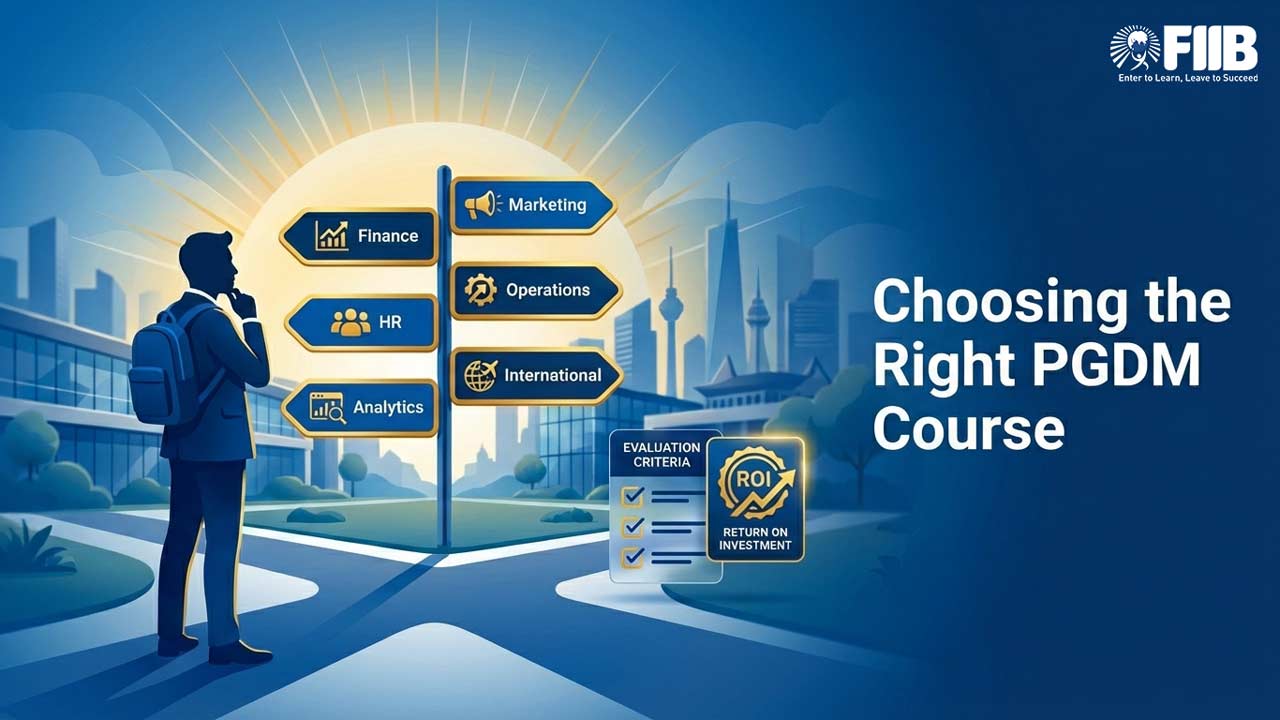
Choosing the right PGDM course can feel overwhelming because you’re not just choosing a program—you’re choosing a direction. Specializations, approvals, placements, ROI, curriculum, and “brand value” all compete for attention, and it’s easy to get pulled by whatever sounds most impressive.
This guide breaks the decision into clear steps. You’ll learn how to align a PGDM course with your career goal, verify what actually matters (instead of marketing claims), and confidently shortlist options using a simple framework and checklist.
1) What Does a PGDM Course Really Mean?
A PGDM (Post Graduate Diploma in Management) is a management program designed to prepare you for business roles through a mix of core subjects and specialization-focused learning. In many institutes, the curriculum is updated more frequently to match industry needs, which is why PGDM programs often highlight “industry-oriented” training.
That said, not every PGDM is equally industry-aligned. The real value comes from how the institute teaches (projects, cases, internships), how credible the approvals are, and what kind of roles students actually get after the program—not just what’s written in the brochure.
Who should choose PGDM
PGDM can be a strong fit if you want a practical management program that helps you build job-ready skills, develop business thinking, and access structured placement support. Fresh graduates often choose PGDM to enter corporate roles faster, while working professionals use it to switch functions (like moving from operations to analytics) or industries.
You should also consider PGDM if you learn best through applied work—live projects, presentations, teamwork, and real business problems. If your priority is purely academic research or a very specialized academic path, you may want to compare PGDM with other postgraduate options before deciding.
How PGDM is typically structured
Most PGDM programs start with a common “core” phase where everyone studies fundamental business subjects like marketing, finance, HR, operations, business communication, and strategy. This phase is important because it builds a shared foundation and helps you understand how functions connect in real organizations.
Later, you usually choose electives or a specialization (or dual specialization). The quality of this stage depends on how relevant the electives are, whether they include tools and real projects, and whether your specialization is backed by strong recruiters, faculty, and alumni outcomes.
2) Start With Clarity: Your Career Goal + Strengths
Define your career goal (before you pick a specialization)
Before you compare colleges, define what “success” looks like for you after PGDM. Some students want the highest possible salary quickly, some want stable growth, others want a specific role (like HRBP, brand manager, financial analyst, supply chain), and some want to build entrepreneurial skills.
When your goal is clear, your decision becomes simpler: you stop chasing “best PGDM” and start choosing the “best PGDM for my outcome.” This prevents mismatches—like choosing analytics because it’s trending, even though you hate working with data all day.
Map your strengths and working style
Your strengths matter as much as your interests. For example, marketing needs comfort with people, storytelling, persuasion, and uncertainty; finance needs patience with detail and strong numerical discipline; operations needs process thinking and execution focus.
Also consider how you like to work: do you prefer client-facing communication, deep analysis, structured processes, or people management? A PGDM specialization should feel challenging in a good way—not like daily friction that drains you.
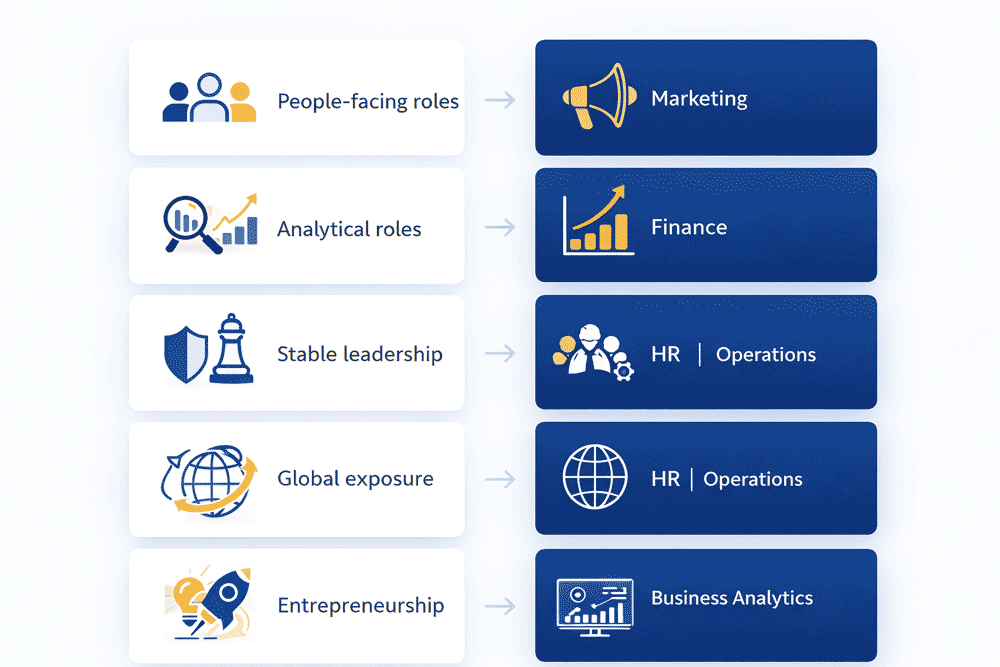
Goal → Specialization map (quick guide)
This map doesn’t “lock” you into one path, but it helps you shortlist smartly. Think of it as a starting point you’ll validate using curriculum, placements, and alumni outcomes.
Here’s a quick reference:
| Your goal | Likely best-fit specializations | Why it fits |
| People-facing growth roles | Marketing, Sales, Digital/Product (if offered) | Strong focus on persuasion, customer understanding, GTM |
| Analytical decision roles | Business Analytics, Finance | Heavier data + modeling + decision frameworks |
| Stable corporate leadership | HR, Operations | Process + people systems + execution leadership |
| Global exposure focus | International Business & Strategy | Cross-border business, trade, global strategy (depends on recruiters) |
| Build/scale a business | General PGDM + Marketing/Finance mix | Broad foundations + practical skills |
Use this as a guide, then pressure-test it with real evidence: course structure, recruiter list, role-wise placements, and alumni LinkedIn outcomes.
3) PGDM Specializations Explained (and How to Pick Yours)
Marketing
Marketing in a PGDM is typically a mix of consumer understanding, brand strategy, sales fundamentals, digital marketing, and go-to-market execution. You’ll often work on case studies, product positioning exercises, and presentations—because marketing roles demand communication and decision-making under uncertainty.
It’s best for people who like fast-moving environments and enjoy connecting ideas with real customer behavior. If you dislike ambiguity or prefer predictable, structured tasks all the time, marketing may feel uncomfortable—especially in early roles where targets and deadlines are intense.
Common roles you may see after PGDM in marketing include:
- Sales/Business Development (often the most common entry point)
- Marketing Executive / Assistant Brand Manager (role availability varies by institute)
- Category/Trade Marketing (in FMCG/retail contexts)
- Digital Marketing (SEO, performance marketing, content, CRM—depends on curriculum)
Finance
Finance focuses on understanding money, valuation, financial reporting, investment decisions, risk, and corporate finance fundamentals. Strong programs also introduce tools like Excel modeling, basic financial analysis, and real-world interpretation of balance sheets and cash flows.
Finance is a strong fit if you enjoy numbers, logic, accuracy, and structured thinking. It can also demand consistency—because small mistakes in finance work can create big problems—so detail-orientation and patience are major advantages here.
Typical finance career outcomes include:
- Financial Analyst / Business Finance roles
- Credit Analyst / Risk roles (often in banks/NBFCs)
- Corporate Finance / FP&A support roles
- Investment-related roles (availability depends heavily on institute tier)
Human Resources (HR)
HR specialization covers talent acquisition, performance management, learning and development, employee engagement, compensation basics, and labor laws. Good HR programs also focus on business partnering—how HR supports business goals and handles real workplace situations.
HR is best for people who enjoy people systems, communication, conflict resolution, and organizational problem-solving. If you want a career where listening and influencing matter as much as analysis, HR can be very rewarding.
Common HR roles include:
- HR Generalist (often later; early roles may be specialized)
- Talent Acquisition / Recruiter roles
- HR Operations / HR Shared Services
- Learning & Development support roles
Operations & Supply Chain
Operations is about execution—how work gets done efficiently across processes like production, supply chain, quality, logistics, procurement, and project management. In strong programs, you’ll learn frameworks like process improvement and inventory planning, and you may work on operational case studies.
This specialization suits people who like structure, systems, and measurable improvement. If you like solving “how do we deliver this better, faster, cheaper, safer?” problems, operations can be a great fit with solid long-term career growth.
Typical roles include:
- Supply Chain Analyst / Logistics roles
- Operations Executive / Plant operations roles (where relevant)
- Procurement / Vendor management roles
- Process improvement / Quality roles
Business Analytics
Business Analytics focuses on using data to make business decisions—reporting, dashboards, basic statistics, business problem framing, and sometimes tools like Excel, SQL, Power BI/Tableau, or introductory Python (depends on the institute). The best programs connect analytics to real use cases like marketing funnels, pricing, operations forecasting, and finance reporting.
Analytics is best for people who enjoy analysis, patterns, and logical problem-solving. You don’t need to be a programmer to start, but you do need comfort with numbers and the patience to learn tools consistently over time.
Common roles include:
- Business Analyst / Reporting Analyst roles
- Data/Insights roles within marketing, product, or operations teams
- BI Analyst / Dashboarding roles
- Analytics roles in consulting/services firms (depends on placements)
International Business (IB) & Strategy
International Business typically covers global trade basics, cross-border strategy, international marketing, foreign exchange fundamentals, and cultural/market differences. However, the value of IB depends heavily on whether the institute actually places students into globally-linked roles—not just teaches IB subjects.
IB can be a good fit if you’re interested in global markets and are open to roles involving export/import, international sales, or global operations support. Before choosing IB, verify recruiter types and role descriptions—because many “IB” placements are domestic roles with limited international exposure.
Possible outcomes include:
- International sales / export business roles
- Global supply chain support roles
- Cross-border operations support (in select firms)
- Market research roles focused on international expansion
Single specialization vs dual specialization vs general PGDM
Single specialization works well if you have clarity and want deeper skill-building in one direction. It can also help you present a sharper profile in interviews, especially when your internships and projects match the same track.
Dual specialization can be useful when the pair is naturally connected (like Marketing + Analytics, Finance + Analytics, Operations + Analytics, or Marketing + IB), but it can dilute your story if you spread too thin. A general PGDM can be fine if the institute’s placements are strong across domains and you want flexibility—just make sure you still build a coherent profile through electives and projects.
4) Approvals, Accreditation, and Recognition (Non-Negotiables)
AICTE approval (what it is and why it matters)
For many PGDM programs in India, AICTE approval is a key legitimacy check. It signals that the institute meets certain regulatory requirements and standards for the program structure and delivery.
But don’t treat approval as a guarantee of quality. Think of it as a minimum filter. After approval, the real evaluation is about outcomes: curriculum strength, recruiter quality, placement transparency, and the learning experience.
Accreditation and what it signals
Accreditations (and quality ratings) can indicate systems, governance, and academic processes. They may also matter for certain employers or for your own confidence that the institute has measurable standards.
However, accreditation alone doesn’t ensure strong placements or modern curriculum. Use it as a supportive factor—then validate the institute through placement reports, alumni outcomes, and industry exposure.
Red flags to watch for
Some institutes use confusing language to look credible. If you see vague claims without verifiable details, treat it as a warning sign and investigate further.
Red flags include:
- No clear mention of approvals on official institute pages
- Placement claims without batch size, median salary, or role breakdown
- “100% placement” claims without explaining opt-outs and job types
- No faculty profiles, outdated curriculum, or generic elective lists
5) Curriculum Quality: What to Check Beyond the Brochure
Core subjects and electives (depth matters)
A strong PGDM core builds real business thinking: not just definitions, but decision-making. Look for depth in core areas—like financial analysis (not just theory), marketing strategy (not just terminology), and operations frameworks that tie to business performance.
Electives should be current and practical. If you see electives that don’t match today’s job market—or electives that sound trendy but lack tool-based learning—treat that as a sign to dig deeper.
Learning approach: cases, tools, and real work
The way you learn matters as much as what you learn. A modern PGDM should involve case discussions, simulations, live projects, presentations, and teamwork—because most management roles depend on these skills daily.
Also check whether the institute teaches real tools where relevant. For example, analytics should include spreadsheet modeling and dashboards; marketing should include digital platforms and measurement basics; finance should include modeling and analysis practice.
Look for these signals:
- Live projects with real companies (not just internal assignments)
- Regular presentations and business writing training
- Tool training integrated into subjects (not only optional workshops)
Internships, projects, and the “proof of learning”
Internships are a major bridge to placements because they help you build stories and evidence. Ask what kind of internships students typically get, how they’re supported, and whether PPOs (pre-placement offers) are common.
Projects should show progression: early learning projects, mid-program live projects, and final capstone-style work. If the institute has strong project outputs (case competitions, consulting-style projects, industry problem statements), it often correlates with stronger employability.
Faculty quality and industry mentorship
Faculty quality is not only about degrees—it’s also about teaching ability and industry relevance. A strong faculty team combines academic rigor with real business exposure, and they guide students on projects and career direction.
Industry mentorship can be a differentiator. Institutes that run corporate mentorship programs, frequent guest sessions, alumni mentoring, and domain workshops often help students develop sharper profiles and interview readiness.
6) Placements: How to Evaluate Them Like a Pro
Metrics that actually matter (not just the “highest package”)
Placements should be evaluated like business data: you want typical outcomes, not best-case examples. Median salary is often a better indicator than average because averages can be inflated by a few high offers.
You should also focus on role quality and specialization-wise outcomes. A high salary is less useful if the role doesn’t match your path or if the institute mostly places students into unrelated roles despite your chosen specialization.
Key metrics to check:
- Median salary (plus average for context)
- Batch size and placement percentage with opt-out clarity
- Role-wise breakup (sales/marketing/finance/analytics/ops/HR)
- Recruiter list with number of offers (not just logos)
How to validate placement claims
Good institutes are transparent. They can share audited reports, role breakdowns, and recruiter engagement details. If you only get generic numbers without proof, treat it as marketing—not data.
Alumni outcomes are one of the strongest validation methods. Check alumni profiles for consistency: do graduates actually land roles you want? Are there many people in your target domain? Do outcomes look stable across batches?
Practical ways to validate:
- Ask for audited placement reports or official placement summaries
- Check LinkedIn: roles, companies, and function alignment
- Speak to current students about internship types and role quality
Placement red flags checklist
Placement red flags often show up when institutes hide context or overpromise. If you notice these, slow down and verify more aggressively.
Red flags include:
- Only “highest package” highlighted, no median or breakup
- No mention of batch size, role types, or internship outcomes
- Heavy reliance on one sector or one role type without admitting it
- Inconsistent recruiter presence year to year (ask about continuity)
7) ROI and Total Cost: Fees Are Only Part of the Story
Total cost of ownership (TCO)
Most students compare tuition fees and stop there. Real cost includes hostel, food, travel, materials, certifications, laptop needs, and day-to-day living—plus the opportunity cost if you leave a job.
When you calculate TCO honestly, it protects you from future stress and helps you make a confident decision. A slightly higher-fee program can be worth it if outcomes and role quality are meaningfully better.
Include these in your TCO estimate:
- Tuition + admission fees
- Hostel/PG + food
- Books, tools, certifications, laptop
- Personal expenses + travel
- Opportunity cost (if you’re leaving a job)
ROI framework (think like an investor)
ROI isn’t only “salary minus fees.” It’s about how quickly you recover the cost and how strong your long-term growth can be in that role track. A role with better learning and growth may beat a slightly higher initial salary over time.
Use a simple break-even mindset: estimate your likely salary range (based on median outcomes and your profile), then calculate how long it takes to recover your total cost. Also consider the risk: how stable are placements, and how aligned is the program with your strengths?
Scholarships, loans, and financing choices
Financing should be compared like a product: interest rates, processing fees, moratorium terms, and repayment flexibility. Scholarships can reduce stress, but check eligibility rules, continuation criteria, and hidden conditions.
If you’re taking a loan, think about your comfort zone for monthly EMIs based on realistic salary outcomes, not optimistic numbers. A financially sustainable plan keeps you focused on learning and career-building instead of constant pressure.
8) College Fit: Location, Campus Life, and Opportunities
Location: metro vs non-metro realities
Location can shape your internship and networking access, especially for part-time projects, corporate events, and industry meetups. Metro cities may offer more exposure—but they also increase living costs and competition.
Non-metro institutes can still be excellent if they have strong recruiter relationships and consistent outcomes. The key is not the city—it’s whether students regularly get relevant internships, industry projects, and placements in your target domain.
Campus culture and career-building opportunities
A strong campus culture pushes you to practice leadership, communication, and teamwork through clubs, committees, competitions, and events. These experiences become valuable interview stories and can differentiate you from other candidates.
Also check how the institute supports career development: mock interviews, resume reviews, aptitude training, domain workshops, and alumni engagement. These “support systems” often make a huge difference in final outcomes.
Peer group quality (your cohort becomes your network)
Your peer group affects your learning pace, motivation, and network quality. A diverse cohort with strong selection standards can elevate classroom discussions and help you build a richer perspective on business problems.
Peer quality also impacts placements. Recruiters often associate a stronger cohort with better hiring ROI, and students benefit from knowledge-sharing, referrals, and peer mentorship even after graduation.
9) Admissions & Eligibility: Choosing a PGDM That Matches Your Profile
Entrance tests and cutoffs (be realistic and strategic)
Different institutes accept different entrance tests (CAT/XAT/CMAT/MAT/GMAT, depending on the college). Instead of only chasing “top colleges,” build a balanced shortlist with ambitious, moderate, and safe options.
Cutoffs matter, but profile matters too—academic background, work experience, achievements, and interview performance. A slightly lower cutoff college with strong specialization outcomes can sometimes be a smarter choice than a higher cutoff college that doesn’t match your target roles.
Work experience and profile fit
Work experience can be an advantage if you use it to tell a coherent story. For example, if you’ve worked in operations, operations/supply chain or analytics (operations-focused) may fit naturally. If you’ve done sales, marketing roles may be easier to target.
If you’re a fresher, focus on building evidence through internships, projects, competitions, and relevant certifications. The goal is the same: prove readiness for the role track you’re aiming at, regardless of experience level.
Interview and SOP alignment (your “why this PGDM” story)
Interviews and SOPs often assess clarity more than perfection. Institutes and recruiters want to know: why this specialization, why now, and how your background supports your choice.
A strong story links three things: your past (skills/experience), your present (why PGDM), and your future (roles and industries you’re targeting). If these don’t connect, you may struggle even in a good college—because your profile narrative feels unstable.
10) A Simple Step-by-Step Decision Framework (Use This to Decide)
The framework (shortlist → validate → decide)
A good framework prevents emotional decisions and keeps you focused on evidence. Start by narrowing choices using non-negotiables (approvals, transparency), then compare outcomes (placements, roles), and only then weigh “fit factors” like location and campus life.
This approach also saves time. Instead of comparing 20 colleges on 20 parameters, you filter early and go deep only on the few that truly match your goals and budget.
Use this sequence:
- Define goal + shortlist 1–2 specializations
- Filter colleges by approvals + transparency
- Compare curriculum + faculty + industry exposure
- Validate placements via reports + alumni outcomes
- Calculate ROI + financial comfort
- Speak to students/alumni + attend sessions
- Choose using a scorecard (not vibes)
Build a simple scorecard (so the “best option” becomes obvious)
A scorecard turns research into a decision. Assign weights based on what matters to you—placements and role quality might be 50% for one student, while ROI and location might matter more for another.
When you score consistently across colleges, patterns show up quickly. One institute may look good on the brochure, but score poorly on transparency and role alignment—making the decision easier and safer.
11) Quick Checklist: Choosing the Right PGDM Course
Course legitimacy and quality checks
Start with legitimacy: verify approvals and baseline quality indicators. This protects you from programs that look attractive online but don’t hold up in reality.
Then check whether the curriculum and faculty support your specialization choice. A specialization is only valuable if it’s taught with depth and backed by real opportunities.
Checklist items:
- AICTE approval verified (where applicable)
- Accreditation/quality indicators checked
- Clear curriculum structure (core + electives) available
- Faculty profiles visible and credible
- Industry exposure is structured (not occasional)
Outcomes and placements checks
Placements should be transparent and role-specific. If your goal is analytics, you should see analytics roles—if your goal is finance, you should see finance roles—not just generic “management trainee” titles.
Also verify internship outcomes because they often predict final placements. Internships are where your profile becomes real.
Checklist items:
- Median salary disclosed (not only average/highest)
- Batch size + placement % with opt-out clarity
- Role-wise and specialization-wise breakup available
- Internship quality evidence (companies, roles, PPOs)
- Alumni outcomes match your target path
Experience, fit, and personal constraints
Even the best college on paper can be a poor fit if cost, location, or campus culture doesn’t work for you. You’ll perform better where you can sustain effort without constant stress.
Use fit checks as the final layer after legitimacy and outcomes—not before. That order keeps you grounded.
Checklist items:
- Total cost (TCO) calculated realistically
- Location supports internships/networking for your goal
- Campus culture supports leadership and career prep
- Peer group quality and diversity look strong
- Financing/loan terms feel comfortable long-term
12) Common Mistakes to Avoid
Why these mistakes happen
Most mistakes come from information imbalance: institutes know how to market, and students don’t always know what questions to ask. Add peer pressure and the fear of missing out, and it becomes easy to choose based on shortcuts like “brand,” “highest package,” or “popular specialization.”
Another reason is rushed decision-making. When deadlines are close, students often skip validation—no alumni conversations, no role breakdown check, no ROI calculation—then feel stuck later when reality doesn’t match expectations.
How to avoid them (practical fixes)
The fix is simple: make decisions based on verified outcomes and personal fit. Don’t treat placement numbers as truth until you understand what roles those numbers represent and how many students achieved them.
Avoid these common traps:
- Choosing a specialization because it’s trending, not because it fits you
- Falling for “100% placement” without role details
- Comparing only average salaries, not median and breakup
- Ignoring internship outcomes and alumni consistency
- Underestimating total cost and financial pressure
FAQs
“High salary” depends on institute tier, recruiter base, your profile, and how well your skills match the role. In many cases, analytics and finance tracks can lead to higher early salaries, but only when the curriculum includes real tools and the placements actually include those roles.
Instead of chasing a specialization label, chase role readiness. A strong marketing candidate with solid internship outcomes can outperform a weak analytics candidate who chose the track only for trend value.
Placements depend more on institute quality than on whether the program is labeled PGDM or MBA. Recruiters look at skills, institute credibility, and consistency of outcomes.
Your better comparison is: which specific college offers stronger role alignment, better placement transparency, and a curriculum that builds job-ready skills for your target domain.
For many PGDM programs, AICTE approval is a major credibility and compliance indicator, and it’s often treated as a non-negotiable check by students. It can also affect recognition and trust in the program’s legitimacy.
However, approval alone doesn’t guarantee quality. Use it as the first filter, then evaluate curriculum, placements, and alumni outcomes to judge actual value.
You can, as long as you’re comfortable with numbers and willing to learn tools consistently. Many entry analytics roles focus on business problem-solving, Excel, dashboards, and SQL basics rather than heavy coding.
Before choosing, check whether the program teaches tools step-by-step and includes practical projects. If the course is mostly theoretical, you’ll struggle to compete for analytics roles even if you like the subject.
Brand can help with initial attention, but role alignment and placement consistency matter more for your actual outcome. A well-known brand with weak specialization outcomes for your target track may not serve you well.
Location matters mainly for exposure and internship access, but a strong institute can compensate through recruiter networks. Choose based on verified outcomes first, then consider location as a fit factor.
Start by asking for official placement summaries that include batch size, median salary, role breakup, and recruiter engagement details. If the institute avoids specifics, be cautious.
Then validate externally: check alumni outcomes on LinkedIn, talk to current students, and look for consistency across multiple batches. Genuine outcomes show stable patterns, not one-time spikes.
In some institutes, you can choose electives later, which gives you flexibility. But switching late can be difficult if you’ve already built projects and internships in a different direction.
The smarter approach is to enter with a strong initial preference and keep a backup option. Even if you switch, ensure your final profile (projects + internship + skills) tells one clear story.
Conclusion – make the right choice confidently
Choosing the right PGDM course is less about finding the “best” college and more about choosing the right match: goal clarity + specialization fit + verified outcomes + sustainable ROI. When these four align, your PGDM becomes a career accelerator rather than an expensive detour.
Use approvals and transparency as your first filter, placements and role alignment as your main evaluation, and campus fit/financial comfort as your final decision layer.
Start by selecting 1–2 specializations that fit your strengths and target roles. Then shortlist colleges using the checklist, validate placements through alumni outcomes, and calculate ROI based on realistic numbers.



















Leave a comment