

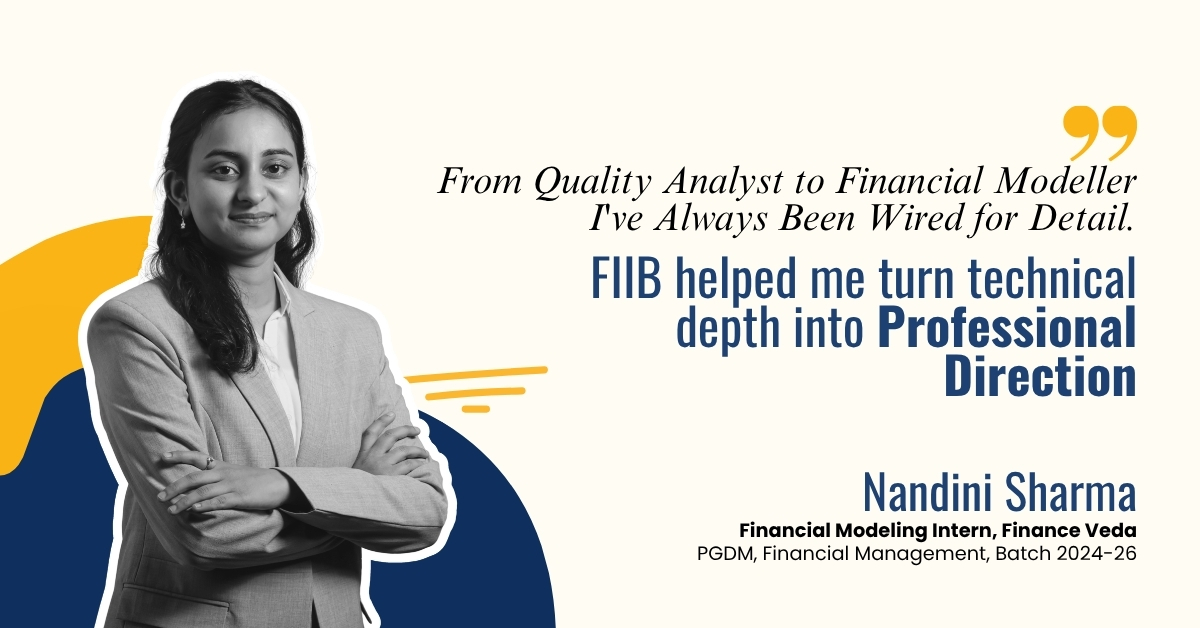
In conversation with the FIIB Newsdesk, Nandini Sharma shares how her journey from understanding balance sheets to building forward-looking financial models reflects the evolving nature of finance—and how FIIB’s MBA shaped that transformation.
Q. You describe your journey as moving from “balance sheets to boardroom decisions.” What does that transition really mean?
For me, it’s about shifting from recording the past to predicting the future.
During my B.Com, finance was largely about understanding what had already happened—financial statements, ratios, and historical performance. It gave me a strong foundation, but it also felt limited.
When I started exploring financial modeling in MBA, especially at FIIB, I realised that finance is not just about analysis—it’s about foresight.
You’re not just asking:
“What happened to this company?”
You’re asking:
“What will happen next—and why?”
That shift—from static analysis to dynamic thinking—is what defines the transition from classroom finance to real-world decision-making.
Q. How did your MBA at FIIB help you build this forward-looking approach to finance?
A big part of it came from how learning is structured.
At FIIB, finance is not taught in isolation. It is connected to markets, strategy, and real-world scenarios through case-based learning, simulations, and applied projects.
When you work on financial modeling in MBA, you’re not just building Excel sheets—you’re building assumptions, testing scenarios, and understanding risk.
For example, while working on equity research and financial modelling projects, I used:
- Discounted Cash Flow (DCF) models
- Scenario and sensitivity analysis
- Financial ratios and valuation techniques
But more importantly, I learned how to connect these models to real business decisions.
That’s what makes financial modeling in MBA meaningful—it moves beyond formulas into strategic thinking.
Q. Your projects span companies like American Airlines and Whirlpool. What did these experiences teach you?
They taught me that numbers always have a story behind them.
For instance, when analysing American Airlines, the focus was on post-pandemic recovery and financial risk. While revenues were improving, high leverage and weak financial indicators pointed towards underlying distress.
On the other hand, Whirlpool of India presented a different picture—strong brand positioning but margin pressures due to input cost fluctuations.
What these projects showed me is that financial modeling in MBA is not about arriving at a “right answer.”
It’s about:
- Interpreting data in context
- Understanding industry dynamics
- And making informed, evidence-based judgments
That’s where real financial insight comes from.
Q. You’ve also worked on ESG analysis. How does ESG connect with finance today?
ESG is becoming an integral part of financial decision-making.
Through my research on ESG practices and their linkage with business KPIs in the Indian IT sector, I realised that while companies are increasingly reporting ESG metrics, the connection to financial performance is still evolving.
In many cases, ESG remains symbolic rather than strategic.
This is where finance professionals need to step in.
At FIIB, the integration of ESG and sustainability into the curriculum helps you understand how environmental, social, and governance factors impact:
- Risk
- Long-term value creation
- Investor sentiment
So ESG is no longer a separate conversation—it’s part of financial analysis itself.
Q. Risk management seems to be another strong area in your profile. How did you build that capability?
Through a combination of structured learning and practical exposure.
During the ATAL Faculty Development Programme on risk management, we explored:
- Scenario-based planning
- Monte Carlo simulations
- Sensitivity modelling
- AI-driven risk insights
We also studied real cases like Alpha Bank and IL&FS, which helped connect theory with actual market events.
What stood out to me was how risk is not just about avoiding losses—it’s about making better decisions under uncertainty.
And that’s a critical skill in finance today.
Q. How does FIIB’s MBA support students looking to build strong finance careers?
What makes FIIB different is its applied approach.
Firstly, there is a strong emphasis on experiential learning, where students work on live projects, internships, and real-world problems. This ensures that concepts like financial modeling in MBA are always applied, not just studied.
Secondly, the institute integrates AI tools and analytics into the learning process, which is increasingly important in finance. From data interpretation to forecasting, technology plays a key role.
Thirdly, there is continuous industry interaction—through guest lectures, mentoring, and projects—which helps you understand how finance functions in real organisations.
This combination ensures that you’re not just academically prepared—you’re professionally ready.
Q. Your work experience as a Quality Analyst also seems quite different from finance. Did it add value?
Definitely.
At Insight Customer Call Solution, my role involved auditing processes, ensuring compliance, and improving performance through feedback.
While it may not seem directly related to finance, it built skills that are extremely relevant:
- Attention to detail
- Data validation
- Process improvement
These skills translate directly into financial analysis, where accuracy and structured thinking are critical.
So in a way, it strengthened my foundation for financial modeling in MBA.
Q. FIIB emphasises experiential learning. How did your internships contribute to your growth?
Internships played a key role in bridging theory and practice.
At Finance Veda, I worked on financial modelling and equity research, analysing companies through valuation models, sector trends, and risk factors.
This was where classroom concepts truly came alive.
You’re no longer solving hypothetical problems—you’re making real investment decisions based on your analysis.
Similarly, my social internship with Sakshi NGO added a different dimension—understanding impact and responsibility.
Together, these experiences shaped a more holistic perspective.
Q. You also write and engage with financial topics beyond academics. How important is that?
It’s very important.
Finance is constantly evolving, and staying updated is essential.
Through my LinkedIn articles, I explore topics like:
- Fixed income risks
- Market trends
- Investment strategies
Writing helps me organise my thoughts and deepen my understanding.
It also reflects something I strongly believe in—learning should not be limited to classrooms.
Q. How would you describe your approach to problem-solving today?
I would describe it as analytical but contextual.
I rely on:
- Data and evidence
- Structured frameworks
- And a big-picture perspective
At the same time, I understand that numbers alone are not enough. You need to interpret them within the broader business and market context.
That balance is something I’ve developed through my MBA journey.
Q. Finally, how do you define finance today, after this journey?
For me, finance is about foresight.
It’s about:
- Anticipating trends
- Evaluating risks
- And enabling better decisions
Financial modeling in MBA is just a tool. What really matters is how you use it to create insight.
And that’s what FIIB has helped me build—the ability to move from data to decision-making.

















Leave a comment