

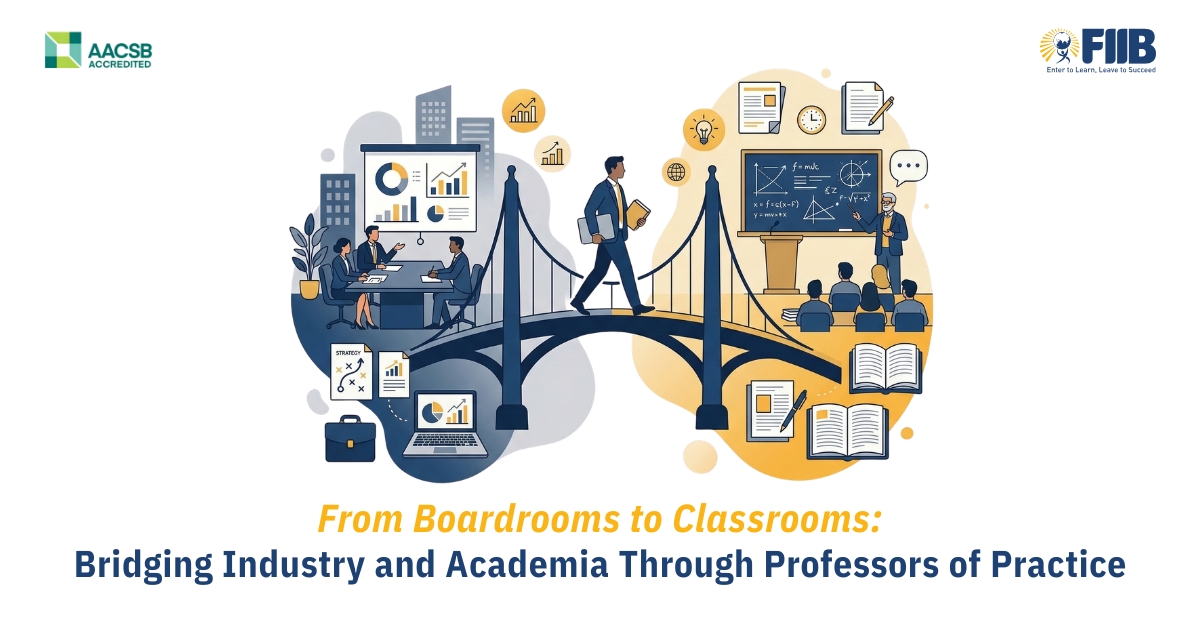
Textbooks teach frameworks. Experience teaches judgment.
Across India’s higher education landscape, a quiet but consequential shift is underway. Universities are increasingly recognising that while theory builds intellectual foundations, it is lived professional experience that prepares students to navigate complexity, ambiguity, and real decision-making.
At the centre of this shift is the Professor of Practice in management education — a role designed to bridge the long-standing gap between academic learning and industry realities.
Formalized by the University Grants Commission (UGC) in 2022 under the National Education Policy (NEP) 2020, the Professor of Practice framework enables seasoned industry leaders to enter classrooms for fixed tenures without displacing traditional academic faculty. Their mandate is simple but powerful: bring the real world into learning spaces.
At Fortune Institute of International Business (FIIB), New Delhi, this philosophy is not aspirational — it is operational and reflective in their PGDM & PGDM FM Programs.
The Employability Challenge: Why Industry Integration Matters
India produces one of the world’s largest graduate talent pools, yet employability remains uneven across disciplines.
According to the India Skills Report 2025, based on over 6.5 lakh candidates who took the Global Employability Test, only 54.81% of Indian graduates are considered employable, highlighting the persistent gap between academic preparation and industry expectations.
Management graduates perform better than most disciplines — but the expectation from employers has also evolved.
Graduate Employability Across Disciplines
| Discipline | Employability Rate |
|---|---|
| MBA / Management | 78% |
| Engineering | 71.5% |
| MCA | 71% |
| Science | 58% |
| Commerce | 55% |
| Arts | 54% |
Source: India Skills Report 2025
Employers today are not simply looking for conceptual knowledge. They expect graduates to demonstrate:
- analytical thinking in uncertain situations
- communication clarity
- leadership without formal authority
- decision-making under pressure
These capabilities are difficult to cultivate through lectures alone. This is precisely where the Professor of Practice in management education model becomes important.
Why the Professor of Practice Model Is Gaining Global Momentum
Globally, business schools are moving toward practice-integrated learning — where academic theory and professional expertise interact continuously.
The Professor of Practice in management education model responds to three structural gaps that traditional academia often struggles to address.
Bridging the Classroom–Industry Divide
| Traditional Academic Gap | Contribution of Professors of Practice |
|---|---|
| Theory-heavy curriculum | Real-world business decision scenarios |
| Limited exposure to leadership roles | Executive-level insights and lived experiences |
| Weak transition from campus to workplace | Mentorship and career readiness guidance |
Unlike visiting speakers or guest lecturers, Professors of Practice are embedded within the institutional ecosystem. They contribute to mentoring, curriculum design, employability coaching, and industry exposure.
At FIIB, this model allows students to see how concepts discussed in class translate into real decisions inside boardrooms and leadership teams.
Research Insight: The Mentorship Advantage
Academic research increasingly highlights the importance of industry mentorship in improving graduate career outcomes.
A recent study examining the transition of graduates into professional careers found that students who received structured mentoring during their academic journey demonstrated stronger leadership development, workplace confidence, and long-term career growth.
The study also revealed that less than half of graduates receive consistent mentoring during their transition from university to industry.
This gap creates a powerful opportunity for institutions to intervene early — by integrating experienced professionals directly into learning ecosystems.
The Professor of Practice in management education framework enables precisely that.
FIIB’s Approach: Experience as Pedagogy
FIIB has consciously adopted the Professor of Practice in management education model to strengthen its focus on employability, leadership readiness, and industry relevance.
Two distinguished professionals currently serve as Professors of Practice at FIIB, bringing decades of cross-sectoral and global experience into the classroom. Their presence reflects FIIB’s belief that management education must be lived, not just learned.
Prof. Indrajit Lahiri: Global Banking Insight, Classroom Impact
With more than 30 years of international banking and financial services experience, Professor Indrajit Lahiri embodies the depth and perspective that the Professor of Practice in management education role is meant to bring.
Having held senior leadership positions across organisations such as Citi, GE Capital, and Barclays, his career spans multiple geographies including India, Southeast Asia, the Middle East, Africa, Russia, and Vietnam.
His professional journey has involved leading large-scale transformations, operational excellence programs, and risk management initiatives across complex financial institutions.
At FIIB, his contribution extends far beyond classroom lectures.
He works closely with students to:
- conduct one-on-one mock interviews and CV clinics
- prepare them for high-pressure recruitment environments
- simulate leadership decision scenarios
- help students navigate global career opportunities
During mentoring sessions, Prof. Lahiri often emphasises a key leadership insight.
“Students often assume leadership begins when authority is given. In reality, leadership begins when you start taking responsibility for decisions — even before the title arrives.”
By translating complex banking and risk frameworks into real decision stories, he enables students to understand how strategic thinking unfolds in real organisations.
Dr. Sorabh Bajaj: Strategy, Systems, and Execution
Professor Sorabh Bajaj brings a complementary perspective to FIIB’s learning ecosystem — one rooted in strategy execution and operational excellence.
With over 18 years of experience across BFSI, defence, and EdTech sectors, he has worked extensively in business transformation, consulting, and operational improvement roles.
His professional credentials include:
- Lean Six Sigma Black Belt
- Project Management Professional (PMP)
- Tata Business Excellence Model Assessor
Prof. Bajaj has also contributed to course design and delivery with institutions such as Northwestern University, INSEAD, UC San Diego, bringing global academic exposure into FIIB’s classrooms.
At FIIB, his role focuses on helping students bridge the gap between strategy formulation and execution.
“Strategy is exciting to discuss,” he notes, “but organisations succeed because of systems, discipline, and execution capability. The real challenge is translating ideas into measurable outcomes.”
His sessions introduce students to consulting frameworks, operational diagnostics, and stakeholder alignment strategies — allowing them to experience how organisations translate ideas into results.
Beyond Teaching: Building Employability and Confidence
What distinguishes FIIB’s Professor of Practice in management education approach is not simply the experience of its faculty — but how deliberately that experience is integrated into the student journey.
Through mentoring, career coaching, and applied discussions, Professors of Practice help students:
- articulate their professional strengths confidently
- understand workplace expectations early
- navigate career decisions more strategically
- transition smoothly from campus to corporate environments
This integrated model aligns with FIIB’s broader philosophy of employability-driven education, where classroom learning, industry exposure, and leadership development are treated as interconnected experiences.
The Future of Management Education
As higher education evolves globally, one insight is becoming increasingly clear: relevance cannot be retrofitted after graduation.
Business schools must create learning environments where theory and practice interact continuously.
The Professor of Practice in management education model represents a powerful step in that direction.
By embedding experienced industry leaders into its academic ecosystem, FIIB ensures that students are not merely prepared to enter organisations — but to contribute meaningfully from their very first day.
In an era where knowledge is widely accessible but judgment remains scarce, the most valuable classrooms may well be those where experience meets education.
And at FIIB, that meeting happens every day — in classrooms, mentoring conversations, and career guidance sessions that prepare future managers for a complex and rapidly evolving business world.



















Leave a comment