

In today’s evolving business landscape, an MBA is increasingly being evaluated not by what students learn, but by what they can apply. For students pursuing an MBA with industry exposure in Delhi NCR, the journey is less about academic checkpoints and more about building real capability through continuous engagement with industry, data, and decision-making environments.
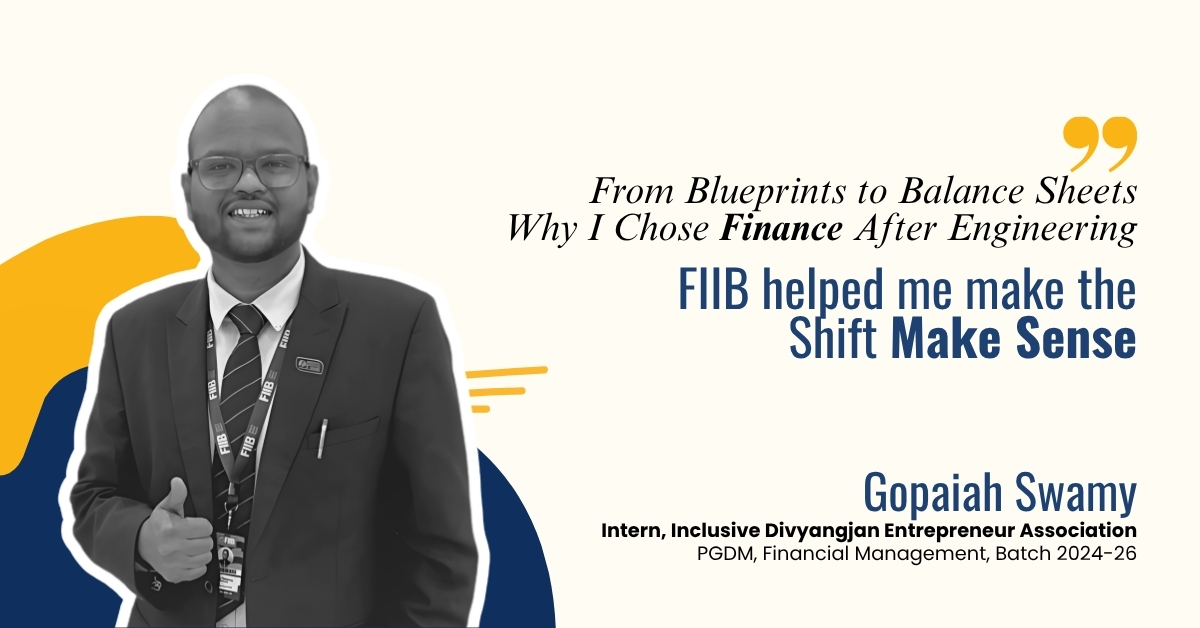
For KVBG Swamy, a PGDM student of Batch 2025-27 in Financial Management at Fortune Institute of International Business, this journey reflects a shift from understanding how projects are built to decoding how they create financial value.
Q. Swamy, your background is in Civil Engineering. What led you to pursue an MBA?
I come from a Civil Engineering background from Lovely Professional University, where I worked closely with infrastructure projects. Over time, I realised that while I understood execution, I didn’t fully understand how these projects were evaluated financially.
I wanted to go deeper into questions like — how is capital allocated, how are returns measured, and what really drives profitability?
That’s what led me to pursue an MBA. And specifically, an MBA with industry exposure in Delhi NCR, because I wanted to stay close to the corporate and infrastructure ecosystem where these decisions are actually made.
Q. How has your MBA experience been different from what you expected?
What stood out to me early on was that the learning here is very application-driven.
Instead of just studying concepts, we’re constantly working on live projects, simulations, and real datasets. That’s what defines an MBA with practical learning in India — you’re not waiting for internships to start applying concepts, you’re doing it from day one.
We have structured experiential learning built into the curriculum, and that changes how you approach problems. You start thinking in terms of outcomes, not just answers. In addition, sessions led by industry leaders across firms like consulting, insurance, and technology sectors offers a front-row view into how decisions are made at the highest levels — bridging the gap between classroom frameworks and boardroom realities.”
Q. You’ve worked extensively on financial modeling. Can you tell us about that experience?
One of my most important learning experiences was a financial statement analysis project where I built a five-year model comparing companies like Apollo Micro Systems, Astra Microwave, Data Patterns, Paras Defence, and Zen Technologies.
I used the DuPont Analysis framework to break down ROE and ROA into key drivers like margins, asset turnover, and leverage.
What I found interesting was that companies with consistent operational discipline tend to outperform those with short-term spikes in profitability.
That’s where being a financial modeling MBA student becomes more than just working with numbers — it’s about understanding the story behind those numbers.
Q. You’ve also participated in multiple case competitions. What did those experiences teach you?
Honestly, my journey in case competitions wasn’t smooth.
I participated in several competitions through the C-ACE honours program, and there were times when we didn’t even clear the initial rounds. One of those moments really stayed with me.
But over time, something changed. I started focusing more on how I was thinking and presenting, rather than just the outcome.
The turning point came during a national-level competition linked to the LinkedIn Campus Ambassador challenge. We were competing with students from 10+ B-schools, presenting in front of industry professionals.
Winning that competition wasn’t just about the result — it was about realising that consistency and preparation eventually pay off. That experience shaped my entire MBA case competition experience.
Q. How important has industry exposure been in your journey so far?
It’s been central.
An MBA with industry exposure in Delhi NCR means you’re constantly interacting with industry professionals — through masterclasses, live projects, and mentoring.
At FIIB, we have sessions with CXOs from companies like Bain & Company, Axis Max Life Insurance, and others. These sessions give you insight into how decisions are actually made at leadership levels.
It helps bridge the gap between theory and practice. You start seeing how frameworks are applied in real business situations.
Q. We’ve heard about your disciplined approach to preparation. Can you tell us more about that?
Yes, that’s something I’ve consciously built.
We have these Simulation and Recording rooms at campus — SR rooms — where we can practice presentations, case discussions, and interviews. I usually come early and use that time to practice. It’s something I’ve been consistent with.
Over time, you realise that an MBA with live projects and continuous application is not just about exposure — it’s about how much effort you put into refining your output. One of the defining aspects of the learning model is the corporate mentoring structure, where students engage with multiple industry mentors. Over time, these relationships often evolve into career opportunities — answering a key question many students have around how to get PPO in MBA programmes.
Q. You’ve had prior experience working on projects and running your own initiative. How has that shaped your approach?
Before my MBA, I worked on infrastructure projects and also ran Shadow Survey Services.
Managing budgets across multiple projects taught me something very important — financial statements reflect operational decisions. When you’ve seen how projects run on the ground, you approach finance differently. It’s not abstract anymore.
That perspective continues to shape how I think about a corporate finance career after MBA — where analysis is always connected to real business context.
Q. How does the overall FIIB ecosystem support this kind of learning?
The structure here plays a big role.
We have frameworks like SANKALP, which guide us through different stages of career readiness — from building skills to applying them in real scenarios.
There’s also a strong support system — faculty mentors, recruitment strategists, and access to industry professionals. Combined with being in Delhi NCR, where you have access to a large corporate ecosystem, it makes the MBA with industry exposure in Delhi NCR much more effective.
Q. What are your long-term career aspirations?
I want to build a career in equity research and corporate finance.
I’m particularly interested in roles where I can combine financial analysis with strategic decision-making — understanding not just what the numbers are, but what they mean.
More than a specific role, I want to build the ability to make informed decisions based on data and structured thinking.
Q. How would you summarise your MBA journey so far?
For me, it’s been a shift from learning concepts to understanding business realities.
From solving problems on paper to analysing real-world situations.
And that’s what defines a true MBA student success story — not just academic growth, but the ability to apply what you learn in meaningful ways. In a business environment that increasingly values execution over intent, the relevance of an MBA with industry exposure in Delhi NCR lies in its ability to prepare students for real-world complexity.
For KVBG Swamy, that preparation is already underway — shaped by data, discipline, and a continuous effort to bridge the gap between knowledge and application.














Leave a comment