

Choosing between an MBA and a PGDM is one of those decisions that feels simple on the surface (“degree vs diploma”), but gets confusing fast once you add approvals, college types, fees, and placement claims. Most students aren’t really comparing “MBA vs PGDM”—they’re comparing institutes, outcomes, and fit.
This guide is written to help you make a practical decision. Instead of treating MBA as automatically “better” or PGDM as automatically “more industry-oriented,” you’ll learn what actually changes between the two, what usually stays the same, and what to verify so you don’t rely on marketing.
MBA vs PGDM in one glance
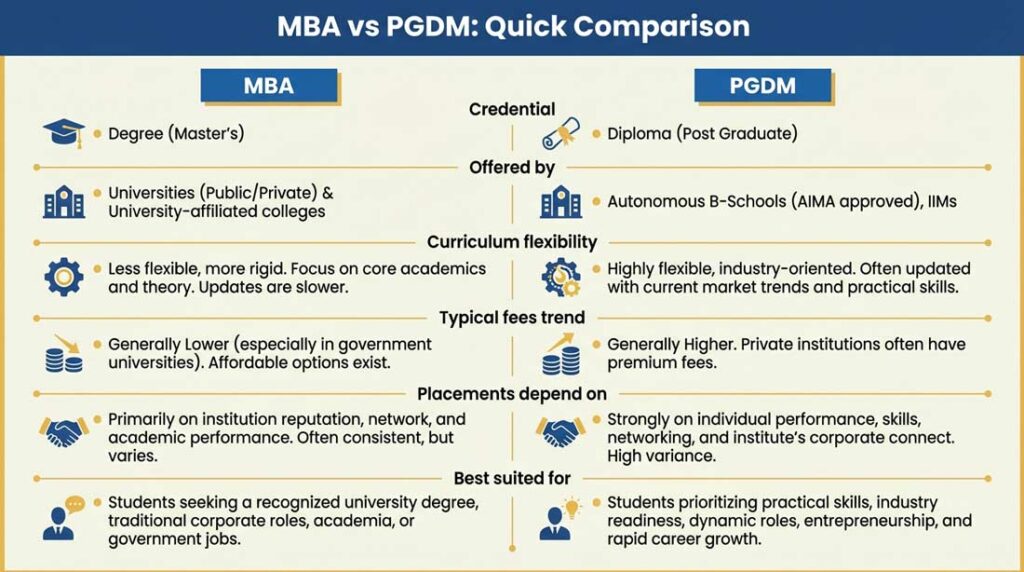
At a high level, an MBA is typically a university-awarded degree, while a PGDM is usually a diploma awarded by an autonomous institute. That difference affects who regulates the program, how often the curriculum can be updated, and sometimes how eligibility is interpreted for specific pathways.
At the same time, employers usually care more about college reputation, roles offered, and student capability than the word “MBA” or “PGDM.” So the “right” choice depends on your goals (job role, ROI, future study plans) and the institute quality.
Snapshot comparison (simple, practical points)
The fastest way to compare is to look at what changes in your daily learning and what changes in your long-term options. MBA programs often follow a university structure, which can bring consistency, while PGDM programs often have more flexibility in electives and industry integration.
Use this snapshot as a starting point, but don’t stop here—two institutes offering the same label can be worlds apart in outcomes.
- Credential: MBA = degree | PGDM = diploma
- Who offers it: MBA = universities/university-affiliated colleges | PGDM = autonomous institutes
- Approvals (typical): MBA = university + regulatory norms | PGDM = often AICTE-approved (for full-time PGDM in India)
- Curriculum updates: MBA = may change slower | PGDM = often updated faster
- Fees (typical trend): MBA = wider range, sometimes lower in public universities | PGDM = often higher at private autonomous schools
- Placements: depends more on institute brand + recruiter mix than label
- Best for: MBA = degree preference, academic/government pathways (sometimes) | PGDM = industry-aligned learning (when institute is strong)
The “which is better?” answer (without the hype)
If you’re choosing between two equally strong institutions, PGDM can be a better fit when you want faster-updating curriculum and a heavily industry-driven approach. If you want a university degree and you’re mindful of certain formal requirements (for example, some academic routes), MBA can be a safer preference.
But in real life, it’s rarely an equal comparison. A strong MBA beats a weak PGDM, and a strong PGDM beats a weak MBA—so your decision should be institute-first, then program label.
Understand the programs before comparing them
Before you compare fees and placements, it helps to understand what each program is designed to do. Both aim to build management capability—business fundamentals, decision-making, communication, and specialization skills.
The difference usually lies in governance and agility: who controls the syllabus, how evaluation is structured, and how quickly the program adapts to industry needs.
What is an MBA?
An MBA (Master of Business Administration) is generally a postgraduate degree awarded by a university or a university-affiliated institution. The structure commonly follows semesters/terms with defined core subjects first, followed by electives and specialization tracks.
In many MBA programs, the curriculum is tied to a university framework, which can create standardized learning outcomes across affiliated colleges. That can be useful for consistency, but the pace of updates may depend on the university’s revision cycle rather than market shifts.
Common MBA elements you can mention in the content:
- Core: marketing, finance, HR, operations, strategy, economics
- Skill modules: communication, analytics basics, leadership
- Practical parts: internships, projects, presentations, case discussions (varies by institute)
What is a PGDM?
PGDM (Post Graduate Diploma in Management) is typically offered by an autonomous institute (not a university department), which means the institute can design and revise the curriculum more independently. In India, many credible full-time PGDM programs are AICTE-approved (approval is important to verify, not assume).
A good PGDM program often markets itself as industry-aligned because it can update electives, add certifications, bring in practitioners, and redesign evaluation faster. However, this advantage appears mainly in institutes that genuinely invest in curriculum design and industry partnerships—otherwise it can become a marketing line without substance.
Common PGDM elements you can mention in the content:
- Industry-heavy electives (e.g., product, growth marketing, business analytics)
- Live projects and internships emphasized early
- Guest faculty/practitioner-led modules
- More flexibility in specialization combinations
Core differences that actually affect your career
Many comparisons get stuck on “degree vs diploma,” but your career outcomes depend more on what the program enables: skills, internships, networking, and brand value. Still, the underlying differences can affect curriculum design, credibility checks, and certain future pathways.
Think of this section as your “decision engine”: each sub-topic below connects to a real-life impact—cost, learning quality, hiring signals, or future options.
Degree vs diploma: what it changes (and what it doesn’t)
The words “degree” and “diploma” matter most in formal settings—for example, specific eligibility clauses in certain applications, or when a university-defined credential is explicitly required. In those cases, an MBA’s degree status can reduce ambiguity.
In the private sector, the label usually matters less than the institute brand, recruiter access, and your skill profile. Hiring managers often prioritize role readiness: internships, problem-solving ability, communication, and domain knowledge—regardless of whether your certificate says MBA or PGDM.
Approvals and recognition: how to verify credibility
MBA programs are generally linked to universities and follow the regulatory framework those universities operate under. PGDM programs, being diploma programs by autonomous institutes, are commonly associated with AICTE approval for full-time management diplomas in India (where applicable).
The key point: don’t assume approval just because the institute is famous on social media. Always verify the institute’s status on official channels and understand whether the approval covers your specific program format (full-time/part-time/online).
What to check (add this list in your article):
- Is the program full-time and recognized/approved as advertised?
- Is the institute AICTE-approved for PGDM (if claiming so)?
- For MBA, is it run by a recognized university / authorized affiliated college?
- Is the institute transparent about accreditation and disclosures (placement + program structure)?
Curriculum and learning style: what your day-to-day feels like
In many MBA programs, you’ll see a structured progression: core management fundamentals first, then specialization electives, plus internships and final projects. If the university system is strong and the institute is proactive, this can be rigorous and well-balanced.
In strong PGDM programs, the learning style may feel more “industry-like”: case-heavy sessions, simulations, hands-on tools, live projects, and elective baskets that reflect current hiring trends. That said, some MBA institutes also do this very well—so treat “teaching style” as an institute feature, not a guaranteed MBA/PGDM feature.
Examples of learning methods you can list:
- Case studies + group discussions
- Live consulting projects
- Simulations (strategy/ops/marketing)
- Tool training (Excel, SQL, Tableau/Power BI—where offered)
- Internships with structured evaluation
Fees, scholarships, and ROI: how to compare properly
Fees vary widely across MBA and PGDM—public universities can be more affordable, while private autonomous institutes can be expensive. But cost alone doesn’t decide value; you should compare total cost of ownership with likely outcomes (roles, median salary, growth trajectory).
ROI becomes clearer when you break it down into components: tuition + living + opportunity cost (if you leave a job), and the kind of roles you are realistically likely to get based on the institute’s placement distribution (not just the highest package).
A simple ROI checklist (include as a list):
- Total cost = fees + hostel/living + relocation + interest (if loan)
- Outcome check = median CTC + top 25% average + role quality
- Payback lens = how many months to recover total cost (approx.)
- Risk lens = batch size vs number of quality recruiters
Admissions and entrance exams: what to expect
For both MBA and PGDM, entry commonly depends on management entrance exams and your overall profile. What changes is how institutes weigh components: some prioritize test scores heavily; others use a more holistic approach with work experience, academics, interviews, and group discussions.
Instead of focusing only on “which exam for MBA vs PGDM,” focus on “which exam is accepted by the institute I’m targeting” and “what score range is competitive there.” Many candidates lose time preparing for the wrong exam mix.
Common exams you can list in your content (India-focused):
- CAT, XAT, GMAT (often used for top-tier admissions)
- CMAT, MAT (accepted by many institutes; varies by tier)
- SNAP (for Symbiosis institutes), NMAT (for NMIMS and others)
- Institute-specific or university-specific processes (where applicable)
Placements: how to read reports without getting misled
Placements depend on three things more than the program label: brand + recruiter relationships + student quality. So your job is to evaluate placement reports the way a recruiter would—looking at medians, role types, and consistency, not just “highest CTC.”
A strong placement report is transparent about salary distribution, recruiter list, internship outcomes, and role categories. If a report is vague, overly glossy, or avoids medians, treat it as a warning sign and verify through alumni.
Placement report checklist (add this list):
- Median CTC (not only average)
- Top 25% / top 50% averages (distribution matters)
- Role titles and domains (sales vs consulting vs product vs ops etc.)
- Internship-to-PPO conversion rate (if disclosed)
- Recruiter repeat rate (do companies return each year?)
- Batch size vs number of offers (is it inflated by multiple offers?)
Which one should you choose? (based on your profile)
Your best choice depends on your starting point: fresher vs experienced, clarity of goals, and risk tolerance on fees. The “best” program is the one that gives you the highest probability of landing the roles you want.
Use the sub-sections below to position yourself. Don’t aim for perfection—aim for a decision you can defend with logic: cost, outcomes, and fit. You can consider talking our team and clear you doubt.
If you’re a fresher
As a fresher, your biggest advantage is flexibility—you can explore domains like marketing, finance, analytics, HR, or operations through internships and projects. The institute’s ecosystem matters a lot here: peer group quality, internship support, clubs, competitions, and alumni network.
For freshers, the MBA vs PGDM label matters less than the campus opportunities that build your profile quickly. A program that offers frequent live projects, strong summer internships, and a structured placement prep ecosystem can outperform a “bigger name” that doesn’t support execution.
Fresher-focused shortlisting list:
- Strong internship pipeline + live projects
- Active clubs/committees (marketing, finance, consulting, product)
- Transparent placement distribution
- Skill-building resources (Excel/analytics/case prep)
- Alumni presence in roles you want
If you’re a working professional or career switcher
If you have work experience, you should judge programs by role outcomes rather than general placement numbers. For example, if you want to move from operations to consulting, look for consistent consulting shortlists and alumni transitions—not just a high average package.
Also consider opportunity cost: leaving a job for 2 years should result in a meaningful role upgrade (better function, better brand, better growth path). Sometimes a strong MBA makes sense; sometimes a strong PGDM does—what matters is the institute’s ability to deliver the transition you want.
Working-professional filters (use this list):
- Past placements in your target domain
- Alumni with similar pre-MBA backgrounds
- Curriculum depth in your chosen specialization
- Leadership roles, projects, industry mentorship
- ROI after factoring lost salary (opportunity cost)
If you’re targeting government, academia, or higher studies
If you’re considering paths where credential interpretation can be strict, it’s smart to prefer clarity. Some routes may explicitly mention degree requirements or have eligibility language that is easier to satisfy with a university-awarded MBA.
That said, many PGDM holders do fine across sectors—what changes is the need for careful verification. If your future plan includes research/teaching or highly formal eligibility checks, choose the option that reduces uncertainty and aligns with your intended pathway.
If you want global mobility
For global mobility, employers and universities abroad typically evaluate your institution reputation, accreditation signals, and your work portfolio. In some cases, a “degree” label can be easier to explain in documentation; in others, institute brand and transcripts matter more than naming.
If international plans are serious, choose a program that offers strong alumni presence abroad, credible international accreditation (where available), and a track record of graduates moving into global roles or global master’s pathways.
Global-mobility checklist (add this list):
- Alumni outcomes abroad (search LinkedIn patterns)
- International accreditation (where applicable)
- Exchange programs / global immersion modules (verify substance)
- Career services support for international recruiting
- Clear documentation: transcripts, program structure, learning hours
College evaluation checklist (works for both MBA and PGDM)
This section is your safety net. Even if you’re confused about labels, this checklist helps you choose a good institute and avoid bad ones.
Treat it like due diligence. A few hours of checking approvals, placement distribution, and alumni outcomes can save you years of regret.
Must-check credibility signals
Start with legitimacy and transparency: approvals/recognition, disclosure quality, and consistent placement reporting. Strong institutes tend to be clear about what they offer; weaker ones often hide behind buzzwords.
Also evaluate outcomes through independent signals: alumni trajectories, recruiter repetition, and student projects you can actually view. Your goal is to confirm that the institute’s marketing claims match reality.
Credibility signals list:
- Official approval/recognition status (as applicable)
- Clear curriculum structure + elective list
- Published placement report with medians and role details
- Alumni visible in target companies/roles
- Recruiters that return year after year
- Real student output: case comps, portfolios, projects
Questions to ask alumni/current students (copy-paste friendly)
Alumni and current students can tell you what brochures cannot: teaching quality, real internship support, placement pressure, and how transparent the institute is about outcomes. The key is asking questions that force concrete answers.
Use questions that reveal distribution and support quality rather than just “Is the college good?” You’ll quickly learn whether outcomes depend on a few top performers or if the system supports most students.
Ask these (list):
- What’s the median package and the most common role type?
- How many people got roles in my target domain (approx.)?
- How early do internships start, and how are they sourced?
- How strong is placement training (cases, aptitude, interviews)?
- What are the biggest negatives students don’t realize before joining?
Myths and mistakes to avoid
A lot of confusion comes from myths repeated online: “PGDM isn’t valid,” “MBA always wins,” or “highest package means best college.” These beliefs can push you into the wrong decision.
Instead, focus on verifiable facts: program legitimacy, institute quality, placement distribution, and fit for your career goal.
Common myths about MBA vs PGDM
Myth 1 is that “PGDM is just a diploma, so it’s inferior.” In reality, many top autonomous institutes offer PGDM programs with excellent placements and industry-aligned learning; the diploma label doesn’t automatically reduce career value.
Myth 2 is that “MBA always has better placements.” Placements are institute-driven, not label-driven. A strong PGDM institute with excellent recruiter relationships can outperform an average MBA college easily.
Myth-busting list:
- “Highest package = true outcome” (look at medians)
- “Fees higher = quality higher” (verify placements + alumni outcomes)
- “PGDM has no value” (value depends on institute credibility and outcomes)
- “Specialization choice guarantees job” (skills + projects matter more)
Red flags while shortlisting institutes
Some institutes rely heavily on vague promises—“100% placement,” “international curriculum,” “industry-ready”—without providing transparent data. Treat unclear placement stats and missing median numbers as a warning.
Another red flag is poor alignment between what you want and what the institute actually places for. If you want analytics roles but the institute mostly places for sales, you’ll face unnecessary friction unless you’re ready to fight uphill.
Red flags list:
- No median CTC disclosed, only “highest package”
- Inflated recruiter lists without role details
- Very large batch size with limited recruiter depth
- Weak alumni presence in relevant roles
- Unclear approval/recognition status
- Pushy sales behavior instead of transparent counselling
FAQs
In everyday hiring, PGDM and MBA can be treated similarly when the institute is credible and the program outcomes are strong. Recruiters usually evaluate your institute, skills, internships, and interview performance more than the label.
For formal equivalence questions, it depends on the context and the specific requirement. If you’re applying somewhere with strict eligibility language, verify how they interpret PGDM and whether your institute/program format meets their criteria.
For some government or formal recruitment pathways, a university-awarded degree may be easier to interpret because the requirement language can be degree-specific. That’s where an MBA can feel “safer” as a preference.
However, requirements vary widely by role and recruiting body. The best approach is to shortlist the roles you want and read their eligibility wording carefully, then choose the program that reduces ambiguity for those specific targets.
Placements are not guaranteed by the label. They’re driven by institute reputation, recruiter relationships, location, student profile, and placement team strength.
A top PGDM institute can have better placements than a mid-tier MBA college, and a top MBA university can beat many PGDM programs. Always compare placement distributions, not just averages, and confirm through alumni.
Many PGDM holders do pursue higher studies, but routes can vary depending on the university and the country. Some institutions may ask for specific documentation, credit structures, or degree-equivalence processes.
If higher studies are a priority, shortlist the universities/countries you’re targeting and check their entry requirements early. Then choose the program (MBA/PGDM) that best matches those requirements and provides the documentation you’ll need.
Conclusion
If you remember only one thing: don’t pick the label—pick the institute and outcomes. MBA vs PGDM becomes easy once you know your goal (role + domain), your budget/ROI boundary, and which institutes consistently place students into the roles you want.
Use this 3-step framework to decide quickly and confidently:
- Step 1: Define target roles (e.g., marketing brand, finance, analytics, consulting, ops)
- Step 2: Compare institutes using medians + role mix + alumni outcomes (not highest package)
- Step 3: Choose the program that reduces risk for your future plans (global study/government/academia) while maximizing role probability















Leave a comment