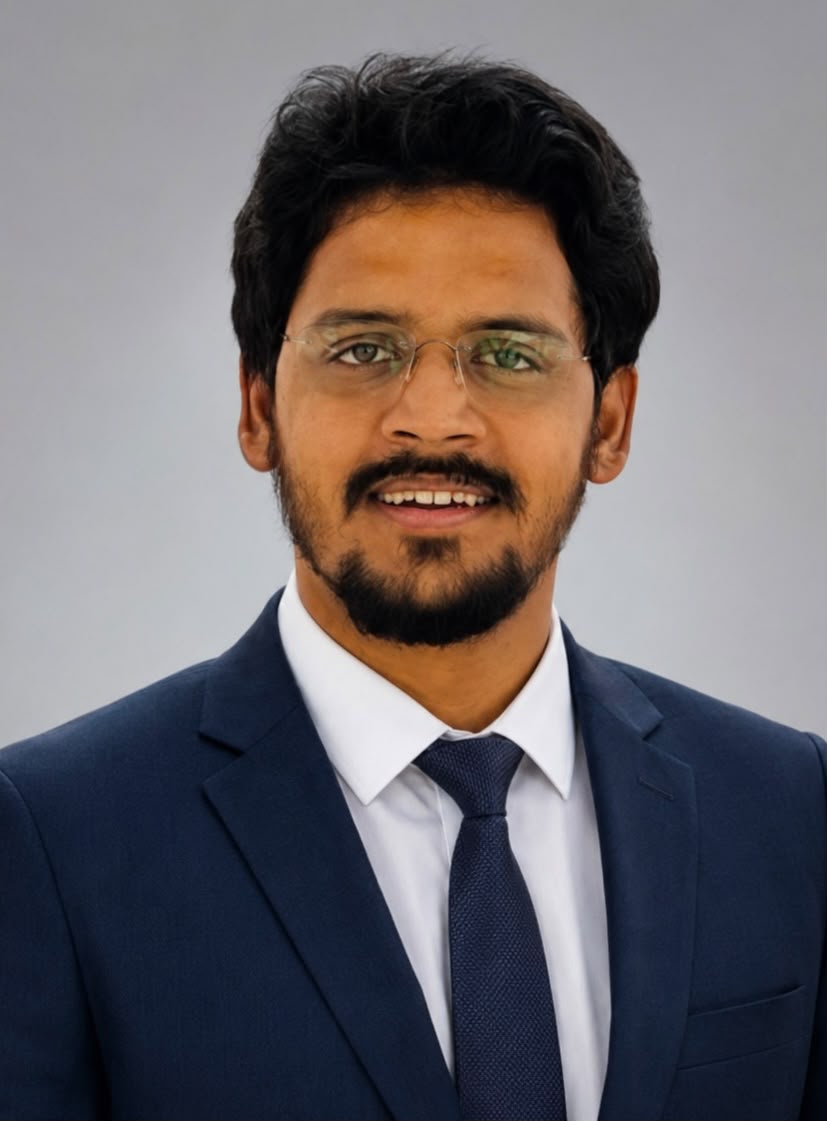
Dr. Wajid Ali
Assistant Professor


He is an Assistant Professor of Business Analytics at Fortune Institute of International Business (FIIB). His areas of expertise are Business Analytics, Text Analytics and Web Scraping. He holds a Ph.D. in Management from the Indian Institute of Technology Jodhpur (2021–2025), an M.B.A. from Jamia Millia Islamia, New Delhi (2019–2021), and a B.Tech from Dr. APJ Abdul Kalam Technical University (2014–2018). His research focuses on core and applied machine learning, including its use in business, finance, institutions and energy-related problems in emerging economies. Specific areas include predictive modelling and supervised learning for business decisions, text analytics and natural language processing of unstructured data, web scraping for large-scale data collection, credit risk and financial distress prediction, and data-driven analysis of energy and sustainability outcomes. His teaching portfolio covers Business Analytics, Data Analytics for Managers using Python, and Machine Learning for Business. In the classroom, he emphasises practical implications and interpretation: students learn to move beyond running Python code and model outputs to explaining what the results mean, how reliable they are, and which managerial decision they support. Sessions combine hands-on coding with real business datasets and case-based discussion, so that analytical findings are translated into clear, actionable recommendations. He serves as a reviewer for A-category and Q1 journals, including Journal of Environmental Management, SN Business & Economics and Energies.
Ph.D. in Management, Indian Institute of Technology Jodhpur (2021–2025)
M.B.A., Jamia Millia Islamia, New Delhi (2019–2021)
B.Tech, Dr. APJ Abdul Kalam Technical University (2014–2018)
Ali, W., Dash, D. P., Jangam, B. P., Singh, A., & Rana, N. P. (2026). Transmission of democracy to a better business environment: Roles of regulation and institutions. Journal of Business Research, 207, 116006. https://doi.org/10.1016/j.jbusres.2026.116006
Ali, W., Boungou, W., & Dash, D. P. (2026). Democracy and credit risk. Policy Studies, 1–40. https://doi.org/10.1080/01442872.2026.2669917
Ali, W., Dhankar, N., Dagar, V., & Rao, A. (2026). Energy poverty dynamics and geostrategic shocks: Moderation of financial markets. Energy Policy, 215, 115278. https://doi.org/10.1016/j.enpol.2026.115278
Ali, W., Rana, K., & Dash, D. P. (2026). Resource and energy transition with digital governance for global decarbonomics. International Economics, 186, 100696. https://doi.org/10.1016/j.inteco.2026.100696
Ali, W., Saini, S., & Dash, D. P. (2026). Institutional governance and energy security: Unveiling the drivers of global value chain participation in Asian economies. Journal of Asian Economics, 103, 102108. https://doi.org/10.1016/j.asieco.2025.102108
Ali, W., Dash, D. P., Dagar, V., Kagzi, M., & Elmawazini, K. (2025). Financial development for energy access: Evidence from credit rationing and carbon emission in the MENA region. International Review of Financial Analysis, 103, 104176. https://doi.org/10.1016/j.irfa.2025.104176
Ambiya, Ali, W., & Dash, D. P. (2025). A changing social aspect across economies: Role of education in engineering financial inclusion. Journal of Developing Areas, 59, 171–197. https://doi.org/10.1353/jda.2025.a970238
Ali, W., Dash, D. P., & Ambiya. (2023). Examining the perspectives of gender development and inequality: A tale of selected Asian economies. Administrative Sciences, 13, 115. https://doi.org/10.3390/admsci13040115
Ali, W., & Ambiya. (2023). Urbanization and nutrition transition: Evidence from South Asia. Asian Economic Letters, 4, Article 4. https://doi.org/10.46557/001c.74857
The Interplay of (RPTs), Corporate Social Responsibility and Financial Distress: A Difference-in-Differences Analysis of COVID-19 Shocks. International Journal of Ethics and Systems.
Participant (fully funded), 8th International Conference on Entrepreneurship for Sustainability & Impact (ESI), Qatar University, Doha, Qatar (2025).
Natural Resource Security with Energy Efficiency and Digital Governance for Sustainable Development: Evidence from Global Economy. Accepted for presentation in the Association for Social Economics session “Rising Military Expenditures, Climate Change, and Government Debt Crises”, 2026 Annual Meeting of the Allied Social Science Associations (ASSA), American Economic Association, Philadelphia, USA (January 3–5, 2026).
Diverging Realities: Corruption’s Unexpected Contributions to Credit Risk Reduction in Banking Crisis Systems of Selected Economies. World Finance Conference 2024, European University of Cyprus, Cyprus (2024).
Institutional Governance and Energy Security: Unveiling the Drivers of Global Value Chain Participation in Asian Economies. International Conference on Enabling Sustained Growth in Emerging Asia (ESGEA), University of Hyderabad.
Fighting Corruption: The Role of Political Development. 27th Annual Conference of the Indian Political Economy Association on Geopolitics, Energy, Finance and Democracy, IIT Bhubaneswar, Odisha.
Revisiting the Effects of Corruption and Institutional Factors in Impacting the Banking System: Evidence from the Selected Economies. 9th Pan IIM World Management Conference, IIM Sambalpur, and International Finance and Accounting Conference (IFAC), IIM Jammu.
Reviewer for A-category and Q1 journals, including Journal of Environmental Management, SN Business & Economics, and Energies.