
Why Some Students Learn More From The Same Experience

Think Forward is a short weekly note on careers, learning, and leadership in a changing world of work. Written by FIIB President Radhika Shrivastava, it shares practical ideas, frameworks, and real stories to help students think more clearly about their professional journeys.
I was recently invited to judge internship presentations at a leading B-School in Mumbai. The quality was strong. (And I’ll admit that I found myself quietly smiling, because I’ve seen FIIB students engage with the same level of depth.)
What stayed with me, though, was something more subtle.
Students had worked on similar kinds of projects. They had the same timelines, the same guidance, and the same evaluation criteria. On paper, the experience was identical. But after a while, a pattern began to emerge. Some students spoke clearly about what they had delivered, such as the output, the process, the result. A few others went further. They spoke about what they had questioned; what surprised them; what didn’t fully make sense yet; what they would do differently if they had another shot.
Same experience. But a very different level of engagement. And that difference has stayed with me. Because I’ve seen it play out again and again in professional life.
The people who grow the fastest are not those who simply complete experiences. They are the ones who interrogate them.
A 10- Second Check
Let’s pause here to think about a recent assignment, project, or interaction that stretched you.
What did you take away from it?
Just reply with A / B / C / D. Curious to see what most of you lean towards.
Next week we’ll share what the community said.
The Big Idea: Better Questions Create Better Learning
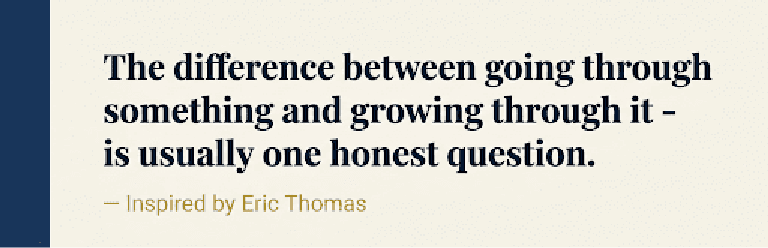
Most students don’t struggle with access to experience. They struggle with how they process it.
Two people can go through the same class, the same internship, the same project — and come away with very different levels of insight. Not because one worked harder. But because one engaged more deliberately with what was happening.
Learning does not come from experience alone. It comes from what you notice, what you question, and what you revisit after the experience is over.
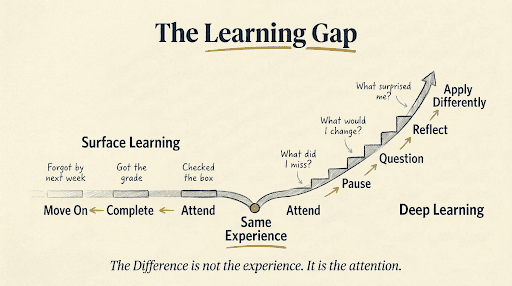
In practice, this shows up in small but important ways: Some students move on as soon as a task is complete. Others pause and ask: What actually worked here? What didn’t? Why? Some focus on getting the right answer. Others focus on understanding how the answer was built.
Over time, this creates a divergence. One path builds familiarity. The other builds judgment.
And in the long run, it is not the number of experiences that shapes growth. It is the quality of thinking applied to them.
Better questions do not come from being smarter. They come from being more honest about what you do not yet know. And that honesty, practiced consistently, changes the trajectory of how someone learns.
Why This Matters More Now
We are living through a period where information is abundant and access to knowledge is nearly universal. In that environment, the ability to absorb facts matters less than the ability to interpret, reflect, and apply.
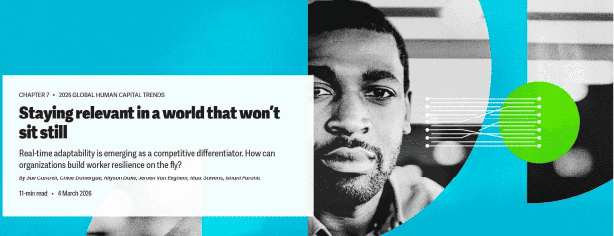
Deloitte's 2026 Global Human Capital Trends report found that only 8% of organisations believe they effectively meet the continuous learning needs of their workforce. The gap is not about access to content. It is about building the habits of reflection and adaptation that turn content into capability.
Harvard Business Review's research on curiosity in the workplace makes a related point: questioning is a uniquely human skill, and organisations that foster it consistently outperform those that reward only execution. In an age where AI can process faster than any team, the professionals who will matter most are those who know how to ask what has not yet been asked.
This is not only a workplace insight. It begins in the classroom.
Also Worth Listening
To go deeper on how learning actually happens:
- 1. Hidden Brain (NPR) — "How Our Brains Learn"Shankar Vedantam explores why great teachers and learners do more than transmit information. The episode looks at how emotional attention, developmental awareness, and the right kinds of questions shape whether an experience actually changes how someone thinks.
- 2. The Knowledge Project with Shane Parrish — Farnam StreetParrish's entire podcast is built around one premise: the best way to get better at thinking is to study how the sharpest minds ask questions and make decisions. A good place to start is any episode on mental models — and how reflection turns experience into judgment.
What This Looks Like During an MBA
In any MBA program, students are placed into similar environments. The same case discussions, the same group projects, the same pressure of deadlines and evaluation.
Yet the range of learning outcomes is wide.
Some students treat a group project as a task to complete. Others treat it as a window into how they collaborate, communicate, and handle disagreement. Some finish an internship with a certificate. Others finish it with a clearer understanding of where they need to grow.
At FIIB, this difference is visible early. The classroom is designed to be participatory. Students are expected to articulate, challenge, and apply ideas in real time. But the students who extract the most from that environment are not always the most vocal. They are the ones who pause. Who revisit. Who ask themselves what they missed the first time.
That kind of learning is harder to measure. But over time, it becomes the most visible form of professional maturity.
Ps. As an MBA student in my IIM Bangalore classroom, I often found myself thinking about what question would make me sound smart. I see the same instinct in many students today. It’s natural. But the shift happens when the question changes: From "How do I sound?" To "What am I not yet understanding?"
3–2–1: Learning More from the Same Experience
- 01. Asking "what did I miss?" after every experience:
The best learners do not assume they understood everything. They revisit with fresh eyes. - 02. Noticing process, not just outcome:
How you worked matters as much as what you delivered. Growth hides in the how. - 03. Seeking perspectives that challenge your own:
Learning accelerates when you stop surrounding yourself only with agreement.
- 01. After your next class or meeting, write one question you did not ask but wish you had.
Not for anyone else. For yourself. The habit of noticing what you missed trains a kind of attention that compounds. - 02. Ask one peer: "What did you see that I did not?"
This is harder than it sounds. But it is one of the fastest ways to surface blind spots and deepen your own reflection.
If two people go through the same experience, what determines who learns more?
Book Recommendation
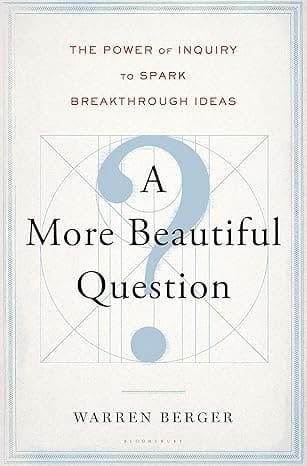
A More Beautiful Question — Warren Berger
Berger makes a point in this book that I wish more students should hear early:
The people who change industries, build new things, or solve what others could not are rarely the ones with the most answers. They are the ones who refused to stop questioning.
He calls it the "Why? What if? How?" cycle. It sounds simple, but it is surprisingly rare in practice. Most professionals stop at the first reasonable answer. The ones who keep asking tend to see what others miss.
I would recommend this to any student who has ever felt they are "doing everything right" but not growing as fast as they expected. The issue might not be effort. It might be the questions you have stopped asking.
MBA takeaway:
The students who learn the most are not those who arrive with the best answers. They are those who keep refining the questions they ask of themselves, their work, and their environment.
In Practice: Questioning and Reflection
in Action

Case Study 1 - Learning deepened after the project ended.
At SIP Mela 2026, Pamela and her team worked with V-shesh, an impact enterprise focused on disability inclusion. Their project examined how inclusive employment and skill development can transform lives.
But what stood out was Pamela's reflection afterward: learning did not end when the project was completed.
It deepened when she had to explain her ideas to others, question her own understanding, and consider perspectives she had not initially accounted for. That is the kind of learning that stays.

Case Study 2 - Five lessons from one event.
As Debate Event Head at Samavesh 2026, Bhumika faced self-doubt about participation and event success. What made her experience distinctive was not the outcome. It was what she extracted from the process.
She identified five specific professional lessons: about trust building confidence, about process mattering more than panic, about emotional management under pressure, and about how value attracts the right audience.
Most students who organise events remember the event. Bhumika remembered what the event taught her about how she works.
Extend the Learning
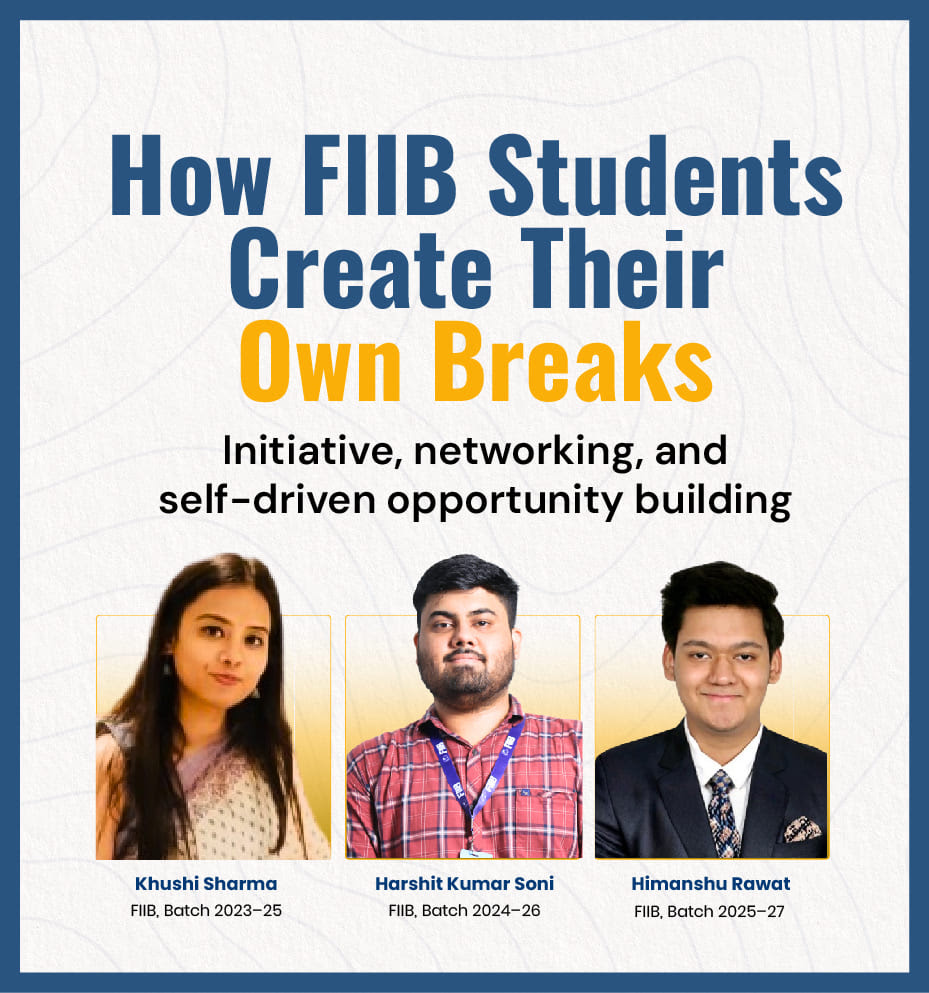
Upcoming Webinar
How FIIB Students Create Their Own Breaks
Initiative, networking, and self-driven opportunity building.
Quite apt for this week’s theme, our Sunday webinar features a simple contrast: Some students wait for the campus drive. Others start building visibility, reaching out, competing, and positioning themselves early. Same institution. Same resources. Different questions about what is possible.
In this session, three FIIB students - Harshit Kumar Soni (Batch 2024–26), Khushi Sharma (Batch 2023–25), and Himanshu Rawat (Batch 2025–27) - share how they created opportunities through proactive networking, competitions, and preparation, instead of waiting for them to arrive.
Date: 19th April 2026 | Time: 07:00 PM onwards
Thought to Carry Forward
Growth compounds in conversation.
If you’re a current student, where do you feel yourself plateauing?
If you’re considering FIIB, what kind of stretch environment are you looking for?
Reply and tell us. I read every response, and many of them shape what we build next. I’ll send a copy of the book featured in this issue to a few readers who share thoughtful responses.
And if this sparked something useful, forward it to someone who takes growth seriously.
Just send them this link.
Let’s build sharper together.