The Feedback You're Avoiding Is Probably Your Next Breakthrough

Think Forward is a short weekly note on careers, learning, and leadership in a changing world of work. Written by FIIB President Radhika Shrivastava, it shares practical ideas, frameworks, and real stories to help students think more clearly about their professional journeys.
I remember receiving a piece of feedback early in my career. At that point, things were going VERY WELL. I had risen quickly at the IFC-World Bank, and that, in many ways, was the problem.
Because when you think you're doing well, you're not really looking for feedback. You're looking for confirmation.
So when the feedback came, I listened, nodded, and even said, "That's helpful." But internally, I didn't really agree. Over the next few days, I found myself quietly building a case; why the situation had been different, why the context mattered, why this didn't really reflect how I worked.
And because everything else seemed to be going well, it was easy to move on. That's the subtle trap. When things are working, feedback feels optional. And the more confident you become, the easier it is to filter out anything that doesn't fit the story you already have about yourself.
A 10- Second Check
Let's pause here and quickly take stock of where you are: Tell me, when someone gives you tough feedback, what's your first instinct?
Just reply with A / B / C / D. Curious to see where this community leans.
The Big Idea: The Success Blind Spot
What I described above isn't just a personal tendency. It's something I've seen play out across classrooms, teams, and early careers, especially among people who are doing well.
Take students, for instance. Most say they want feedback, and they do. They actively seek it out when something hasn't gone well, when they're unsure, or when they're trying to figure things out.
But something shifts when things start working.
When grades are strong, presentations land, and you begin to be seen as someone who is doing well, feedback starts to feel different. It is no longer just about improving a skill. It begins to feel like a comment on how you are showing up.
And that is where resistance begins. Not the obvious kind, but quieter forms. You listen, but do not really engage. You agree, but do not act. You explain it away as context. Because at that point, you are no longer really looking for direction. You are trying to protect what is already working.
That is the paradox.
Feedback is hardest to hear not when you're struggling, but when you think you're succeeding.
Why This Matters
That discomfort has a name in educational psychology. Lev Vygotsky called it the zone of proximal development. More recently, it has been described as the stretch zone, the space between what you can do comfortably and what you have not yet proven to yourself you can do.
It is where learning actually happens. But it rarely feels like learning in the moment. It feels like falling short.
Here is where the blind spot becomes costly.
When you are doing well, you tend to stay within what already works. You rely on strengths that have brought you success so far. Feedback, especially the uncomfortable kind, pushes you out of that zone. It takes you into areas where you are less certain, less polished, less confident.
And that is precisely why it is easy to ignore.
But growth does not happen inside what is already working. It happens in that stretch.
Nadella captured this shift when he asked Microsoft employees to stop proving themselves and start improving themselves. The discomfort that followed was not a sign of a failing culture. It was the culture beginning to grow.
If you filter out the feedback that points you toward that stretch, you stay within what is familiar. You continue to perform. But you stop evolving.
Why This Matters Now
The World Economic Forum's Future of Jobs Report 2025 identified resilience, flexibility, and agility as among the most critical capabilities for the global workforce. The report estimates that over 40 percent of current workplace skills will need to be transformed in the next five years. In other words, the ability to absorb input, adjust, and keep moving is no longer a soft advantage. It is a professional requirement. And yet, most workplaces are not built to support this.
Gallup's 2026 State of the Global Workplace report found that only 44 percent of managers globally have received formal management training. The people expected to give feedback are often not equipped to give it well, and the people receiving it have rarely been taught how to process it.
Research from Harvard Business Review reinforces this gap. 72 percent of professionals say receiving critical feedback is important for their career development. But only 5 percent believe they actually receive it well.
This is not a knowledge gap. It is an emotional one.
Also Worth Listening
If this made you pause and reflect, these two conversations explore the idea from a different angle.
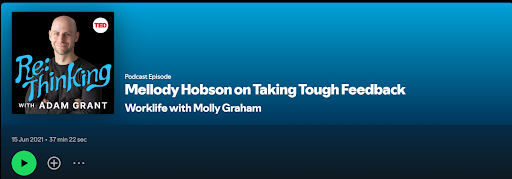
- 1. WorkLife with Adam Grant — "Mellody Hobson on Taking Tough Feedback"Mellody Hobson shares a reframing that stays with you: feedback is not something you are entitled to, it is something you are given. Once you see it that way, the question shifts from "Do I agree?" to "What can I learn here?" A thoughtful conversation on how to find the grain of truth in critique, when to discount it, and how to stay open without losing judgment.
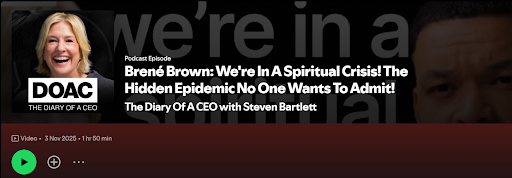
- 2. Brené Brown on The Diary of a CEO — "We're In A Spiritual Crisis"Brené Brown explores why we instinctively protect ourselves when something feels uncomfortable. Her work on courage and vulnerability offers a useful lens here. If feedback feels difficult, it is often because it asks you to lower that protection, even briefly. Her central point is simple: vulnerability is not weakness. It is what allows growth to happen.
Why This Matters For You
Coming back to my own experience, for a while I rode that wave. I was working hard, delivering, and things were moving in the right direction. The signals were positive, which made it easy to believe that my approach was working exactly as it should.
Looking back, I can see that I had quietly started filtering out feedback that challenged how I showed up, not just what I delivered. Over time, something began to feel slightly off. Conversations did not land as expected. I was getting to outcomes, but with more friction than necessary. And at times, I sensed that colleagues were choosing their words more carefully around me.
That was the signal. Not just that I was missing feedback. But that I was making it harder for others to give it. I had lost an edge that had helped me grow in the first place. The willingness to hear what was uncomfortable and act on it.
I was able to recover because someone chose to say it clearly, early enough for me to do something about it. That made a difference.
Not everyone gets that kind of intervention. Which is why this matters. Because the feedback that changes your trajectory is not always louder or clearer. Sometimes, it is already there. Held back. Softened. Or left unsaid. Especially when things are going well.
3-2-1: The Feedback You're Avoiding
- • You are hearing feedback, but not really engaging with it.
You agree in the moment, but nothing changes afterward. - • Things are working, but with more friction than they should.
Outcomes are fine, but conversations feel harder than necessary. - • You find yourself explaining feedback away.
Context, timing, people. It feels reasonable, but the pattern keeps repeating.
- • After your next piece of feedback, write down one thing it is asking you to change. Not how it felt. Just what it points to.
- • Ask one person you trust: "What is one thing I do that might be holding me back, even if it is working right now?"
What is one piece of feedback you've heard more than once, but still haven't acted on?
Book Recommendation
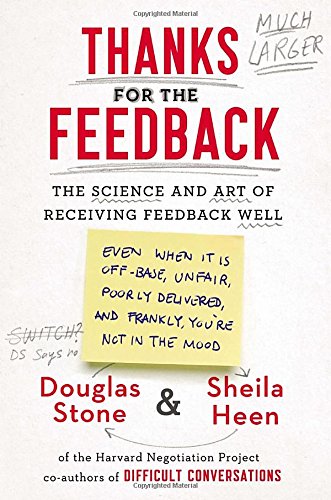
Thanks for the Feedback by Douglas Stone & Sheila Heen
Most books about feedback are written for the person giving it. This one is different. Douglas Stone and Sheila Heen, both lecturers at Harvard Law School, focus entirely on the receiver's side. Their central insight is simple. We have two competing needs. We want to learn and grow. But we also want to feel accepted and respected as we are right now. Feedback sits exactly at that tension.
What makes the book especially useful is their idea of three triggers that cause us to reject feedback, even when it is valid.
- Truth triggers. We disagree with the content.
- Relationship triggers. We react to who is giving it.
- Identity triggers. It challenges how we see ourselves.
That third one is the most relevant here. The reason feedback can feel difficult is not always how it is delivered. It is that it asks us to revisit something we thought was already settled about ourselves. That is where the resistance comes from. Learning to notice which trigger is active is the first step. It helps you hear feedback at its actual size, not at the size your reaction makes it.
- • Feedback resistance is rarely about the feedback.
• It is usually about which trigger it hits. - • Learning to separate the three is one of the most useful professional skills you can build before entering the workplace.
In Practice: Feedback and Stretch in Action

Case Study 1: From knowing concepts to being able to defend them.
During the Corporate Mentorship Programme, Rachita worked on employer branding and hiring architecture. The shift she describes is telling: she moved from descriptive, assumption-based thinking to work that had to be validated and defended.
Her mentor offered structured guidance and honest feedback. Her faculty pushed her to think better, work harder, and raise her standards. At the Grand Finale, a panelist told her she had what it takes to become an excellent HR Generalist. She calls that feedback meaningful, but also humbling.
That combination, pride and responsibility arriving together, is what stretch feels like from the inside.

Case Study 2 - Growth happened when the comfortable options ran out.
Himanshu secured an internship in a Founder's Office in Bangalore, a role built on business development and strategic initiatives. It was not a conventional placement. It required him to operate with ambiguity, take initiative without a playbook, and apply knowledge in situations where there was no clear precedent.
His reflection is direct: growth happened outside the comfort zone. Not from lectures or textbooks, but from putting himself in rooms where he had to figure things out in real time.
Extend the Learning
There may be no better example of the stretch zone than deciding to build something from nothing.
Every founder has a version of this story. The pitch that did not land. The mentor who said "your thinking is not clear enough yet." The early customer who walked away. The ones who grow through it are the ones who learn to hear feedback as curriculum, not verdict.

From MBA to Founder
Turning ideas into ventures and ambition into ownership
FIIB's entrepreneurial alumni share how they moved from student to founder, navigating risk, funding, strategy, and early growth. Discover how MBA networks, mentors, and structured thinking support entrepreneurial journeys, and what mindset shifts are required if you aspire to build rather than be placed.
Date: 26th April 2026 | Time: 05:00 PM onwards
Thought to Carry Forward
Satya Nadella did not transform Microsoft by telling people they were wrong. He shifted the question from proving to improving.
That is what good feedback does at its best. It does not take away from what is working. It reveals what you may be overlooking, especially when things are going well. The discomfort is real. But it is often a signal, not a setback.
Reply and tell us. I read every response, and many of them shape what we build next. I'll send a copy of the book featured in this issue to a few readers who share thoughtful responses.
Because the feedback that helps you grow is not always the easiest to hear. It is the easiest to filter out.
If this resonated, forward it to someone who could use the reminder.
Let's build sharper together.