

Why Most MBA Students Plateau
Welcome to Think Forward, FIIB's newsletter for students, alumni, and professionals. Each issue, we bring you ideas, frameworks, and stories that stretch your thinking. Because growth never stops — unless you let it.
⚡ A 10-SECOND CHECK
In the last 30 days, your biggest growth came from:
The Big Idea: The Comfort Curve
The first 90 days of an MBA are electric.
New people. New frameworks. New ambition.
Then something subtle happens.
Not failure. Not burnout. Not disengagement.
But Plateau.
MBA life mirrors this.
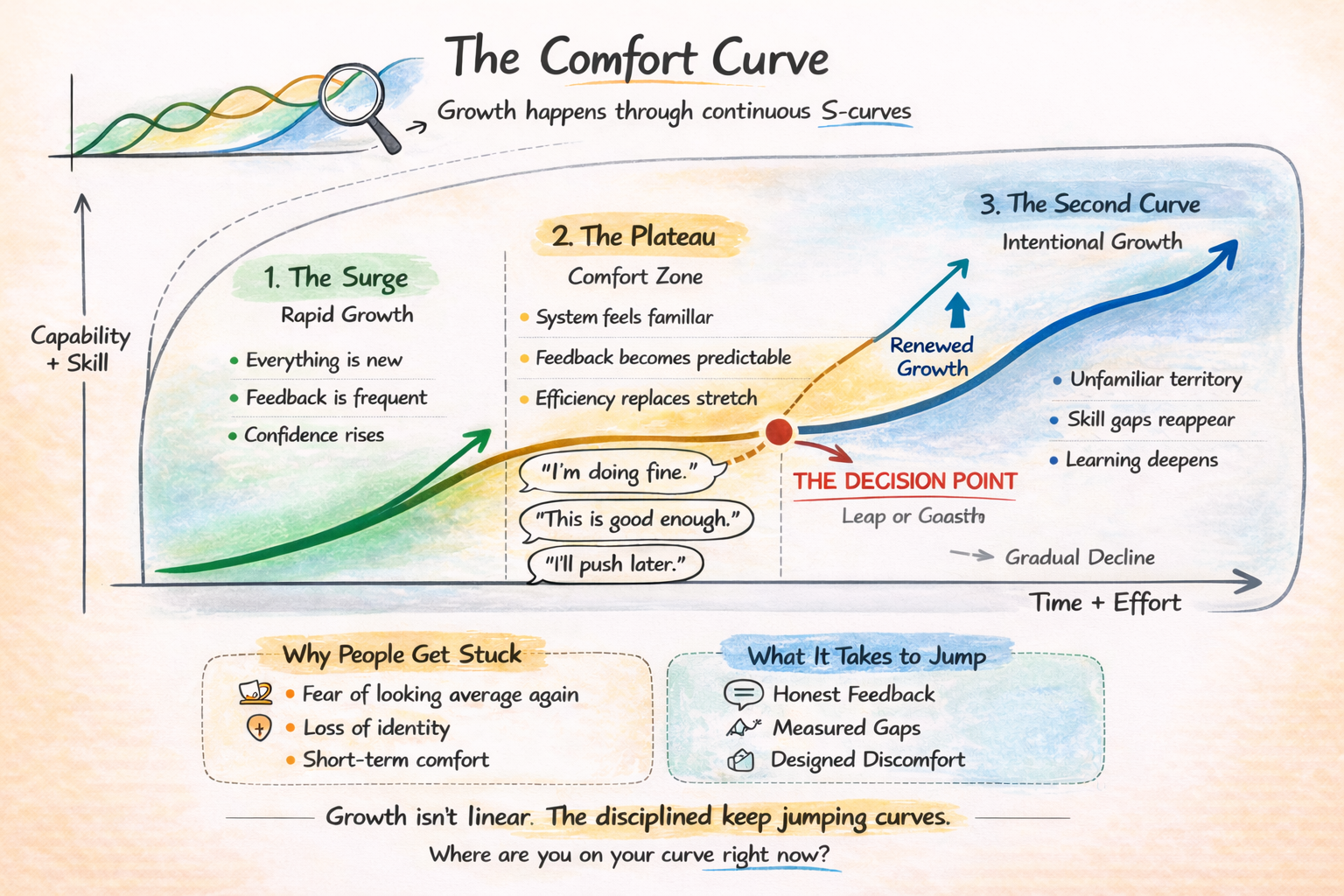
The first term stretches you. By second term, you've figured out the system. By third, you're efficient — efficient at assignments, fluent in frameworks, comfortable in conversations.
Efficiency feels like competence. And that is where growth slows.
The issue is rarely intelligence. It is the absence of designed discomfort.
Athletes call it progressive overload. Japanese manufacturers institutionalised it as Kaizen. Neuroscience calls it neuroplasticity.
Your brain does not grow because you attend classes.
It grows because you struggle intelligently.
Olympic champion Eileen Gu once described training her brain the same way she trains her body — by deliberately seeking discomfort. Watch her explain it here →

This is not about motivation. It is about biology.
Neural pathways strengthen under friction — not familiarity.
Leadership thinker Stephen Covey often described personal growth through the S-Curve: rapid early learning, followed by flattening unless you deliberately step into the next curve.
The plateau is not a problem. It is a signal. A signal that your current system is no longer stretching you.
Look at companies like Zoho. Its scale didn't come from breakthrough bursts. It came from institutionalised improvement after early momentum faded. In a recent conversation, its founder Sridhar Vembu reflected that India's next 20 years will shape the next century.

3–2–1: Breaking the Plateau
- 1. Performance improvement slows when feedback becomes predictable.
- 2. High-growth firms build structured iteration loops after early success.
- 3. Neuroplasticity strengthens under challenge, not repetition.
- • Ask one professor or mentor: "What is the single biggest gap you see in me right now?"
- • Pick one recurring task (presentations, GDs, case analysis) and track a measurable metric.
Where have you become efficient instead of sharper?
Book Byte

Book Byte: Atomic Habits — James Clear
Most people misunderstand compounding. It doesn't feel dramatic while it's happening.
Clear's central idea is simple: If you improve by 1% daily, you're nearly 37x better in a year. But the real insight isn't the math. It's this: Progress accelerates when you design systems that force small, repeatable stretch.
Plateau happens when habits maintain performance instead of expanding capacity.
MBA takeaway:
Don't chase transformation moments.
Design feedback loops that compound skill.
In Practice: Anti-Plateau in Action

One of our second-year students recently secured a job offer. That's where many people stabilise. He didn't.
Instead, he began working on a startup idea born out of his own painful experience of navigating business school choices — misinformation, misalignment, decision anxiety.
Rather than enjoy placement comfort, he turned frustration into design. That's what anti-plateau looks like: Security plus stretch.
Growth does not stop when outcomes are secured.
It shifts into new arenas.

A first-year student faced multiple rejections in a competitive challenge cycle. Instead of switching competitions, she analysed:
- • What type of questions she struggled with
- • Where her articulation broke down
- • How top winners structured responses
Over weeks, she rebuilt her preparation approach.
The result: She went on to win a prestigious LinkedIn competition.
No sudden talent spike. Just structured recalibration.
That is neuroplasticity in practice.
Extend the Learning

This week, we're hosting a panel featuring FIIB alumni working at the Big Four — Deloitte, PwC, EY, and KPMG.
If there is one thing these environments demand, it is this: You cannot plateau.
Every project stretches you. Every review cycle measures you. Every year resets the curve.
This panel will explore how professionals sustain skill velocity in high-accountability systems. Because in fast-moving ecosystems, plateau is expensive.
Details to register or get recording in your inbox here →Closing
Growth compounds in conversation.
If you're a current student — where do you feel yourself plateauing?
If you're considering FIIB — what kind of stretch environment are you looking for?
Reply and tell us. I read every thoughtful response — and many of them shape what we build next.
And if this sparked something useful, forward it to someone who takes growth seriously.
Let's build sharper together.
Warm regards,
Dr. Radhika ShrivastavaPresident & CEO, FIIB