

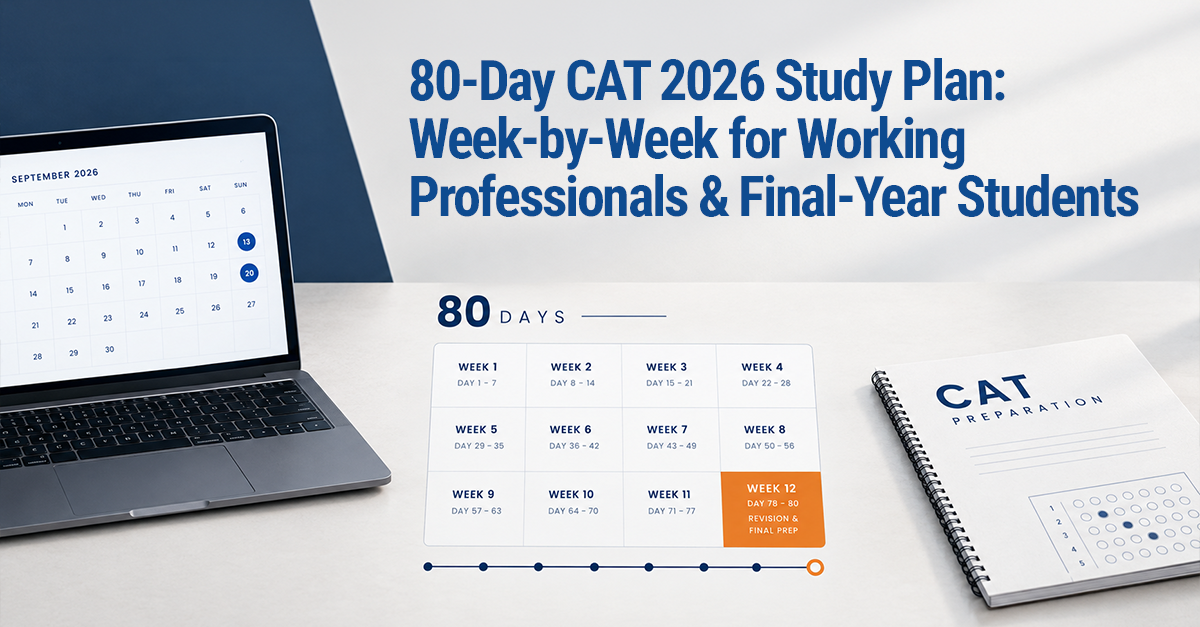
CAT 2026 is on 29 November. If you are reading this with roughly 80 days on the clock, you are essentially looking at CAT preparation in 3 months, give or take a week. The honest question is not whether that is enough time. It is whether the next 80 days follow a plan or just happen to you.
Eighty days, whether you have 2 hours a day around a full-time job or 5 hours a day as a final-year student, is enough to build real exam readiness if the time is structured. It is not enough to wing it. Below is a single week-by-week table covering both tracks side by side, so you can see exactly where a working professional’s week differs from a final-year student’s, and where they are identical.
Before anything else: if you have not registered for CAT 2026 yet, that deadline is separate from and earlier than exam day. Registration closes 22 September at 5:00 PM at iimcat.ac.in. Handle that first. Everything in this plan assumes registration is done.
Confirm your CAT 2026 registration status at the official site: iimcat.ac.in
How the 80 days are structured
CAT preparation in 3 months works best when it is broken into phases rather than treated as one long, undifferentiated stretch of studying. The plan runs across roughly 12 weeks, counting down from 29 November. Four phases sit underneath the week-by-week table: foundation (weeks 1-3), topic-wise practice (weeks 4-7), mock tests with error analysis (weeks 8-10), and final revision with exam simulation (weeks 11-12). The table below is the full breakdown, with a dedicated column for each track’s daily focus and a separate column for the mock-test schedule both tracks should follow.
The week-by-week plan: both tracks, one table
| Week | Dates | Days to Exam | Working Professional (~2 hrs/day) | Final-Year Student (~5 hrs/day) | Mock Test Schedule |
|---|---|---|---|---|---|
| 1 | 10-16 Sep | 80-74 | Diagnostic mock (cold, no prep). Daily 60-90 min block, fixed time. Basic concept revision across VARC, DILR, QA. | Diagnostic mock (cold). 4-5 hrs daily. Deeper concept revision + start daily RC reading habit. | 1 full diagnostic mock, untimed review. |
| 2 | 17-23 Sep | 73-67 | Continue daily block. Rotate VARC/QA/DILR across weekdays. Identify weakest section from diagnostic. | Continue concept revision. Add timed topic sets in QA (Arithmetic, Algebra basics). | No mock this week; review diagnostic in depth. |
| 3 | 24-30 Sep | 66-60 | Weekend: 2-3 hr session on weakest section. Weekday: 1 topic set/day. | Daily timed topic sets across all 3 sections. Build reading stamina for RC. | No mock; foundation consolidation. |
| 4 | 1-7 Oct | 59-53 | Start topic-wise practice: 3-4 sets/week per section, rotated. | Same rotation, higher volume: 5-6 sets/week per section. | 1st sectional mock (weakest section only). |
| 5 | 8-14 Oct | 52-46 | Continue topic rotation. Track topic-wise accuracy from week 4 onward. | Continue rotation + 1 sectional mock in each of the 3 sections this week. | 1 sectional mock (working prof); 2-3 sectional mocks (final-year). |
| 6 | 15-21 Oct | 45-39 | Topic practice continues. Begin timing every practice set strictly. | Topic practice continues at higher depth. All sets timed. | 1 sectional mock, reviewed same week. |
| 7 | 22-28 Oct | 38-32 | Final week of pure topic practice. Consolidate weak topics flagged so far. | Final week of topic practice. Start light full-length mock prep. | 1 sectional mock; transition prep for full mocks next week. |
| 8 | 29 Oct-4 Nov | 31-25 | Phase shift: 1 full-length mock this weekend + deep error-log review on a weekday evening. | 2 full-length mocks this week, each followed by deep review. | Wk prof: 1 full mock. Final-year: 2 full mocks. |
| 9 | 5-11 Nov | 24-18 | 1 full-length mock + error-log review, focused on previous week’s flagged gaps. | 2 full-length mocks + error-log review, same cadence as week 8. | Wk prof: 1 full mock. Final-year: 2 full mocks. |
| 10 | 12-18 Nov | 17-11 | 1 full-length mock (final one of this phase) + consolidate error log into a short revision list. | 2 full-length mocks (final of this phase) + consolidate error log. | Wk prof: 1 full mock. Final-year: 2 full mocks. |
| 11 | 19-25 Nov | 10-4 | Stop new content. Revise only error-log topics. 1 mock under exact exam-day conditions. | Stop new content. Light, targeted revision only. 1 mock under exam-day conditions. | 1 exam-simulation mock, both tracks. |
| 12 | 26-29 Nov | 3-0 | Light review only. Rest. No new mocks. Confirm exam-day logistics. | Light review only. Rest. No new mocks. Confirm exam-day logistics. | No mocks. Taper to exam day, 29 Nov. |
Countdown anchored to the verified CAT 2026 exam date: 29 November 2026. Adjust calendar dates to your actual start date using the ‘Days to Exam’ column.
Why the table is structured this way
The two tracks converge more than they diverge. Both follow the same four-phase arc: foundation, topic practice, mocks, revision. That arc is what makes CAT preparation in 3 months realistic for almost anyone, regardless of how many hours are available each day. The difference between the two tracks is volume and depth within each phase, not the phase sequence itself. A working professional does not need a different plan. They need the same plan compressed into fewer weekly hours, with consistency protected more carefully.
Weeks 1-3 (foundation) matter more than most aspirants expect. A cold diagnostic mock in week 1, before any prep, tells you your real starting point. Skipping this step and diving straight into topic practice means you spend weeks 4-7 without knowing whether you are actually addressing your weakest areas.
Weeks 4-7 (topic-wise practice) is where the working-professional and final-year tracks diverge most in volume. A working professional doing 3-4 topic sets per section per week, against a final-year student’s 5-6, is not a lesser plan. It is a realistic plan. Track your topic-wise accuracy as you go. By week 7, the data should tell you where your remaining weeks of practice need to concentrate, rather than guessing.
Weeks 8-10 (mocks and error analysis) is the highest-leverage phase in the entire 80 days, for both tracks. This is where score improvement actually happens. A working professional taking 1 full mock per week with deep review typically outperforms someone taking 2 mocks with shallow review. The review is what converts a mock attempt into an actual skill improvement, not the mock itself.
Weeks 11-12 (final revision) is deliberately light on new content for both tracks. The final-year track does not get more mocks here; it gets more rest. Overloading the last two weeks tends to produce fatigue on exam day rather than sharper performance, regardless of how many hours you have available.
A note on the error log
The single most underused habit across both tracks is a running error log: every mistake from every practice set and mock, categorized by type (concept gap, timing issue, careless error, wrong set selection). Start it in week 4, when topic-wise practice begins, and keep it updated through week 10. By the time you reach weeks 11-12, that log tells you exactly what your limited final revision time should target, instead of a vague sense of ‘I should review everything.’
Adjusting the plan to your actual start date
If you are reading this on a date other than 10 September 2026, the calendar dates in the table will not line up with your calendar. Use the ‘Days to Exam’ column instead. Count back from 29 November to find where you currently sit, and start your plan at the corresponding week row. An aspirant starting with 60 days left, for example, effectively begins at week 4 of this table and compresses the foundation phase into a faster 1-week pass rather than 3 weeks.
What comes after the plan
Once your CAT percentile is in hand, it becomes one input in a broader PGDM or MBA application, alongside your academic profile, work experience, and interview performance. FIIB‘s PGDM and PGDM-FM programs, for the 2027 intake, evaluate CAT scores as part of a fuller admissions process. It is worth understanding a program’s full evaluation criteria while you still have prep time left, so you know what else to be building alongside your CAT score over these 80 days.
Fee-by-Category Table
| Category | CAT 2026 Application Fee |
| General | Rs. 2,700 |
| EWS | Rs. 2,700 |
| NC-OBC | Rs. 2,700 |
| SC | Rs. 1,350 |
| ST | Rs. 1,350 |
| PwD | Rs. 1,350 |
Stay on Track: Join FIIB’s Weekly CAT Strategy Webinar
A study plan works best with regular course correction along the way. FIIB runs a free CAT Test Strategy Webinar every Sunday, where faculty and alumni cover mock-test analysis, sectional strategy, and how to adjust your prep as you move through the phases above.
Register for the CAT Test Strategy Webinar →
FAQs
Q: Is CAT preparation in 3 months realistic?
Yes, for a focused aspirant following a phased plan: foundation, topic-wise practice, mock tests with error analysis, and final revision. Roughly 80 days, is enough time when the plan is structured, not left to chance. The determining factor is not total hours but whether the mock-test and error-analysis phase gets genuine attention, since that is where most score improvement happens.
Q: How should working professionals structure a CAT study plan with only 2 hours a day?
Prioritize a consistent daily 60-90 minute block over irregular longer sessions. Rotate VARC, DILR, and QA across weekdays rather than covering all three daily, and use weekends for longer sessions: sectional or full-length mocks and deep error review. Consistency matters more than session length.
Q: How many mock tests should I take in an 80-day CAT prep plan?
From week 8 onward (roughly the final 3 weeks before revision), working professionals should aim for 1 full-length mock per week, totaling 3-4 mocks with deep review each. Final-year students with more available hours can manage 2 mocks per week in the same phase, totaling around 6. Review quality matters more than mock quantity.
Q: What is the biggest mistake aspirants make in an 80-day CAT prep plan?
Spending too much time on comfortable topics and too little on genuine error analysis after mocks. A simple error log, tracked from week 4 onward and categorized by mistake type, is one of the highest-leverage habits in CAT preparation and is consistently underused.
Q: Should I keep studying new topics in the final week before CAT 2026?
No. The final 1-2 weeks should focus on revising material already covered, reviewing your error log, and one mock under exam-day conditions. New content in the final week tends to add anxiety without meaningfully improving readiness.
Q: When is the CAT 2026 exam and what was the registration deadline?
The CAT 2026 exam is scheduled for 29 November 2026. Registration closed 22 September 2026 at 5:00 PM at iimcat.ac.in.



















Leave a comment