

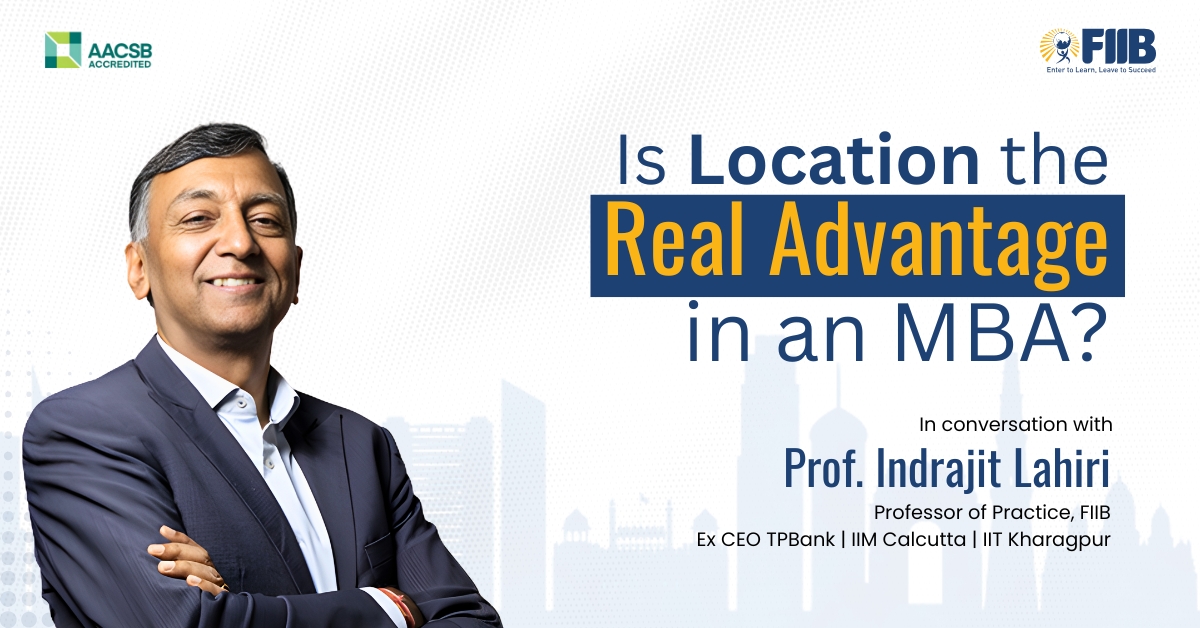
When students evaluate an MBA in Delhi NCR, the conversation often revolves around placements, salary packages, and recruiters. But what often goes unnoticed is a far more powerful differentiator — how early and how consistently students engage with companies during the program.
To unpack what “access to companies” truly means beyond the surface, we spoke with Prof. Indrajit Lahiri, Professor of Practice at FIIB, a global banking leader with over three decades of experience across Citi, HSBC, Barclays, and GE Capital.
“Everyone says Delhi NCR offers better access to companies. What does that actually mean for a student?”
That phrase is often misunderstood. Most students assume access to companies begins during placements. In reality, if you’re pursuing an MBA in Delhi NCR — especially at an institution like FIIB — access is not an event, it’s an ecosystem.
You are in one of India’s most active business corridors, with Gurugram and Noida housing consulting firms, fintech companies, global MNCs, and high-growth startups. But geography alone is not enough.
What makes the difference is how an institution integrates this ecosystem into everyday learning.
At FIIB, access is designed to be continuous. Students are not just preparing for companies — they are interacting with them, learning from them, and being evaluated by them from the very beginning.
“How does FIIB make this access visible and real for students?”
It comes down to structured, consistent engagement — not one-off guest lectures.
For instance, FIIB’s Corporate Mentoring Program (CMP) connects students with industry professionals from organizations like Unilever, American Express, Airtel, and JP Morgan. This is not symbolic mentoring.
Students work with mentors over months, set career goals, receive feedback, and even complete stretch assignments based on real business problems. That’s direct exposure to how companies think and operate.
Similarly, initiatives like the Career Pathway Simulation (CPS) bring recruiters into simulated hiring environments. Students go through evaluation processes that mirror actual recruitment — long before placement season begins.
Then you have large-scale platforms like the HR Leadership Summit, where senior HR leaders, CHROs, and talent heads engage directly with students. These aren’t passive conferences — they become spaces where students understand hiring trends, expectations, and decision-making frameworks in real time.
So access here is layered:
- Mentorship from industry leaders
- Direct evaluation by recruiters
- Exposure to leadership conversations shaping industries
“Does this interaction actually influence how students learn?”
Very strongly. In fact, it changes the intent behind learning.
When students know they are going to interact with industry professionals regularly, their approach becomes more practical and outcome-driven.
Take FIIB’s curriculum design:
- 90% of courses include analytics-driven projects
- Students work on tools like Tableau, Power BI, Python, SPSS, and AI platforms
- Learning is reinforced through 15+ business simulations across functions
But the real shift happens when this learning is validated externally.
For example, students don’t just study strategy — they apply it in live consulting projects or global competitions like the Global Scaling Challenge, where FIIB students secured a top 20 global rank working on real startup problems.
Similarly, through the Social Internship Program (SIP), students engage with organizations like Dream Girl Foundation, translating classroom concepts into measurable social impact — which later feeds into research, as seen in Anushka Tomar’s international recognition.
So the classroom is constantly being tested against real-world expectations.
“Can you share examples where this access has translated into real outcomes?”
There are several.
Take the case of Shiv Sharma, who leveraged mentorship, networking, and LinkedIn engagement to secure an internship with ITC Limited in the strategy and growth team — independently.
Or Ishan Sharma, whose leadership roles within campus ecosystems translated into a pre-sales strategy internship with Sleepwell.
These are not isolated cases. They reflect a pattern:
When students are consistently exposed to industry expectations, they become proactive rather than dependent on placement processes.
Even at a global level, students like Mansi Kaushik have gone on to represent South & Central Asia at the United Nations General Assembly Week through FIIB’s association with PRME.
These outcomes are not accidental — they are built on sustained exposure.
“How does being in Delhi NCR amplify all of this?”
It adds speed and proximity.
Opportunities don’t feel distant here. Whether it’s an internship, a corporate event, or a networking interaction — access is immediate.
But more importantly, FIIB ensures that students are not overwhelmed by the ecosystem but are strategically connected to it.
This combination is powerful:
- A high-opportunity external environment
- A structured internal system that channels those opportunities
That’s what creates acceleration in learning and career readiness.
“So by the time placements arrive, what changes for students?”
Placements stop feeling like a starting point.
Students have already:
- Engaged with corporate mentors
- Worked on real business problems
- Participated in simulations and recruiter-led evaluations
- Understood industry expectations through platforms like the HR Leadership Summit
So when they sit for placements, they are not trying to figure things out — they are leveraging what they have already built.
That’s the real advantage of pursuing an MBA in Delhi NCR with the right institutional ecosystem.
Final Thought: Access Is Not a Moment — It’s a System
In today’s competitive landscape, choosing an MBA in Delhi NCR is often seen as a strategic decision because of location.
But as Prof. Lahiri highlights, location alone does not create outcomes — structured access does.
At FIIB, access to companies is:
- Continuous, not seasonal
- Structured, not incidental
- Experiential, not theoretical
And that is what ultimately transforms access into career readiness.














Leave a comment