

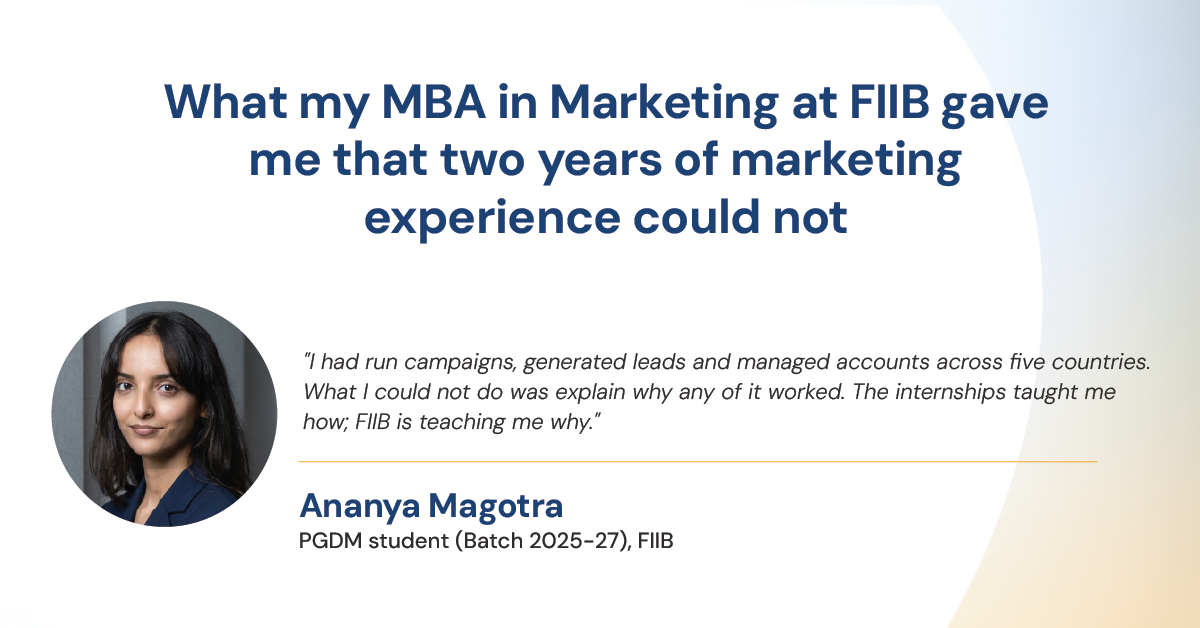
When I joined FIIB, I was not starting from zero. I had already spent two years doing marketing in one form or another. I had made outbound calls, managed social media accounts for brands, run outreach across five countries and generated over 600 leads along the way. If you had asked me then, I would have told you I had a fairly decent idea of how marketing worked.
I was wrong, though not in the way I expected to be. The work I had done was not bad work. The problem was that I had never once stopped to ask myself why some of it worked and some of it did not. I could run a campaign. I could not explain what had made it succeed, which meant I had no reliable way of repeating it on purpose.
That gap is almost invisible while you are inside a job, because a job only asks you to deliver. It shows up the moment somebody asks you to justify a decision. This is the honest reason I believe an MBA in Marketing is still worth doing even after a couple of years of work experience, and it is something I did not anticipate before I got here.
My first real lesson came from NoBrokerHood, where I was making outbound calls to generate leads. Somewhere in those hundreds of conversations I picked up something I only found the words for much later, which is that the message you put out has to match what people are already looking for. Whether somebody finds you through a Google result or picks up your call, they should hear the same thing. As I now understand it, “people do not trust brands, they trust experiences that feel familiar and honest.”
At Grynow, I managed LinkedIn outreach for brands across India, UAE, Bali, Indonesia and Bangkok, and it was the first time I saw how one channel sits inside a much bigger picture. LinkedIn was only the opening move. The real objective was carrying somebody from not knowing us at all to wanting to work with us, and no single message on a single platform does that. I helped bring in over 50 brands and we saw a 25% jump in revenue in that period, and the brands that moved fastest were consistently the ones already showing up in several places at once.
Freelancing for Kal Dekhenge as a social media manager taught me the other half of the job. I handled more than 50 pieces of content across YouTube and Instagram, from the idea all the way to scheduling, and I learnt that posting regularly is the easy part. The difficult part is deciding what to post, when and why. The question that changed how I worked was not “what should we post today” but “what does our audience actually care about this week”.
None of that came from a classroom, and I would not pretend otherwise. But there is also no version of me who could have made sense of any of it without one. Looking back at my first year at FIIB India, here are four things the program gave me that two years of doing the work simply had not:
1. The vocabulary to explain why something worked
Classes on consumer behaviour, brand building and communication gave me language and structure for things I had been doing on instinct. That sounds academic until you have to defend a plan to somebody who disagrees with you, and you discover that instinct on its own does not survive a good question. Being able to name what you are doing is what turns a habit into a method.
2. A view of the whole journey, not just my channel
On the job I could see the pattern of consistency paying off, but I could only see it from inside my own channel. Studying the customer journey gave me a frame for what I had been watching happen in a spreadsheet every week, and it changed the questions I ask at the start of a campaign rather than at the end of one.
3. The discipline to choose when resources are tight
My internship project at Saijaya Youth Trust was where this became real. We ran a fundraising campaign for a cause around girls’ education on a very small budget, and having almost no money forced us to be deliberate about every single decision, because you cannot afford to be vague when resources are tight. “When you have limited options, you stop being lazy about your choices.” Two years of work had taught me to execute quickly. That project taught me to choose well, and choosing well is the part of marketing that actually compounds.
4. The confidence to be questioned, not just to deliver
This is the one I underestimated most. Delivering work and defending work are different skills, and only one of them gets practised in a delivery role. Presentations, case discussions and group projects put me in front of people whose job in that moment was to push back, and getting comfortable with that has made me better at the work itself.
If you already have experience behind you and you are weighing an MBA degree, the worry I hear most often is that a classroom will only teach you what you already know. My experience has been almost the opposite of that. The job gave me range and the program gave me reasons, and reasons are what let you apply the same thinking to a problem you have never seen before.
The other thing I would say is simpler, which is to not wait until you feel ready. I was making cold calls before I understood the full sales process and running international campaigns before I had studied anything about global markets. Most of what I know came from doing it, getting it wrong and then working out why.
Because the question sitting behind all of marketing is actually a very simple one: how do you reach the right person with the right message at the right time? Everything else is tools and tactics that help you answer it better. The message I would like to leave you with is that experience will teach you the tools, but a program like this one teaches you the question, and you are going to need both.














Leave a comment