

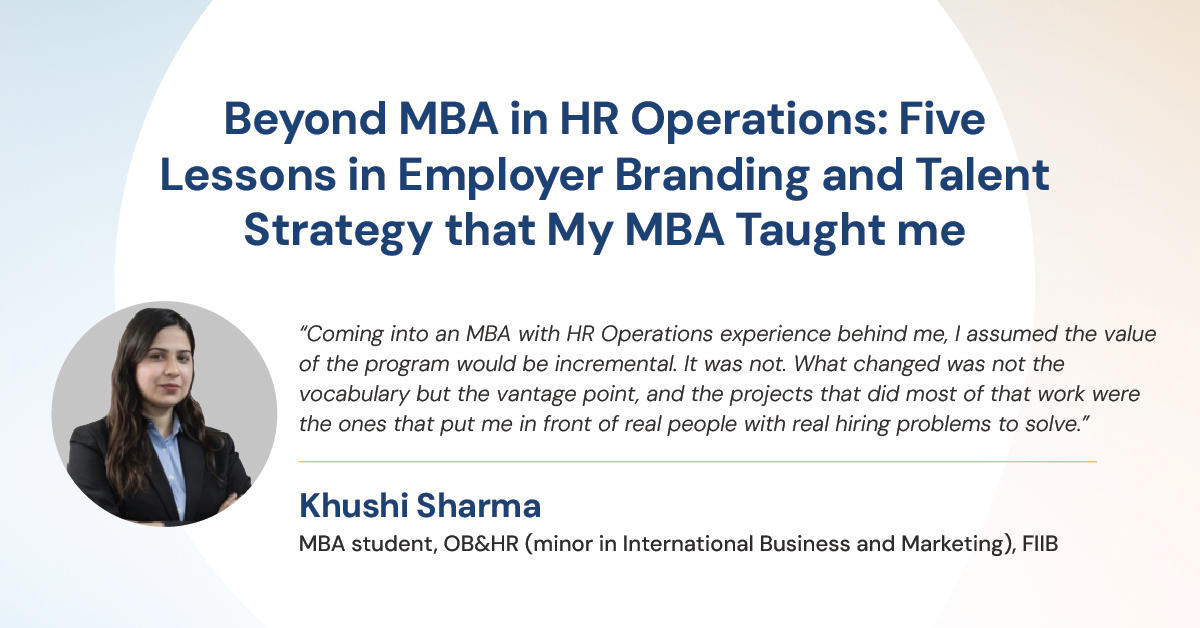
When I started my MBA in HR at Fortune Institute of International Business, I was not new to the realm of human resource management. I had already worked in HR Operations, so I arrived with a working knowledge of how the function runs day to day. What I did not have, and what I only recognised once I was here, was any real sense of the strategic side of Human Resources or of how much sits beyond operational responsibility.
I am currently specialising in Organizational Behavior and Human Resource (OB&HR), with a minor in International Business and Marketing. Alongside academics, my internship at Quest Retail (The Body Shop India) has given me practical exposure to the corporate world and, more usefully, a way of testing classroom learning against how things are actually done in industry.
Looking back at the MBA program so far, the shift has been less about learning new terms and more about learning to see the same work differently. Here are five lessons that changed how I understand HR:
1. Employer branding is a talent strategy, not a social media activity
This was the concept that surprised me most during my MBA in HR & Organizational Behavior. I had assumed employer branding was largely about LinkedIn presence and social media posts, until a faculty member explained how closely it is tied to Talent Acquisition and the overall employee experience. A company with strong employer branding attracts better talent almost as a by-product of how it operates.
Candidates today do not evaluate a salary package alone. They look at culture, engagement activities, the onboarding experience, growth opportunities and how professionally an organisation presents itself. LinkedIn engagement, employee-centric initiatives and the way workplace culture is communicated all shape how a company is read in the job market, which makes branding a hiring lever rather than a marketing one.
2. Recruitment is a lifecycle, not a vacancy to be filled
In my third semester I studied Talent Acquisition and Competency Mapping, which gave me a full view of the Talent Acquisition Lifecycle (TALC): sourcing, screening, hiring, selection, workforce planning, retention and employee experience. Seeing those stages as one connected system rather than a sequence of tasks is what changed my thinking. Recruitment stops being about filling a position and starts being about building long-term organisational strength.
3. Ten conversations taught me what a textbook could not
One faculty assignment asked us to connect with and speak to ten HR Managers about the practical challenges and strategies of their work. It remains one of the most valuable things I have done here. The problems practitioners described, and the trade-offs they make in solving them, were more textured than anything I could have taken from a chapter, and they gave me a sense of what the function actually feels like from the inside.
4. Hiring for a role from scratch is where theory gets tested
Through the Corporate Mentorship Program (CMP), my mentor set me a project to hire for a Plant Manager profile. I had to write the Job Description from scratch and work through the complete Talent Acquisition Lifecycle, which meant speaking to professionals, understanding what the role genuinely required and approaching the hiring process strategically rather than procedurally. It was hands-on in a way coursework cannot be, and it did more for my confidence in handling HR responsibility than any single class.
5. Analytics is no longer optional in HR
Analytics used to be one of my weaker areas. During the program I have learned Power BI and Python, and I am currently advancing my Excel skills alongside them. The technical learning matters, but what has come with it matters just as much: the ability to work under pressure, collaborate across several teams at once and manage competing responsibilities without dropping any of them.
For me, doing MBA in HR & OB is not only about earning a degree. It is about evolving professionally, understanding people management strategically, and learning through real projects and experiences that prepare me for the future HR world. I came to know how the function operates. I am leaving with an understanding of why it operates that way, and that is the difference I did not know I was missing.








Leave a comment