
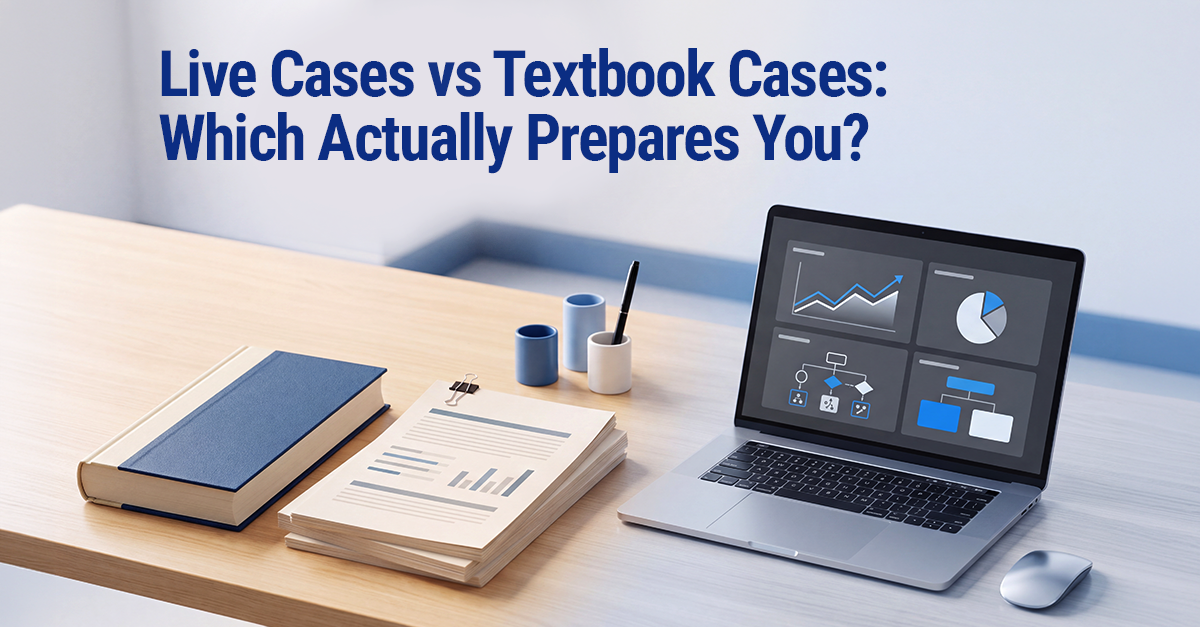
Here’s the real difference: live cases put you inside a business problem nobody has solved yet. Textbook cases hand you a problem that’s already been solved, so you can study how someone else got there. Live cases teach you to make decisions under uncertainty. Textbook cases teach you to build and apply frameworks. If you’re comparing PGDM programs, you need both in the mix, because employers aren’t just hiring for theory recall anymore. They’re hiring for judgment. FIIB‘s ActionWorks™ builds live-case exposure into the curriculum across five business problem formats.
Why This Comparison Actually Matters
Employers evaluating PGDM candidates now test judgment under ambiguity, not theory recall. Can a candidate make a sound call when the information is incomplete and the stakeholders disagree, or do they need a clean, closed problem to perform?
AI has already taken over a lot of what textbook cases used to train: structuring data, picking the right framework, drafting a first-pass recommendation.
What AI still can’t do is navigate a room where the brief keeps changing and nobody’s on the same page. That’s the exact terrain live cases put you in.
Schools that lean entirely on textbook cases end up producing graduates who can pick apart a problem that’s already been solved, but freeze when the problem is still moving. That’s not a knowledge gap. It’s a readiness gap: you can explain a decision after the fact, but you haven’t actually made one under pressure. That’s the real question behind live cases vs textbook MBA.
What Textbook Cases Actually Teach You
Textbook cases build structured thinking around a problem that has boundaries.
What They’re Good For
You’re handed a defined data set and asked to apply a specific lens, a market-entry model, a financial-ratio breakdown, whatever fits. Since the outcome’s already documented, the exercise comes down to method: did you use the right framework, and did you use it correctly.
Where They Fall Short
Because the case is closed and the ending is already known, textbook cases never test what happens when the data’s incomplete, the stakeholders disagree, or the brief shifts halfway through. And that’s usually exactly what real management decisions look like.
What Live Cases Actually Teach You
Live cases build decision-making by putting you inside a real problem that hasn’t been solved.
How They Work
An operating company brings a live problem, and here’s the thing: the company itself doesn’t know the answer yet. You’re working with incomplete data, constraints that shift, and stakeholders who are actually real, then walking away with a recommendation the company can act on.
At FIIB, this runs through ActionWorks™, part of FIIBX™, which puts students through five distinct live business problem formats over the course of the program, each tied to a current industry brief instead of an archived one.
What You Get From Live Cases That You Can’t Get From Textbooks
Comfort working with incomplete information
Practice defending a recommendation to an actual stakeholder, not a grading rubric
A front-row seat to how a brief shifts once real constraints, budget, timeline, internal politics, enter the picture
Who Should Prioritize Live-Case-Heavy Programs?
Where you land on this really depends on where you’re headed. This tends to matter most if you’re:
Targeting consulting, strategy, or general management roles, where ambiguity is just part of the job
A working professional who already has the theory down and wants applied decision practice
Preparing for a role where managing stakeholders matters as much as the analysis itself
What to Look At When You’re Comparing PGDM Programs
Here’s how the two approaches stack up across the dimensions that actually matter for choosing a program:
| Dimension | Textbook Case Led Program | Live Case Led Program | Best For |
| Problem state | Solved, documented outcome | Unresolved, real-time | Live case: ambiguity-heavy roles |
| Primary skill built | Framework application | Judgment under incomplete data | Textbook: foundational analytical grounding |
| Stakeholder exposure | Simulated or absent | Real company stakeholders | Live case: client-facing careers |
| Assessment basis | Case-write-up accuracy | Applied recommendation quality | Depends on assessed rigor, not just format |
| Curriculum example | Traditional case-method electives | ActionWorks™ within FIIBX™ | Program-specific; verify structure directly |
Frequently Asked Questions
Is live-case learning actually better for placements?
Not on its own. Employers want both: the analytical grounding textbook cases build, and the applied judgment under ambiguity that live cases build. Programs that combine both, with real assessment behind them, tend to signal stronger readiness.
How long before you actually see the benefit of live-case learning?
It builds up over time rather than from any single exercise. You need repeated exposure to different business contexts and different types of stakeholders before the decision-making under ambiguity actually sinks in.
Can working professionals benefit from live-case PGDM programs?
Yes, often more than fresh graduates. Working professionals usually already have solid analytical grounding from their prior roles, so live cases add exactly what’s hard to build through self-study: real practice with ambiguity and stakeholder navigation.
What’s the risk of a PGDM program that only uses textbook cases?
Not a knowledge gap, a readiness gap. You come out able to analyze a solved problem correctly, but untested on what happens when the data’s incomplete or the brief shifts, which is closer to how real management decisions actually play out.
Do Indian business schools commonly use live cases?
It varies a lot, and there’s no standard across Indian B-schools. Don’t assume based on reputation, ask any program directly what share of the coursework involves live, unresolved company problems versus documented case studies.











Leave a comment