

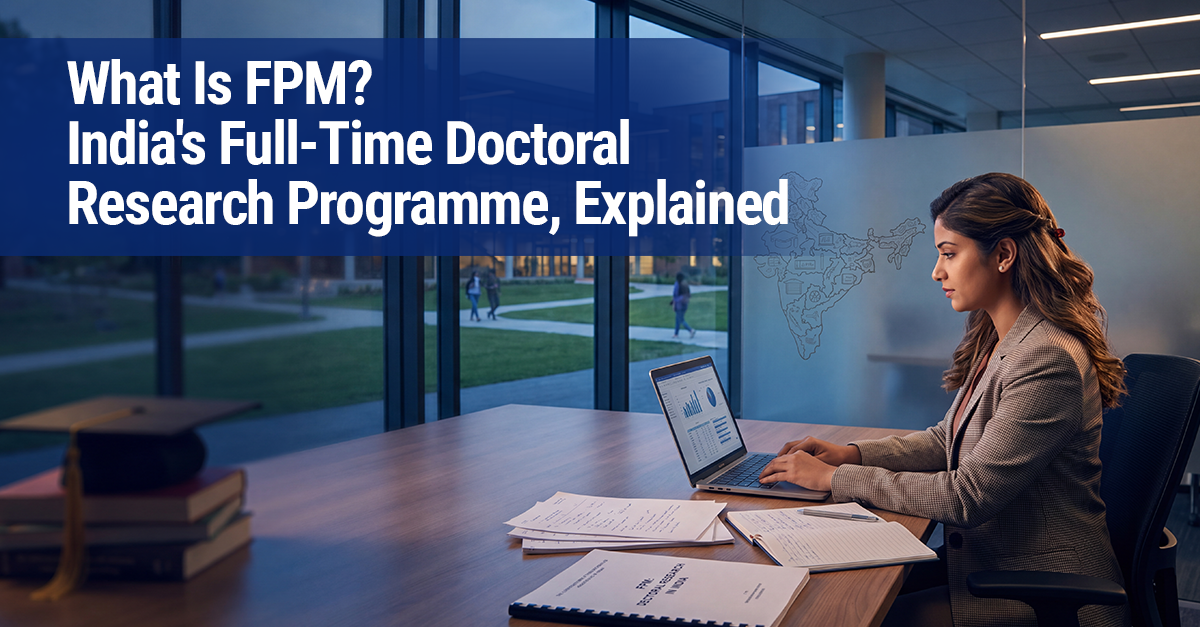
FPM, or Fellow Program in Management, is India’s full-time doctoral research degree in management studies, equivalent in academic standing to a PhD. It is offered by AICTE-approved management institutions, including AACSB-accredited schools like FIIB, and typically spans 4 to 5 years covering coursework, a comprehensive examination, and a thesis based on original research.
Graduates use the title “Fellow” rather than “Dr.,” though both are doctoral-level qualifications in practice.
If you are a management graduate or working professional considering a research career in academia, or in a policy or consulting role that requires deep domain expertise, FPM is the credential to understand.
FPM in management: what the program actually covers
Most FPM programs in India follow a two-phase structure.
- Phase 1, coursework: rigorous courses in research methodology, statistics, and your chosen area of specialization. Typically 1 to 2 years, ending with a comprehensive examination that tests whether you are ready to conduct independent research.
- Phase 2, thesis: you identify a research problem, develop a research design, collect and analyze data, and produce an original contribution to management knowledge. This is where most of the time goes, realistically 2 to 3 years for most candidates.
Total FPM course duration: typically 4 to 5 years from admission to degree completion. Some candidates finish in 4 years; some take longer, especially if they are balancing research with other commitments.
FPM vs PhD in management: are they the same?
In practice, yes. FPM and PhD in Management are treated as equivalent doctoral qualifications by the University Grants Commission (UGC) and by employers in both academia and industry.
The naming difference comes from institutional origins. Business schools that are not affiliated with a university cannot award a PhD, which is a university-granted degree. They award the FPM instead, which is an AICTE-approved equivalent. IIMs, for example, award the Fellow Program in Management, not a PhD, and those degrees carry the same standing as PhDs from IITs or central universities.
If you are comparing FPM vs PhD in Management for career purposes, the functional difference is small. The substantive differences are in research culture, specialization depth, and the specific institution’s faculty expertise and research output.
FPM admission process: how it works
FPM admission in India typically requires a postgraduate degree in management or a related field. Most programs accept candidates with a valid CAT, GMAT, or UGC NET score, though some institutions conduct their own entrance assessment.
The typical FPM admission process runs in stages:
- Application and document review
- Written test or research aptitude screening
- Personal interview where faculty assess your research interest and potential
What faculty look for in an FPM interview is different from what a PGDM interview tests. They want to see a research question you care about, some evidence that you have thought about how to investigate it, and a sense of whether your interest aligns with a faculty member’s area of expertise. Vague answers about “wanting to explore management broadly” rarely go far at this stage.
FPM admission in Delhi and at Delhi NCR institutions follows the same broad pattern. Application windows typically open in the early months of the calendar year, with most institutions completing admissions before June.
FPM after MBA: who actually applies?
The most common profile for FPM applicants in India is someone who has completed an MBA or PGDM and worked for a few years before deciding they want to go deeper into a subject rather than continue climbing a corporate ladder.
FPM after MBA makes sense when:
- You want to teach at a business school
- You want to move into a research-led consulting or policy role
- You have a management problem you genuinely want to investigate at a level corporate jobs do not permit
It is less commonly pursued immediately after an MBA. Most FPM students have some professional experience behind them, even if it is only 2 to 3 years. That experience matters because the best management research tends to come from people who have seen real organizational problems firsthand.
Working professionals who cannot commit to a full-time program often consider the eFPM (Executive Fellow Program in Management), the part-time equivalent, which follows the same academic requirements over a longer timeline.
FPM career options: where FPM graduates work
The most straightforward FPM career option is faculty at a business school. Business schools across India face a persistent shortage of qualified research faculty, and an FPM from an accredited institution is the standard entry requirement for a full-time faculty position at AICTE-approved schools.
Beyond academia, FPM graduates work in research institutions, government think tanks, policy organizations, and in senior research or analytics functions inside large corporations. Management consulting firms occasionally recruit FPM candidates for research-heavy practice areas.
The career path after FPM is not linear in the way PGDM placements are. FPM graduates build careers based on their research area and publication record. A doctoral graduate who has published in peer-reviewed management journals has a different market value than one who has not. Research output matters, and it takes time to build.
Full-time FPM in India: what to look for in a program
Not all FPM programs in India are equivalent. The quality of faculty supervision, the institution’s research output, the accreditation status, and the funding support available to scholars all vary significantly.
AACSB accreditation is one of the more meaningful indicators for a doctoral program in management.
- Held by fewer than 6% of business schools globally.
- Requires institutions to demonstrate active research output and qualified faculty, not just infrastructure.
Faculty expertise in your intended research area matters more for FPM than for any other program you will ever join. You will work closely with one or two supervisors for 3 to 4 years. The quality of that supervisory relationship is the single largest determinant of whether you complete your thesis and what it produces.
Funding availability is also worth investigating. Some FPM programs offer fellowships or monthly stipends to full-time scholars; others do not. The presence of a fellowship substantially changes the financial reality of committing to a 4-to-5-year full-time program.
FIIB’s FPM program: what distinguishes it
FIIB’s FPM program operates under the FIIBX™ framework, which structures academic and research development across both coursework and the thesis phase. The program draws on FIIB’s AACSB accreditation, which requires active faculty research as a condition of maintaining accreditation status.
- Research at FIIB spans areas including organizational behavior, marketing strategy, financial management, and AI’s applications in business.
- Faculty mentorship is built into the program structure from the first year, not introduced only when the thesis begins.
- FIIB is located in Delhi NCR, putting FPM scholars in proximity to a dense corporate, consulting, policy, and institutional ecosystem. For management researchers, access to real organizations for fieldwork, case studies, and primary data collection is a practical advantage that matters for the quality of empirical research.
- For those unable to commit full-time, FIIB also offers the eFPM (Executive Fellow Program in Management), which allows working professionals to pursue the same doctoral credential on a part-time schedule.
FPM program India 2026: what the landscape looks like
The FPM landscape in India has grown a lot over the past decade. IIMs still pull the most applicants — brand equity and research funding do that. But it’s not just IIMs anymore. A number of AACSB-accredited and NAAC-graded schools outside that network now run serious FPM programs too.
If you’re looking at FPM admission in Delhi or NCR specifically, there are several AICTE-approved options, though faculty strength and publication records vary a fair amount between them. Worth checking: faculty-to-scholar ratios, what the faculty you’d work with have published recently, and how the funding is structured.
Demand for qualified management faculty isn’t slowing down. Business education keeps expanding and the supply of doctoral graduates hasn’t caught up — which is really the whole career argument for doing an FPM in the first place.
Comparison Table
| Dimension | FPM (Fellow Program in Management) | PhD in Management |
| Full form | Fellow Program in Management | Doctor of Philosophy |
| Awarding body | AICTE-approved autonomous institutions (IIMs, accredited B-schools) | University-affiliated institutions (IITs, central/state universities) |
| UGC recognition | Yes, equivalent to PhD | Yes |
| Typical duration | 4-5 years | 4-5 years |
| Admission entry point | MBA/PGDM or equivalent PG degree | MBA/MA/MSc or equivalent PG degree |
| Title conferred | Fellow (FIIB) / Fellow (IIM) | Dr. |
| Primary career path | Business school faculty, research institutions, industry R&A | University faculty, research institutions, industry R&A |
| Research funding | Varies by institution; some offer monthly fellowship | Varies by institution; many offer UGC fellowship |
| AACSB-accredited programs | Available at select institutions including FIIB | Available at select university programs |
FAQs
Q: What is FPM?
FPM stands for Fellow Program in Management. It is India’s full-time doctoral research degree in management studies, awarded by AICTE-approved business schools. It is academically equivalent to a PhD and is recognized as such by the UGC. FPM graduates are eligible for faculty positions at business schools and for research roles in industry and policy organizations.
Q: What is the FPM course duration?
FPM course duration is typically 4 to 5 years. The first 1 to 2 years cover coursework and a comprehensive examination. The remaining 2 to 3 years are devoted to thesis research and submission. Some candidates complete in 4 years; others take longer depending on the complexity of their research and their circumstances.
Q: What is the FPM admission process?
FPM admission typically requires a postgraduate management degree and a valid score on CAT, GMAT, or UGC NET. The process involves an application review, a written or research aptitude test, and a personal interview with faculty. Institutions assess research potential, area of interest, and fit with faculty expertise.
Q: Is FPM the same as a PhD in management?
For most practical purposes, yes. FPM and PhD in Management are both doctoral-level qualifications recognized by the UGC. The naming difference exists because autonomous business schools that are not university-affiliated cannot award PhDs. The academic rigor and career outcomes are comparable. IIMs award FPMs, not PhDs, and those qualifications are treated identically by employers and accreditation bodies.
Q: Can I pursue FPM after MBA?
Yes. FPM after MBA is the standard entry route for most applicants. A few years of work experience between the MBA and FPM is common and is often viewed favorably by faculty, since it grounds research in real organizational experience. Some institutions may also consider candidates who apply directly after their MBA without work experience.
Q: What are the FPM career options?
The primary career path after FPM is faculty at a business school, where the FPM is the standard entry qualification. FPM graduates also work in management research institutions, government think tanks, policy organizations, and in research or analytics functions at large corporations and consulting firms. Career outcomes depend significantly on research area and publication record.
Q: What is FIIB’s FPM program and how does it differ?
FIIB’s FPM program operates under the FIIBX™ framework at an AACSB-accredited institution in Delhi NCR. AACSB accreditation, held by fewer than 6% of business schools globally, requires demonstrated faculty research output as a condition of accreditation. The program includes structured faculty mentorship from the first year and access to Delhi NCR’s corporate and institutional ecosystem for research fieldwork.















Leave a comment