
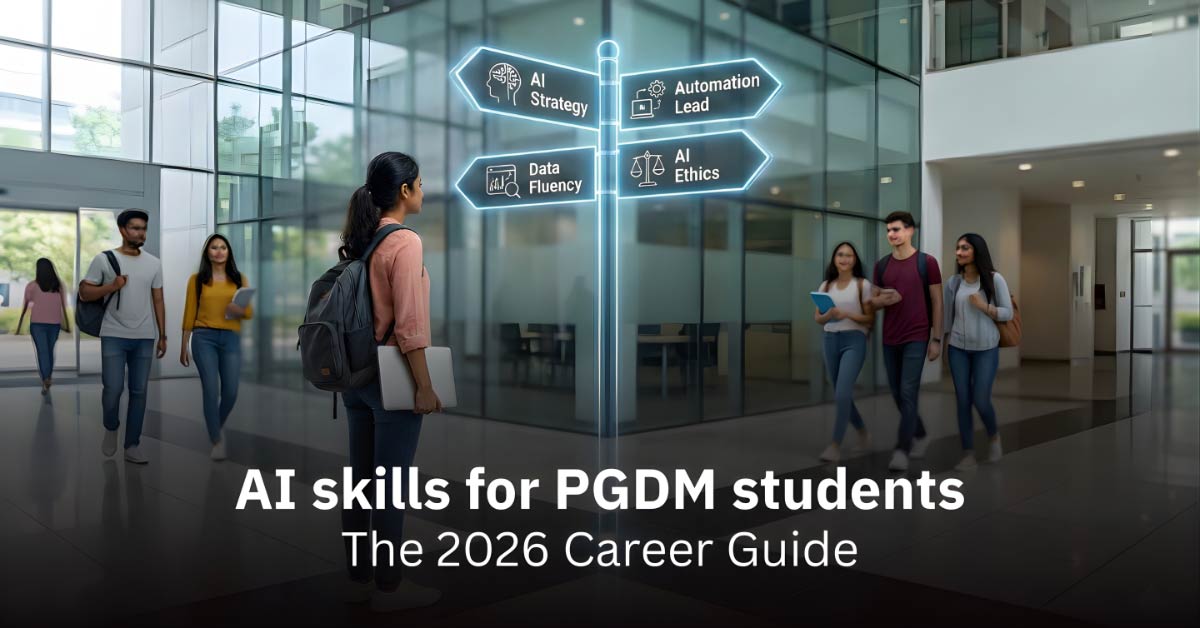
Artificial intelligence has moved beyond IT departments. It now sits at the center of boardroom strategy.
For years, management education focused on finance, marketing theories, and human resources. Today, those foundations remain vital, but they are no longer enough. A 2025 McKinsey Global Survey reveals that 88% of organizations now use AI in at least one business function. This shift creates a new reality. You can no longer simply manage people. You must manage technology, data, and algorithms in conjunction with your human team. This demand has made AI skills for PGDM students the most critical addition to your resume.
Recruiters now hire managers who can bridge the gap between technical teams and business goals.
Why AI Skills for PGDM Students Are the New Currency
In the current job market, proficiency in AI is the primary value you trade for a high-quality job offer. It is “currency” because it is the only asset that guarantees liquidity in your career. You can spend it to move across industries, from banking to retail, because every sector faces the same challenge: they have the technology, but they lack the people who understand how to use it.
The market now demands a “Hybrid Manager.” This role acts as a translator. You need to understand business objectives and explain them to data scientists. Additionally, you will need to interpret the technical output for the stakeholders involved.
According to Deloitte’s 2025 State of AI in the Enterprise report, we have seen a shift towards “Agentic AI,” where the agent executes multiple steps autonomously and does not require continuous monitoring or oversight from humans.
This development changes your role from a supervisor of tasks to an orchestrator of outcomes. HDFC Bank provides a clear example of this transition. CEO Sashidhar Jagdishan recently noted that AI allows the bank to move employees from backend operations to customer-facing roles. As a future manager, you will lead this transition. You will decide which tasks go to the AI agents and which require a human touch.
Core Skill 1: Data Fluency and “Intelligent Interrogation”
Reading a spreadsheet is a basic requirement. The new essential skill is intelligent interrogation.
AI models can hallucinate. They can produce confident but incorrect answers. A skilled manager knows when to question the machine. You must understand the logic behind an AI prediction.
Practical Application: Imagine you are a marketing manager at Zomato. Their roadmap relies on predictive demand models to manage logistics. If the AI predicts a surge in orders for a specific locality, you cannot simply trust it blindly. You must look at the variables. Is there a local festival? Is it raining?
You need the ability to audit the AI’s logic. There is no coding required for you to do this. However, you need to have an idea of how the different types of data input will affect your various outputs.
Core Skill 2: Strategic Implementation
The majority of Indian Firms do not create AI Tools from Scratch. They buy them.
Research indicates that Indian enterprises overwhelmingly prefer buying established AI solutions over building custom ones. This trend creates a specific demand for graduates who can evaluate software.
Your job will involve:
- Assessing different AI vendors.
- Calculating the Return on Investment (ROI) for a new tool.
- Managing the integration of that tool into existing workflows.
Flipkart often uses a hybrid approach. They buy tools for standard tasks to move fast. Indian Firms usually create Custom AI Solutions for their unique Strategic Differentiation. Understanding this Buy vs. Build strategy is now a key part of operations management.
Core Skill 3: The Human Element
With AI overtaking many analytical tasks, your human skills will become more valuable.
According to LinkedIn’s 2025 Labor Market Report, there is an expected 40% increase in hiring in India, while most other countries are experiencing a slowing job market. In addition, those positions that will be in the highest demand will combine technical skills with strong human skills. As machines will not be able to negotiate complicated contracts, as they do not possess empathy toward a frustrated client, do not understand office politics, and cannot effectively lead a team through a crisis.
Critical Human Skills:
- Ethical Judgment: The rising prevalence of AI technology raises ethical issues regarding how customer data will be processed and used.
- Change Management: Your team might fear AI will replace them. You must lead them through this fear. You must show them how to use these tools to their advantage.
Emerging AI Careers MBA Graduates Can Pursue
The AI careers MBA graduates can pursue are no longer just for engineers. New management roles are opening up across sectors.
- AI Product Manager: You define the “what” and “why” of an AI product, while engineers figure out the “how.”
- AI Business Consultant: You help traditional businesses identify where they can apply AI to save money or grow.
- Digital Transformation Lead: You manage the rollout of new tech across a company.
Tata Motors provides a strong case for finance students. They used the “TCS Cognix” platform to automate their accounts payable process. This system drastically improved on-time processing. A finance manager in this setup spends less time checking invoices and more time analyzing cash flow strategies.
Actionable Advice for Students
You can start building these skills today. Do not wait for your first job.
- Audit an AI Tool: Choose an AI tool, either ChatGPT or Perplexity, and ask it a complex business question, verify its answer using multiple fact-checking methods, and identify any weaknesses in its response and the reasons for those weaknesses.
- Learn Low-Code Platforms: Explore low-code platforms, such as Glide and Microsoft PowerApps, to build simple applications without the need for extensive coding knowledge.
- Follow the Money: To understand the money side of a company, look at the quarterly reports issued by an Indian company such as Reliance, Infosys, or ICICI Bank and what they say about their investment in technology.
- Focus on Process: To use AI most effectively, you must first define the process clearly so you will get a better outcome. Start by identifying the various components that make up complex tasks and then use that information to create a workflow to help your process.
The Path Forward
The demand for AI-literate managers is real. It is not about becoming a coder. It is about becoming a leader who is not afraid of the code.The tools will change. The algorithms will update. But the ability to connect technology to business value will remain a constant requirement. Focus on that connection. The AI skills that PGDM students learn are in such high demand that by mastering them, the student will have a competitive edge in the job market.















Leave a comment