

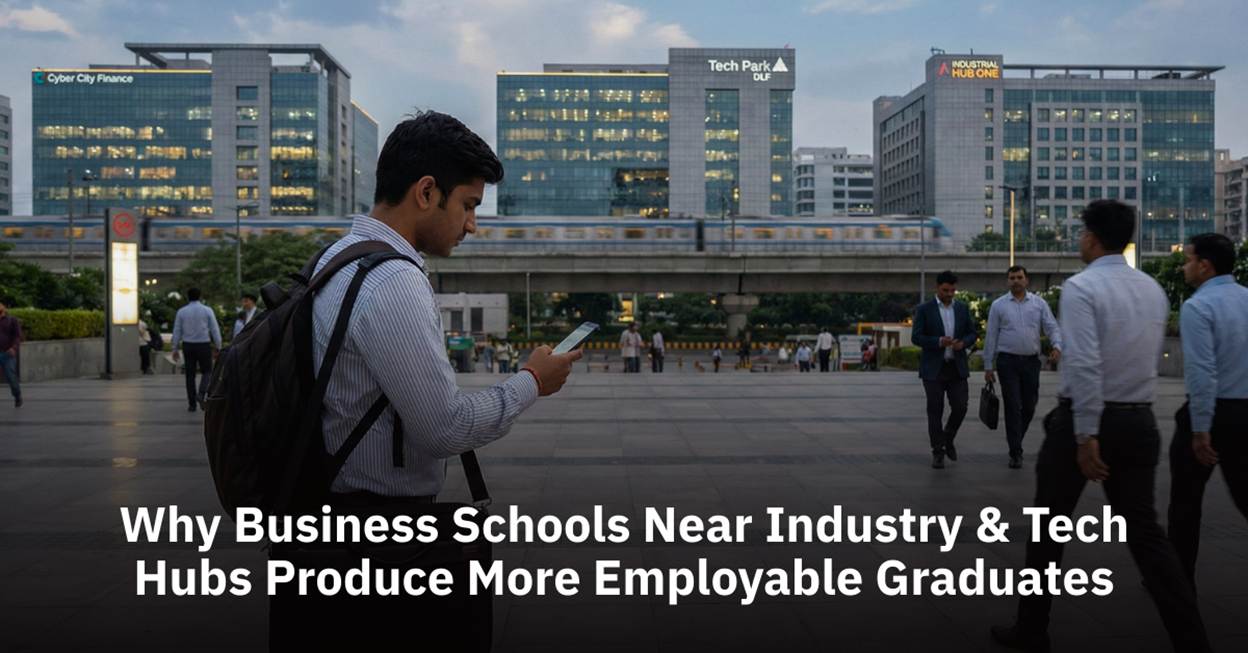
The old real estate adage remains true for your education: location matters above all else.
When you choose a business school, you do not just choose a campus. You choose a professional environment. Many students focus solely on rankings or tuition fees. They ignore the single biggest factor that determines employability: proximity to the action.
A business school located in an industrial vacuum cannot produce graduates ready for a hyperactive market. Geography is destiny in the early stages of your career.
The Unfair Advantage of Top Business Schools Near Delhi
Students often ask why top business schools near Delhi consistently report higher employability figures. The answer lies outside the classroom walls.
The National Capital Region (NCR) is not just a political center. It is India’s largest cluster of startups, multinational corporations, and policy think tanks. According to recent economic data, the NCR region hosts over 8,500 active startups and 30+ unicorns as of 2025.
Proximity to this density creates an “osmosis effect.” You absorb corporate culture simply by being there.
The “Active Practitioner” Difference
Schools isolated from commercial hubs rely heavily on academic faculty. Schools in hubs like Delhi NCR rely on active practitioners.
When a VP of Marketing from a Gurgaon-based FMCG giant finishes their day job, they can easily travel to a nearby campus to deliver a guest lecture. They share real-time challenges they faced that day. They do not teach from a textbook written five years ago.
This access changes the texture of your education. You learn the gap between theory and current reality.
The Hub vs. Isolation Comparison
Here is a practical breakdown of how location impacts your daily learning experience:
| Feature | Schools in Industry/Tech Hubs | Schools in Remote Locations |
| Curriculum Updates | Real-time, based on immediate corporate feedback. | Slower, academic-cycle-based updates. |
| Live Projects | Concurrent with classes throughout the year. | Usually restricted to summer internships. |
| Networking | Organic, frequent evening meetups and events. | Planned, infrequent annual college fests. |
| Faculty Mix | High percentage of visiting industry leaders. | Mostly permanent academic staff. |
The Curriculum Speed Advantage
Markets change fast. Curriculum boards usually change slowly.
However, schools located near major corporate centers face intense pressure to remain relevant. Recruiters from neighboring companies will not hire graduates who lack current skills. This forces the institution to update its syllabus rapidly.
Consider institutions situated right in these hubs. For Instance, FIIB, located in New Delhi, can use its location as a tool to incorporate many of the different industries that it interacts with into its PGDM. It allows the students to solve real-time problems of the industry with companies that are located near them and to create an academic curriculum that meets the immediate demands of companies in the Delhi/NCR region.
The Tech Hubs MBA Edge: Beyond Standard Management
The nature of management jobs is shifting toward technology.
Completing an MBA or PGDM near a tech hub changes the type of roles open to you. You do not just interview for traditional sales jobs. You interview for Product Management roles in a Noida fintech firm or Operations roles in a Gurgaon e-commerce giant.
A tech hub’s MBA experience means your internships are likely focused on digital transformation, data analytics applications, or scaling digital products. These are the highest-growth areas in the Indian economy right now.
NASSCOM reports indicate that the demand for management professionals with “digital fluency” in hubs like Delhi NCR grew by 35% in the last two years alone.
Actionable Advice for Students
Before you commit your two years and tuition fees, audit the school’s location advantage.
- Check the “Visiting Faculty” Page: Do the visiting professors have current-day jobs at notable companies nearby? If they are all retired academics, treat it as a red flag.
- Map the Neighbors: Open Google Maps. Look at what companies are within a 20-kilometer radius of the campus. These are your likely sources for live projects and final placements.
- Ask About Concurrent Projects: During admissions, ask if students work on industry projects during the trimester, not just during summer breaks. Hub-based schools will always say yes.
Making the Strategic Choice
Your PGDM is a bridge to the corporate world. A bridge is useless if it does not connect to anything on the other side.
Choosing a school near an industry hub shortens that bridge. It reduces the friction between learning a skill and applying it. In the competitive Indian job market, proximity is not a luxury. It is a necessary strategic advantage.



















Leave a comment