

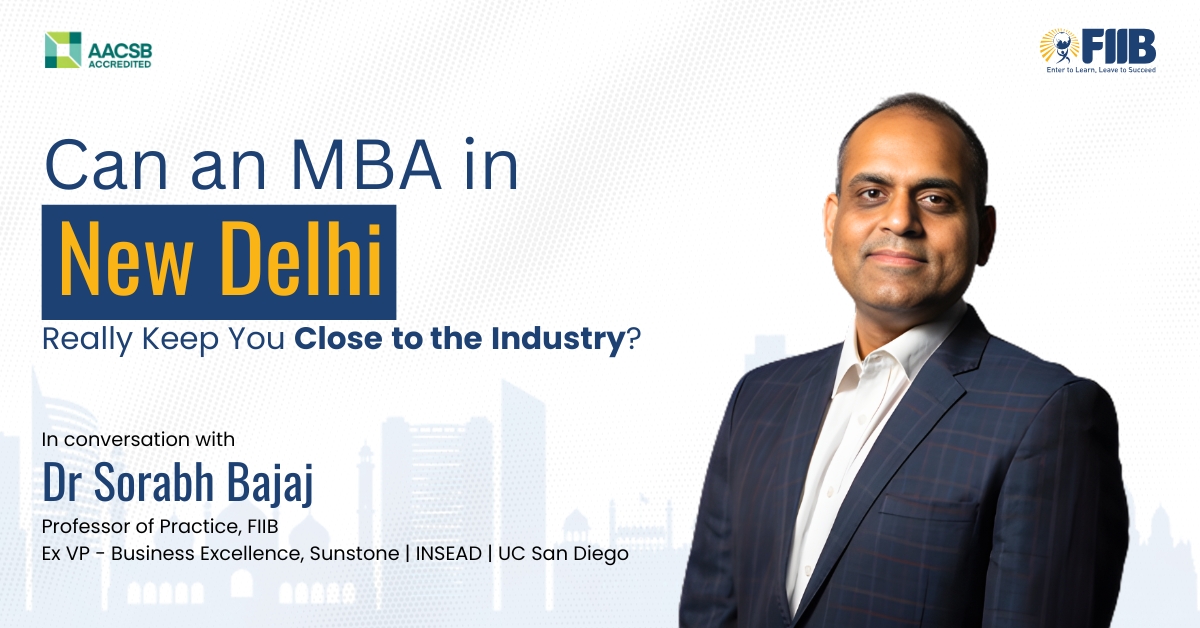
Industry exposure in MBA programs is often positioned as a defining advantage. It appears in brochures, rankings, and campus narratives. Yet, for many students, it remains limited—confined to a few guest lectures or a short internship at the end of the program.
So the real question is not whether exposure exists. It is whether industry exposure in an MBA actually translates into capability and opportunity.
In a conversation with Dr. Sorabh Bajaj, Professor of Practice, FIIB the distinction becomes clear: exposure is meaningful only when it is continuous, applied, and outcome-driven.
Why does industry exposure in MBA programs often fall short?
The limitation is not access—it is integration.
In many programs, industry exposure in MBA education is fragmented. Students attend sessions, listen to leaders, and complete internships, but these experiences often remain disconnected from academic learning.
Without continuity, exposure becomes episodic. Without application, it remains theoretical.
This creates a familiar gap—students understand business concepts, but struggle to apply them in real-world contexts.
What does meaningful industry exposure in an MBA look like?
“Exposure becomes meaningful when it is continuous, contextual, and connected to outcomes,” explains Dr. Bajaj.
In an ecosystem like Delhi NCR, students are surrounded by opportunity. But at FIIB, the focus is on converting that environment into a structured learning system.
Industry exposure in MBA programs here is built through multiple layers:
- 600+ industry professionals engaging annually
- 100+ live projects across domains
- 50+ CXO interactions through masterclasses
But what makes the difference is not volume—it is depth of engagement.
How does exposure move from observation to real participation?
The shift begins when students stop observing and start contributing.
With hubs like Gurgaon and Noida nearby, students regularly engage in real business environments. But more importantly, they are expected to add value.
For instance, during industry interactions like the “View From The Top” series, students don’t just hear from leaders—they question decisions, challenge assumptions, and engage with real business dilemmas.
As one industry leader noted during a session, what stood out was not just the access—but the curiosity and readiness of students to engage beyond the surface.
This is where industry exposure in MBA programs begins to shift from passive to active.
How does industry exposure translate into real corporate capability?
The most visible transformation happens during structured programs like the Corporate Internship Program (CIP).
Unlike short-term internships, CIP is a 12-week, full-time corporate immersion where students work on real business problems.
Take the example of Divanshi Behl at Evalueserve. Her internship was not limited to task execution—it culminated in a final presentation that reflected ownership, structured thinking, and professional clarity.
Similarly, Drishti Pathak, working with Metro Cash & Carry under Reliance Retail, translated complex data into a compelling managerial narrative—demonstrating not just analytical ability, but business storytelling.
In another case, Daksh Chaudhary at AML RightSource showcased structured problem-solving and clarity of thought, presenting outcomes in a way aligned with industry expectations.
These are not isolated experiences. With nearly 29% of students securing pre-placement offers, industry exposure in MBA programs here is clearly linked to outcomes.
How does mentorship convert exposure into opportunity?
One of the most powerful yet understated aspects of industry exposure in MBA programs is mentorship.
At FIIB, each student is guided by three industry mentors. These are not advisory roles—they are working relationships.
Consider Hitesh Rathi, who worked closely with his mentor from Ummeed Housing Finance on capital market strategy, analysing private placements versus IPOs and building an investor pitchbook. This engagement directly led to an internship opportunity.
Ankit Kumar, mentored by a professional from Moore Kingston Smith, explored omnichannel strategy through a study of Lenskart, while also analysing India–EU and India–UK trade opportunities. The outcome was not just knowledge—but cross-market strategic thinking.
Rachita Lohiya, working with an AI strategist, contributed to branding and employer positioning projects—building capability in areas that directly align with evolving industry needs.
In such cases, mentors do more than guide—they open pathways.
How is academic learning aligned with real industry problems?
A key differentiator in industry exposure in MBA programs is how academic rigor supports practical learning.
At FIIB, students engage with over 60 Harvard Business School case studies and multiple simulations across domains. But the emphasis is not just on solving cases—it is on thinking like decision-makers.
This is further extended through initiatives like SPARK, where students work on research that is not just academic, but globally relevant.
For instance, students have published research in IEEE-indexed journals—exploring areas like technology-driven financial strategy and market volatility in emerging economies. For a first-year MBA student, this level of output reflects a deep integration of theory and practice.
What role does AI play in shaping industry exposure today?
Industry exposure today is incomplete without understanding how technology is reshaping business.
At FIIB, over 25 AI tools—including ChatGPT, Claude, and Gemini—are embedded into the learning process.
Students use AI not just for efficiency, but for:
- Conceptual understanding
- Resume optimization
- Interview simulations
- Data-driven decision-making
An AI-powered employability system further enables students to simulate real interview scenarios, receive feedback, and improve iteratively—before they enter actual hiring processes.
This ensures that industry exposure in MBA programs is aligned with the realities of modern, tech-enabled workplaces.
Does exposure also extend beyond corporate roles?
Increasingly, yes—and this is where the definition of industry exposure in MBA programs expands.
Through FIIBPreneur, students are building ventures that address real-world problems.
Priya Jhinkwan’s Anthro Voice AI, for instance, focuses on improving clinical documentation and patient engagement. Adarsh Singh’s EcoQuench explores sustainable packaging through biodegradable water bottles—aligned with global sustainability trends.
Others take a different route—converting internship experiences into structured business cases through initiatives like Katastasi, or competing globally through platforms like C-ACE, where FIIB teams have won national-level competitions.
These examples reflect a broader shift—from job readiness to value creation.
How does global exposure strengthen industry readiness?
Industry exposure in MBA programs is no longer confined to domestic markets.
Through global immersion programs, students engage with international ecosystems—working on projects in markets like Dubai and Vietnam, collaborating with global peers, and interacting with international faculty.
For instance, students working in Dubai engaged with organisations like Unlimits and Lab of Future, gaining exposure to innovation-driven business environments.
In another case, Mansi Kaushik represented South & Central Asia at UNGA Week in New York, participating in global policy discussions as a youth speaker.
Such experiences expand the scope of industry exposure—from local to global.
Final Thought: When Does Exposure Become Opportunity?
Industry exposure in MBA programs cannot be occasional. It cannot be symbolic. And it cannot be delayed.
It has to be continuous, applied, and deeply integrated into the learning experience.
At FIIB, supported by its ecosystem in Delhi NCR, exposure is not treated as an activity—it is designed as a system.
Because when students consistently engage with real business problems, real professionals, and real environments, opportunities do not arrive unexpectedly.
They emerge naturally.














Leave a comment