

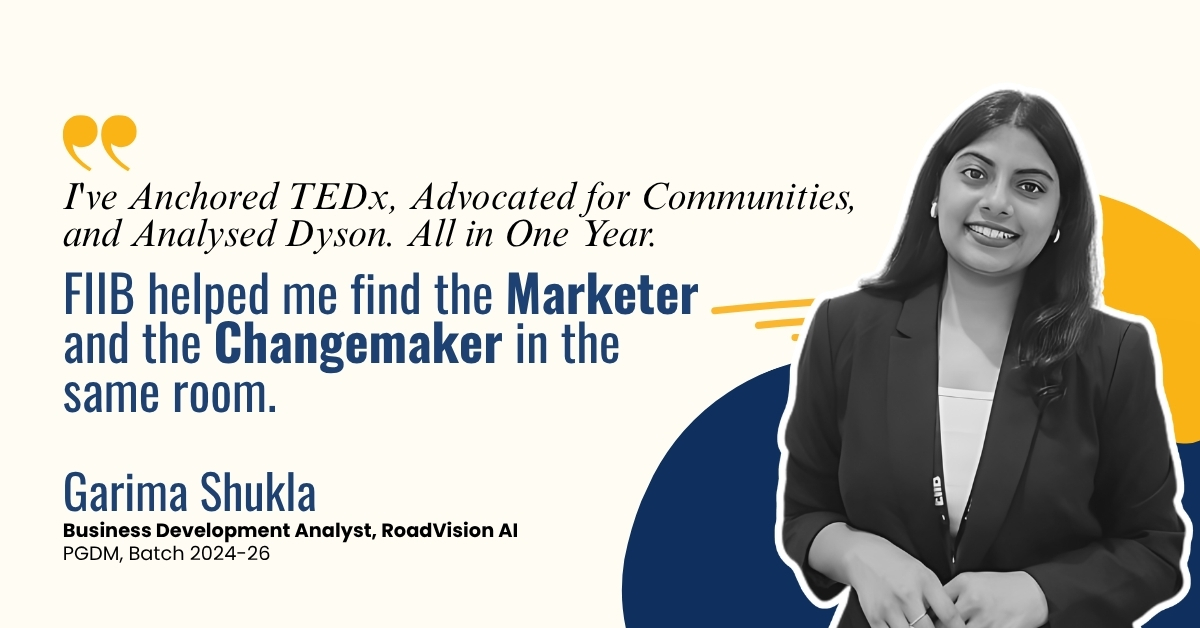
In today’s rapidly evolving business landscape, an MBA is no longer just about classroom learning—it’s about continuous application. In this conversation, Garima Shukla, a marketing and business student from the Fortune Institute of International Business (FIIB), shares how an MBA with internships and live projects helped her bridge the gap between theory and real-world execution, ultimately leading to her placement at Tata Capital.
Q. Garima, take us back to the beginning—what did you expect from your MBA, and how did the experience evolve?
When I started my MBA, I expected it to be largely academic—learning frameworks, understanding concepts, and then applying them during placements. But very early on, I realised that the structure here is very different.
It’s designed as an MBA with internships and live projects, where you’re constantly applying what you learn. Whether it was working on marketing strategies, analysing brands, or engaging with real business problems, the shift from theory to practice happened almost immediately.
That changes your mindset—you stop preparing for the future and start building it in real time.
Q. You’ve worked across multiple roles—from marketing to business development. How did these experiences shape your learning?
Each experience added a different layer to my understanding.
At Casita, I worked on student journey mapping and lead conversion optimisation, which helped me understand how customer behaviour translates into business outcomes. During my time with House of Amara, I explored digital marketing and SEO, while my role at RoadVision AI exposed me to business development and market research.
What made the difference was that these weren’t isolated internships. They were part of a larger MBA with internships and live projects ecosystem, where every experience builds on the previous one.
So when you study something like segmentation or positioning in class, you’re simultaneously applying it in a live context. That’s where real learning happens.
Q. Many MBA students work on projects, but your profile reflects consistent hands-on exposure. How did the curriculum support this?
A big part of it comes from how the curriculum is designed.
At FIIB, a significant portion of learning is experiential—through live projects, simulations, and internships. You’re not just studying case studies; you’re solving actual problems.
For example, I worked on STP and competitor analysis for Cadbury and value proposition analysis for Dyson Airwrap. These projects required structured thinking, but also creativity and market understanding.
This is where an MBA with internships and live projects really stands out—you’re constantly testing your ideas in real scenarios, not just writing about them.
Q. Tell us about your Corporate Internship experience. How critical was it in shaping your career path?
The Corporate Internship Program was a turning point.
It’s a 12-week, full-time immersion, and you’re treated like a professional, not a trainee. You’re expected to contribute, present your work, and deliver outcomes.
That experience gives you clarity—about the role, the expectations, and your own strengths.
More importantly, it builds confidence. By the time you sit for placements, you’re not speaking hypothetically—you’re speaking from experience.
That’s the advantage of pursuing an MBA with internships and live projects—you enter the placement process already industry-ready.
Q. You’ve also worked on social impact initiatives. How did that influence your MBA journey?
My internship with the TWEET Foundation was very different from my corporate experiences, but equally important.
I worked on fundraising and community engagement aligned with UN SDGs 5 and 10, which gave me exposure to stakeholder management in a completely different context.
It made me realise that management is not just about business outcomes—it’s also about impact.
That balance between corporate learning and social exposure is something I found very valuable during my MBA with internships and live projects.
Q. You were also part of the Student Council and major campus initiatives. How did that contribute to your development?
Being part of the Student Council (SPAC) and working on platforms like TEDx and Manthan taught me things you can’t learn in a classroom.
You’re managing teams, coordinating with stakeholders, handling pressure, and making decisions in real time.
At FIIB, student-led initiatives are taken seriously—you’re not just participating, you’re leading.
This kind of exposure complements an MBA with internships and live projects because it builds leadership alongside functional skills.
Q. How did the integration of AI and new-age tools impact your learning experience?
AI is a big part of how we learn now.
We’ve worked with multiple tools for research, marketing, and analysis, which makes the learning process much more efficient and relevant.
It also changes how you approach problems—you start thinking in terms of data, automation, and scalability.
In an MBA with internships and live projects, this becomes even more important because you’re applying these tools in real business contexts, not just learning about them theoretically.
Q. Finally, how did all these experiences come together during placements?
By the time placements began, I had already:
- Worked on live marketing projects
- Completed multiple internships
- Gained exposure to both corporate and social sectors
- Built leadership experience through student initiatives
So interviews felt like an extension of my journey, not a completely new challenge.
That’s how I eventually secured my role at Tata Capital.
I think the biggest difference is that in an MBA with internships and live projects, placements are not the starting point of your career—they are the outcome of everything you’ve already built.
A New-Age MBA That Builds, Not Waits
Garima Shukla’s journey reflects a larger shift in management education—where success is no longer defined by a single placement moment, but by continuous capability building.
An MBA with internships and live projects ensures that students graduate not just with knowledge, but with experience, confidence, and clarity.
And in today’s competitive landscape, that’s what truly makes the difference.











Leave a comment