
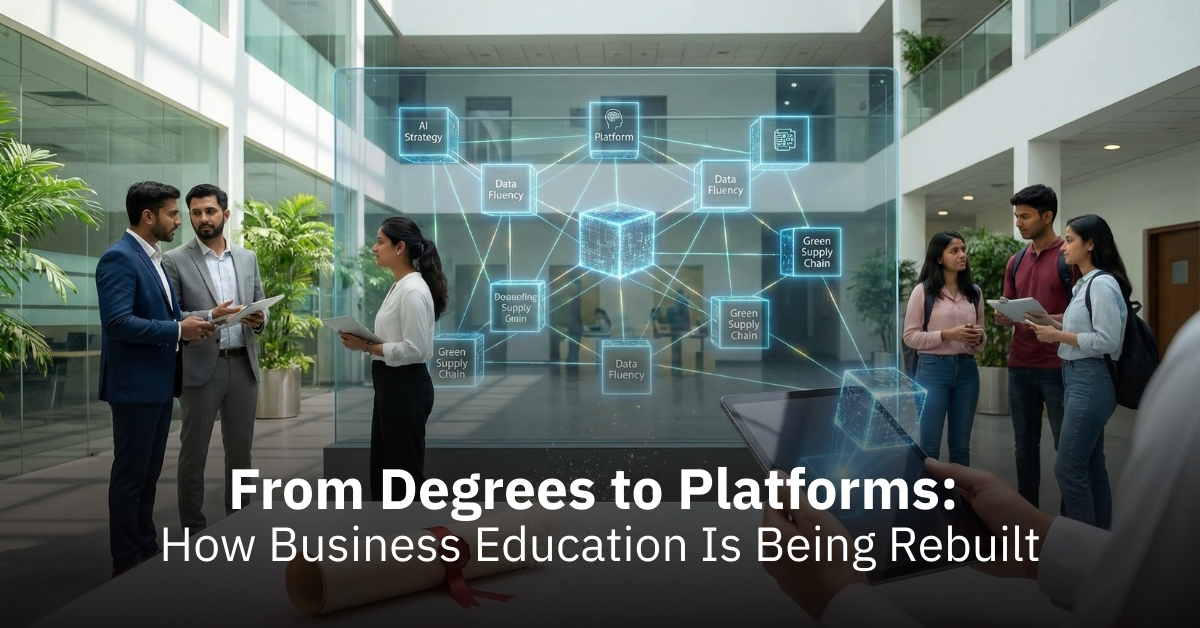
In 2005, many companies treated social media as a side activity. Today, it is a core function across sectors. Entire teams now exist to manage digital communities, platform analytics, and online brand presence—roles that barely existed two decades ago.
The same pattern is repeating across more functions today, and the cycle of change is becoming shorter.
A widely cited projection in research from Dell Technologies suggests that 85% of jobs that will exist in 2030 have not yet been invented. While some labour economists debate the exact percentage, the underlying message remains clear: the nature of work is evolving faster than traditional career planning models assume.
Research by World Economic Forum further highlights that 44% of workers’ core skills are expected to change by 2027 as automation, artificial intelligence, and digital technologies reshape industries.
In other words, job titles may shift, but the capabilities that support those roles are becoming the real currency of employability.
This is why conversations about future jobs after PGDM cannot rely solely on predicting specific job titles. A more meaningful question is emerging:
Which skills and capabilities remain valuable when roles, industries, and technologies keep evolving?
The Shift from Job Titles to Skill Sets
Recruiters still advertise positions using familiar titles. Organisations still hire for defined roles. However, the actual work inside those roles is constantly evolving.
Three structural forces are driving this shift.
First, artificial intelligence is becoming embedded in everyday business workflows. Tools that assist with research, drafting, analytics, and customer interactions are now widely used across functions. As a result, professionals are increasingly expected to work alongside intelligent systems rather than operate independently of them.
Second, oversight responsibilities are growing. When automated tools generate outputs, someone must validate those results, identify risks, and document decisions. Many modern roles therefore combine analytical ability with governance and accountability.
Third, the broader skills landscape in India is changing rapidly. Reports from NASSCOM indicate that India will require over one million professionals with AI and data-related skills by the end of the decade, reflecting the expanding integration of digital systems across industries.
For students exploring future jobs after PGDM, this signals an important shift. The future will not necessarily reward narrow specialisation alone. Instead, employers increasingly value professionals who combine domain expertise with technological awareness and sound decision-making ability.
Role Directions That Are Emerging Now
Rather than trying to predict futuristic job titles, it is often more useful to track role directions. Titles may change over time, but the underlying work patterns tend to remain consistent.
| Role Direction | What the Work Includes | Where It Appears |
|---|---|---|
| AI Operations and Governance | Validating AI outputs, setting process rules, monitoring risks | BFSI, consulting, SaaS |
| Data-to-Decision Roles | Analysing dashboards, running experiments, forecasting trends | FMCG, retail, product teams |
| Cyber Risk and Privacy Coordination | Managing access controls, vendor risks, data policies | IT services, healthcare |
| Sustainability and ESG Reporting | Tracking environmental metrics, compliance documentation | Manufacturing, energy, logistics |
| Digital Product and Growth Roles | Pricing experiments, customer funnel analysis, product rollout | Fintech, edtech, consumer apps |
For students considering future jobs after PGDM, the important takeaway is that success increasingly depends on preparing for capability clusters rather than fixed job titles.
Skills That Protect Employability When Job Titles Change
A student preparing for future jobs after PGDM needs skills that remain relevant across sectors and technologies.
1. AI Literacy with Strong Verification Habits
AI literacy does not necessarily mean coding expertise. Instead, it refers to the ability to work with AI tools responsibly while maintaining critical oversight.
Practical skills include:
- Writing prompts with clear context and constraints
- Checking outputs against reliable sources
- Identifying potential bias or missing information
- Documenting human decisions alongside machine-generated outputs
As AI tools become more common in business environments, professionals who combine technological comfort with strong judgment will be particularly valuable.
2. Data Fluency for Everyday Business Decisions
Data analysis is no longer limited to specialised analytics teams. Many entry-level roles now involve working with dashboards, reports, and performance metrics.
Developing basic analytical habits can make a significant difference:
- Defining a clear metric before beginning analysis
- Interpreting conversion funnels and performance drop-offs
- Distinguishing correlation from causation
- Presenting conclusions with clear visual evidence
These skills are increasingly central to MBA future careers, especially in sectors where rapid experimentation and data-driven decision-making are essential.
3. Risk Awareness and Governance
New technologies create new operational and regulatory risks. Organisations increasingly require professionals who understand how to operate within defined frameworks.
Examples include:
- AI usage policies and responsible automation
- Data privacy and compliance requirements
- Vendor and third-party risk management
- Cybersecurity awareness in digital environments
Understanding these frameworks helps ensure that innovation occurs within responsible boundaries.
4. Cross-Functional Execution
Many emerging roles sit between business strategy, technology implementation, and operational execution.
Students who develop strong cross-functional skills often transition more smoothly into evolving job environments. This includes:
- Writing clear updates and decision summaries
- Running meetings with defined outcomes
- Converting feedback into actionable plans
- Tracking and reporting measurable results
In practice, these capabilities enable professionals to operate effectively even when roles and responsibilities are still evolving.
Skills That Will Matter Most for Future Jobs After PGDM
| Skill Area | Why It Matters | Example Roles |
|---|---|---|
| AI Literacy | Working effectively with intelligent tools | AI operations manager |
| Data Interpretation | Translating analytics into decisions | business analyst |
| Strategic Thinking | Managing uncertainty and complex systems | management consultant |
| Sustainability Knowledge | Supporting ESG reporting and compliance | sustainability analyst |
| Cross-Functional Collaboration | Coordinating across departments | product manager |
Building Proof for Emerging Roles
When roles are new, recruiters often rely on evidence of capability rather than conventional experience.
Students preparing for future jobs after PGDM can build stronger profiles through:
- Project outcomes: measurable improvements such as increased conversions or reduced process time
- Portfolio documentation: dashboards, reports, decision memos, and analysis summaries
- Outcome-driven internship descriptions: focusing on impact rather than tasks
A simple rule applies: if a project cannot be explained in three lines with one measurable outcome, the proof of capability may be too weak.
A Practical Preparation Plan for MBA Future Careers
Students do not need to predict future job titles to prepare effectively. A structured preparation approach can help.
Step 1: Choose one domain anchor
Examples include marketing, finance, operations, analytics, or strategy.
Step 2: Add a complementary tool track
For instance, Excel with Power BI, SQL basics, CRM reporting tools, or AI research workflows.
Step 3: Complete one meaningful project every quarter
Each project should result in a clear analysis and measurable outcome.
Step 4: Build a concise portfolio
Recruiters should be able to review it within two minutes.
Step 5: Prepare interview narratives around outcomes
Focus on results rather than responsibilities.
Signals That a New Role Is Emerging
Students often miss early indicators of emerging careers because they focus exclusively on job titles. More useful signals include:
- New regulations creating reporting requirements
- Industry-wide adoption of new technologies
- Job descriptions emphasising skills rather than roles
- Existing roles expanding to include new responsibilities
Tracking these signals can help students align their electives, internships, and projects with future jobs after PGDM.
The Need of the Hour
Preparing students for roles that do not yet exist is not about predicting a precise list of future careers. It is about building durable capabilities, strong decision habits, and measurable proof of impact.
In an economy where technologies, industries, and business models evolve rapidly, professionals who combine domain knowledge, analytical ability, and technological awareness will remain valuable across multiple career transitions.
For management institutions, this reality has important implications. Curriculum design, industry engagement, and experiential learning must evolve continuously to reflect how work itself is changing.
The search for future jobs after PGDM therefore leads to a broader insight: career resilience depends less on job titles and more on the skills, judgment, and adaptability that professionals bring to every role they undertake.














Leave a comment