

Thinking about where you can find open access management research? Here are ten peer-reviewed articles, free to read, download, teach and cite.
Open Access facilitates the wider dissemination of research, making scholarly insight accessible to a broader research community and fostering a greater exchange of ideas. The practitioner community gains directly from evidence-based research, and the classroom gains a live connection to current scholarship. FIIB Business Review (FBR) brings together contemporary research that engages with emerging business challenges, evolving technologies, organizational practices and societal concerns. We invite you to explore a selection of Open Access articles offering insight across diverse areas of management and business research.
Why Open Access Matters?
Open Access shortens the distance between a finding and its use. A study that circulates freely reaches the scholars who will extend it, the practitioners who will apply it, and the students who will learn from it. The benefit is structural, and it compounds across three constituencies.
- Researchers – Fuller literature reviews, built on complete papers rather than abstracts, and genuine engagement with scholarship from outside one’s own funding ecosystem.
- Practitioners – Managers, consultants and policy professionals gain evidence-based research without a journal subscription. This is how rigorous findings enter organizational decisions.
- Educators and students – Faculty can assign a current, peer-reviewed paper rather than a secondary summary of it, bringing live scholarly debate into MBA and doctoral seminars.
The Collection: Ten Articles, Free to Read
These articles reflect the range of questions shaping contemporary management scholarship across the world. They address relevant themes in management theory and practice while demonstrating the diversity of research methodologies now used to investigate contemporary management challenges. They are grouped by theme below.
I. Leadership, Culture and the Employee Experience
Four studies on what makes people share what they know, stay where they are, and withstand the pressure of the job.
- Knowledge-sharing behaviour through leadership and culture: The moderating role of job autonomy and gender.
Authors -Md Asadul Islam, A. K. M. Ahasanul Haque, Mahfuzur Rahman, Dieu Hack-Polay & Francesca Dal Mas
Why read it? Establishes knowledge sharing as a conditional outcome rather than a cultural given. Essential reading for work on knowledge management, leadership styles and moderation design. Read here →
- Unlocking the dynamics of employee retention: Examining the interplay of job security, promotion and work engagement in a developing economy. Authors -Md. Ashraful Islam, Amer Hamzah Bin Jantan, Md. Aminul Islam, A. B. M. Abdullah & Md. Siddikur Rahman
Why read it? Tests retention in a developing-economy context, where job security carries weight that Western-sample HRM literature consistently underestimates. Read here →
- Diversity, equity, and inclusion (DEI) initiatives, organizational culture, and employee retention: Situational traits-mediated model.
Authors – Ann Varghese, Benny Godwin J. Davidson, Jossy P. George & Peter V. Muttungal
Why read it? Moves DEI research past declared intent to a specified mediating mechanism, a working reference for any model linking organizational culture to retention outcomes. Read here →
- Revisiting the role of mindfulness practices for stress reduction: An empirical study.
Authors –Wahab Shahbaz & Aymen Sajjad
Why read it? Subjects a construct widely adopted in workplace wellbeing programmes to the empirical scrutiny it has not always received. Read here →
II. Digital Adoption and the Connected Consumer
Three studies on how people take up technology and how they argue about it in public.
- Continuance intention of m-banking adoption: The dynamics of UTAUT3, trust and attitudes.
Authors – Sofiane Laradi, Amina Elfekair, Hafiz Mudassir Rehman, David Hanna & Mahmaod Alrawad
Why read it? Extends UTAUT3 from initial adoption to continuance, where trust behaves differently, directly relevant to technology-acceptance research in financial services. Read here →
- New trends in digital marketing: Analysis of the social conversation on X.com about metaverse and artificial intelligence.
Authors -Marian Blanco-Ruiz, Alba Adá-Lameiras & David Atauri-Mezquida
Why read it? Analyses public discourse on two contested technologies, and demonstrates how platform data can be treated as a rigorous marketing research corpus. Read here →
- Engaging customers through gamification in global markets: Insights and implications from cross-cultural perspectives.
Authors – Ayushi Gupta, Ashish Gupta & Abhishek Behl
Why read it? Treats culture as a boundary condition rather than a control variable, the distinction that separates comparative research from convenience sampling. Read here →
III. Sustainability and Responsible Behaviour
Two studies on consumption, enterprise, and the behaviour underlying both.
- Household food waste practices through the lens of social practice theory: A theory-based review.
Authors – Phuong Phung, Anh Thi Van Nguyen, Anushka Siriwardana & Umair Akram
Why read it? Reframes food waste as embedded social practice rather than individual failure, and stands as a model of how a theory-based review should be constructed. Read here →
- From risk to reward: Understanding the influence of Generation Z and personality factors on sustainable entrepreneurial behaviour.
Authors – João M. Lopes, Sofia Gomes & Tiago Trancoso
Why read it? Links generational cohort and personality traits to sustainable venturing, connecting entrepreneurship research to behavioural evidence. Read here →
IV. Evidence Synthesis for Practice
- Exploring the role of social media in healthcare: A systematic literature review using the TCCM framework.
Author – Gitte Galea & Ritesh Chugh
Why read it? A TCCM-structured systematic review that repays two readings: one for the healthcare findings, one as a template for structuring a review of your own. Read here →
A Note on Methodological Range
Read as a set, these ten papers amount to a short course in method. They include moderated and mediated models, an extended technology-acceptance framework, cross-cultural comparative design, platform-based social conversation analysis, a theory-based review anchored in social practice theory, and a systematic review structured through the TCCM framework. For doctoral scholars still settling on a design, and for faculty teaching research methods, that range carries as much value as the findings. These are current, published, peer-reviewed exemplars of each approach (available in full text, at no cost).
How to Use This Collection
• Refresh a literature review. Most of these papers were published in 2025 and 2026. They will update a review chapter that has begun to age, and they are citable today.
• Take them into the classroom. With no paywall, an entire cohort can be assigned the same full paper without a licensing conversation with the library.
• Study the craft, not only the findings. Read one paper for its argument and a second for its construction: how the gap is framed, how the model is specified, how limitations are handled.
• Locate your own research gap. Each paper closes with a future-research agenda. Read several in sequence and the open questions in your field begin to converge.
• Treat it as a submission brief. If you are deciding where to send your next manuscript, this collection is the clearest available statement of what FBR publishes and the standard it applies.
About FIIB Business Review
FIIB Business Review is the peer-reviewed flagship journal of the Fortune Institute of International Business (FIIB), New Delhi, published by Sage. Since 2011 it has published contemporary management research that is theoretically grounded and consequential for practice, and it has done so with a clear editorial position: rigour and relevance are not competing objectives.
The journal publishes across four sections — Research (conceptual and empirical scholarship), Perspective (viewpoints on contemporary management topics), Business Case, and Review. This gives scholars at different stages more than one credible route into print. FBR is equally known for the character of its peer review. Reviewer reports are developmental: they tell an author how to strengthen a manuscript, not merely why it fell short. For a substantial number of doctoral and early-career scholars, an FBR article is a first Scopus-indexed publication.
Standing and Recognition
- Indexed in Scopus with continuous coverage since 2011, and in Web of Science (Emerging Sources Citation Index).
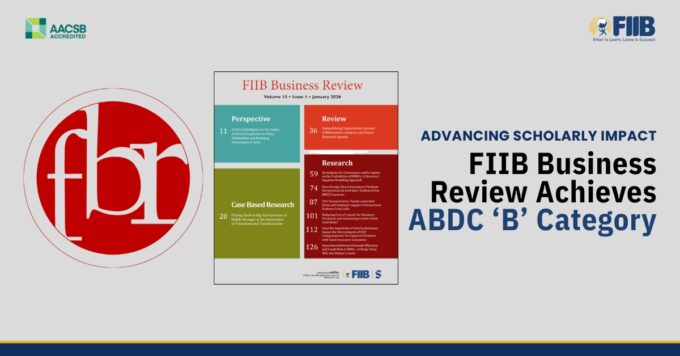
- Upgraded to ‘B’ in the ABDC Journal Quality List, the Australian Business Deans Council ranking widely used to assess journal quality, and listed in the ABS Academic Journal Guide.
- Q2 in SCImago across all four of its subject categories — Business and International Management; Business, Management and Accounting; Organizational Behavior and Human Resource Management; and Strategy and Management — with an h-index of 28.
- Highly selective. FBR reports an acceptance rate of approximately 2.7% from 756 national and international submissions in its most recent cycle.
- Editorially led by scholars of standing. The journal’s editorial leadership features in Stanford University’s list of the world’s top 2% of scientists.
- Publication integrity. A member of the Committee on Publication Ethics (COPE), with no retractions on record.
- Genuinely international. Roughly 27% of recent output involves cross-border research collaboration.
Conclusion
Research earns its value in circulation. A paper that is read, contested, taught and built upon advances a field further than one that is merely published. In opening these ten articles, FIIB Business Review is making a deliberate commitment: that the boundary of the scholarly community should be drawn by curiosity, not by subscription.
The journal’s standing Scopus and Web of Science indexing, an ABDC ‘B’ classification, Q2 SCImago placement across every subject category it publishes in, and one of the more selective acceptance rates in management publishing, altogether is what makes that commitment worth acting on. Whether you are drafting a review chapter, designing a study, preparing a seminar, or choosing where to submit your next manuscript, this collection is yours to use.













Leave a comment