

Industry-first management education uses live industry problems, rather than retrospective case studies, to drive curriculum, assessment, and faculty selection. It matters because AI-shaped hiring now rewards demonstrated capability over credentials alone. FIIB applies this model through FIIBX™, a program-wide redesign that places students inside real business briefs through ActionWorks™.
Why Industry-First Management Education Is the Future
Hiring has changed. AI tools compress the time needed to produce standard analytical output, so recruiters now look for judgment applied to ambiguous, real-time problems over execution of known frameworks.
- Employer impact: Roles increasingly favor candidates who have practiced on live problems, not just studied them in a classroom
- What is lost by ignoring it: Graduates trained only on retrospective cases enter roles unprepared for problems with no textbook answer yet
- Strategic relevance: A portfolio of applied work now carries more weight in hiring conversations than a transcript
Business schools responding to this seriously are restructuring assessment and faculty selection around it, not bolting on a single elective.
Core Elements of an Industry-First Curriculum
Live Business Problems Replace Retrospective Cases
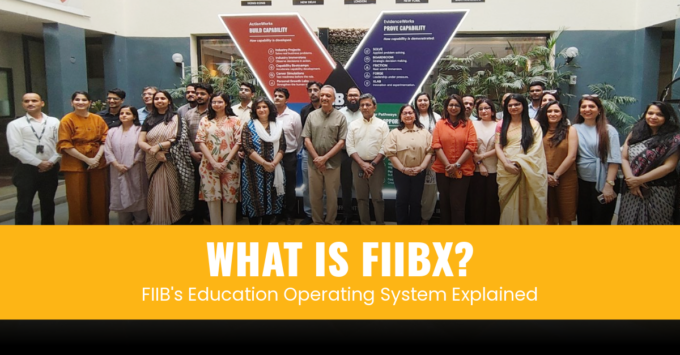
ActionWorks™ places FIIB students inside five live business problem formats, each sourced from an active industry brief. The problems change as the briefs change, so the curriculum stays current by design rather than by revision cycle.
Practitioner Faculty Bring Current Context
A faculty roster built on active practice looks different from one built on academic credentials alone. Faculty who still work in the field bring problems into the classroom that are current this quarter, not a decade old.
Assessment Measures Applied Capability
EvidenceWorks™ proves student capability across multiple real-world assessment formats before graduation. The degree carries evidence of applied work alongside a grade, which is the point of building an assessment system around it in the first place.
Structured Industry Immersion, Not a Single Internship
FIIB builds immersion across the program rather than compressing it into one placement-season internship, through its Corporate Internship Program (CIP) and Social Internship Program (SIP), each running to a defined period.
Industry-First vs. Traditional Case-Study Models
| Dimension | Traditional Case-Study Model | Industry-First Model |
| Problem source | Published, historical cases | Live, current industry briefs |
| Faculty profile | Primarily academic research background | Mix of academic and active practitioner faculty |
| Assessment | Written exams, case analysis | Delivered outputs against real briefs |
| Industry exposure | Placement-season internship | Structured immersion across the program |
| Best for | Foundational theory building | Applied, decision-ready capability |
Who Should Choose Industry-First Management Education?
Best suited for:
- Aspirants who want to build a portfolio of applied work alongside a degree
- Working professionals seeking frameworks they can apply immediately in current roles
- Corporate L&D buyers evaluating programs for cohort-based upskilling
Frequently Asked Questions
What does industry-first mean in an MBA or PGDM context?
It means the program is structured around live industry problems and practitioner input as the primary learning source, rather than theory delivered first and applied later. Assessment, faculty selection, and curriculum design all follow from this same principle.
Is industry-first different from experiential learning?
Experiential learning is a broader teaching method that can include simulations or classroom exercises. Industry-first specifically requires the problems, briefs, and immersion to come from active industry sources, not simulated ones.
How do I evaluate if a PGDM program is genuinely industry-first?
Check whether faculty currently work in industry, whether assessments are tied to real briefs rather than only exams, and whether industry immersion runs throughout the program rather than a single placement-season internship.
Can working professionals benefit from an industry-first PGDM?
Yes. Programs structured this way typically emphasize applicable frameworks and live problem-solving, which working professionals can apply directly in their current roles while studying.
Is an industry-first program worth it compared to a traditional MBA?
This depends on career goals. Aspirants prioritizing applied, decision-ready capability generally find industry-first structures more aligned with current hiring expectations; those prioritizing deep theoretical research may prefer a traditional academic track.
What is the risk of choosing a program that only markets itself as industry-first?
Some programs use the term without structural changes to faculty, assessment, or immersion design. Verify practitioner faculty ratios, immersion duration, and assessment format before enrolling.















Leave a comment