

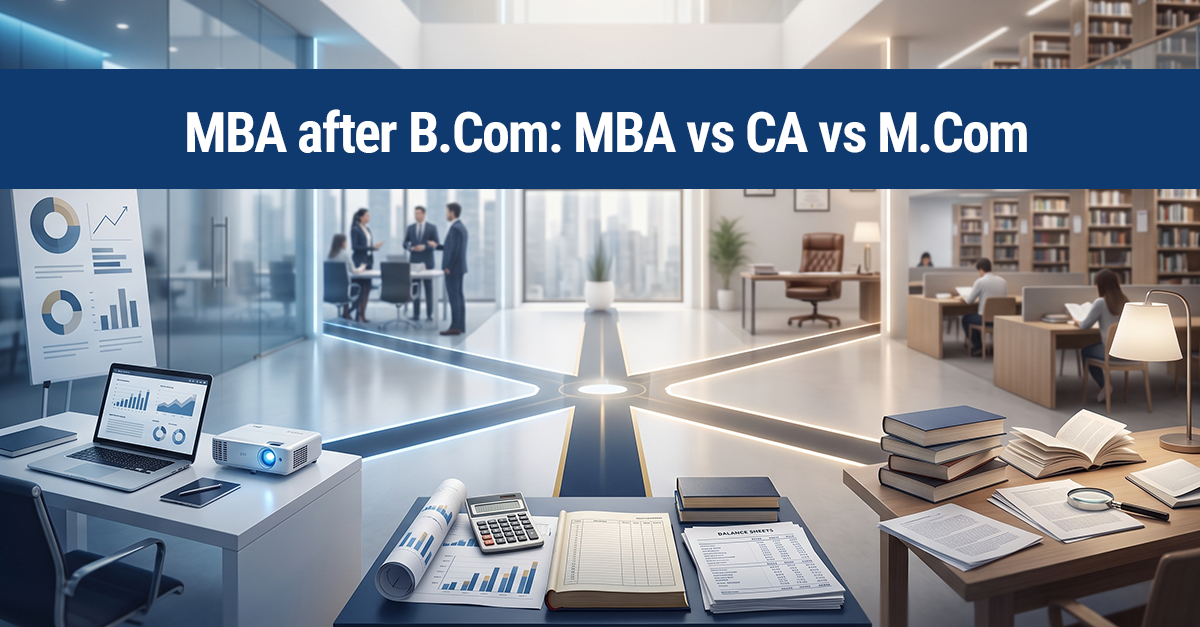
What Is an MBA After BCom?
MBA after BCom is a postgraduate management program that a commerce graduate enters after a three-year B.Com degree. It typically runs two years and builds skills in finance, marketing, operations, and leadership. Most Indian B-schools accept B.Com graduates through entrance exam scores and a selection process.
Why MBA After BCom Matters in 2026
B.Com graduates face a three-way choice, and the wrong fit costs two to five years. CA leads to a regulated accounting profession. MCom deepens subject knowledge. An MBA or PGDM moves you toward management roles.
The choice matters more now because employers hire for decision-making as well as technical accuracy. Each path builds a different capability, so matching the path to your target role is the real decision.
MBA vs CA vs MCom: The Three Paths Compared
The three paths differ in what they certify, how long they take, and which roles they open. The table compares them at category level.
| Dimension | MBA / PGDM | CA | MCom |
| What it is | Management postgraduate program | Professional accounting qualification (ICAI) | Academic postgraduate degree |
| Typical duration | 2 years | Multi-stage with practical training | 2 years |
| Entry route | Entrance exam and selection process | ICAI registration and staged exams | University or college admission |
| Core strength | Management, leadership, cross-functional skill | Audit, taxation, financial reporting | Subject depth, research orientation |
| Typical roles | Management, consulting, corporate finance, marketing | Audit, tax, controllership, practice | Teaching, research, specialist analysis |
| Best for | Those targeting managerial careers | Those targeting regulated accounting work | Those targeting academia or further study |
Why the three are not direct substitutes
CA is a license to practice in a regulated field. An MBA is a management education. MCom is an academic degree. Comparing them on prestige misses the point: compare them on the work you want to do at 30.
MBA After BCom or CA: How to Choose
Choose CA if your target is a regulated accounting role. Choose an MBA if your target is management. The two paths answer different questions, and many professionals eventually combine them.
A four-step decision method
- Name the role you want at age 30. Auditor, tax advisor, financial controller, product manager, and consultant each imply a different path.
- Check whether the role requires a qualification. Signing audits requires CA. Most management roles do not require it.
- Match the path to how you learn. CA rewards sustained technical study. An MBA rewards case discussion, teamwork, and communication.
- Test your choice against a time budget. Count the years and the working income you forgo on each path.
When people combine them
Some professionals qualify as CA and later add an MBA to move into leadership. Others begin with an MBA and specialize in finance. Neither sequence is wrong. The sequence should follow your target role.
MCom vs PGDM After BCom
MCom builds subject depth. PGDM builds applied management capability. The right choice depends on whether you want to study commerce further or work through business problems.
What MCom offers
MCom extends coursework in accounting, economics, and commerce subjects. It suits students aiming for teaching, research, or doctoral study, where academic credentials carry weight.
What PGDM offers
A PGDM is a two-year management program awarded by an autonomous institute, with AICTE approval. It emphasizes industry exposure, internships, and applied projects. At FIIB, the PGDM includes the Corporate Internship Program (CIP), a structured industry placement within the program.
Where PGDM-FM fits
If you want finance specifically, a PGDM in Financial Management narrows the management curriculum toward finance roles. Review the PGDM-FM curriculum and career paths to see how the program is structured.
How to Evaluate MBA Colleges for Freshers
Freshers should compare B-schools on five structural dimensions, not on rankings alone. The strongest programs for candidates without work experience build industry exposure into the curriculum.
What to compare
- Curriculum depth: How many finance, analytics, and management courses, and how current.
- Faculty practice experience: Whether faculty have run or advised businesses.
- Industry immersion structure: Who sets the problems students solve, and for how long.
- Assessment rigor: Whether students defend decisions or submit reports.
- Placement process design: How preparation is staged before recruiters arrive.
- Alumni network reach: Whether alumni mentor, refer, and hire.
Why this matters for B.Com graduates
B.Com graduates often arrive with strong accounting foundations and less exposure to marketing, operations, and strategy. Programs that structure industry immersion help close that gap. FIIB‘s Industry-First model sets the brief through industry partners, and students work it through FIIBX™, the institute’s applied learning framework.
Who Should Choose MBA After BCom?
Commerce graduates targeting management, consulting, or corporate finance roles benefit most from an MBA or PGDM.
Best suited for:
- Final-year B.Com students who want management or leadership roles rather than a regulated practice.
- Graduates who want to add marketing, operations, and strategy to a commerce base.
- Candidates comfortable with case discussion, teamwork, and presentation.
Not the right fit for:
- Those whose target role requires CA, such as signing statutory audits.
- Those who want an academic or research career, where MCom and doctoral study are more direct.
- Those who cannot commit two years of full-time study.
What to evaluate when comparing programs: curriculum depth, faculty practice experience, industry immersion structure, assessment rigor, placement process design, and alumni network reach.
| Dimension | MBA / PGDM Route | CA Route | MCom Route |
| Learning style | Case work, projects, teamwork | Sustained technical study | Lecture and research |
| Career signal | Management capability | Regulated accounting license | Subject depth |
| Time commitment | 2 years full-time | Multi-year with practical training | 2 years |
| Best for | Management and consulting careers | Audit, tax, controllership | Teaching and research |
Frequently Asked Questions
Can I do an MBA after BCom?
Yes. B.Com graduates are eligible for MBA and PGDM programs in India. Most institutes require a bachelor’s degree with a minimum percentage and a valid entrance score, such as CAT, XAT, CMAT, or institute-specific tests. Exact criteria vary by institute, so verify requirements for your target program before applying.
What is the difference between MBA and CA after BCom?
CA is a regulated professional qualification focused on audit, taxation, and financial reporting, earned through staged ICAI exams and practical training. An MBA is a two-year management program focused on leadership and cross-functional skills. CA suits accounting careers. An MBA suits management, consulting, and corporate finance roles.
Which is better after BCom: MBA or CA?
Neither is better in general. CA is stronger for regulated accounting work such as audit and tax practice. An MBA is stronger for management roles across functions. Choose by the role you want at 30, check whether it requires a qualification, and compare the time each path takes.
What is the difference between MCom and PGDM after BCom?
MCom is an academic postgraduate degree that deepens commerce subject knowledge and suits teaching or research. PGDM is a management program with applied projects, internships, and industry exposure, suited to corporate and managerial roles. Both take two years. Your career target determines which one fits.
How long does an MBA after BCom take?
A full-time MBA or PGDM after B.Com typically takes two years. Preparation for entrance exams adds several months before admission. Some institutes also offer one-year executive or part-time formats for candidates with work experience. Check each program’s structure, because duration, internships, and electives vary by institute.
What should freshers look for in the best MBA colleges?
Freshers should compare curriculum depth, faculty practice experience, industry immersion structure, assessment rigor, placement process design, and alumni network reach. Programs that build internships and live projects into the curriculum help candidates without work experience gain applied skills. Rankings are one input, but structure shows how learning actually happens.
Is an MBA after BCom worth it?
It is worth it when your target role values management skills and your chosen program builds them through industry exposure and applied learning. It is less suited to roles requiring CA or academic credentials. Weigh two years of study and cost against your career target, and check how the program supports placements.
















Leave a comment