


Stuck between 70 and 85? You are in a better place than it feels
If your mocks keep landing between 70 and 85 percentile, the frustration is understandable, and the first question is usually about mock percentile vs actual CAT percentile: does this number tell me anything real? You work hard, take test after test, and the number barely moves. It helps to know what that range actually says about you.
A CAT mock percentile 80, or anything in this band, says you have the fundamentals. You can read, calculate and reason well enough to beat most of the people taking serious mocks. What it does not say is how you will do on exam day, and it does not say you are stuck for good. Most candidates in this range lose marks in a small number of repeatable ways, which means the gap is usually fixable.
Mock percentile vs actual CAT percentile: what the number really tells you
Many aspirants read a mock percentile as a prediction. The mock vs actual gap is really a difference in who you are being compared with, so it is better read as a measurement of a different race. A mock percentile ranks you against the people who took that particular mock. That group is not the CAT population, and the mock provider estimates the percentile from its own assumptions.
One experienced CAT coach, writing for 2IIM, makes the point bluntly: proctored mock samples are only around one percent of CAT takers, and they lean towards the most serious and experienced candidates. His advice is to drop the percentile obsession and focus on how you attempt the paper. Other providers describe their mocks as close to the real exam in difficulty, but none we found publishes data on how mock percentiles map to actual results.
The practical takeaway: a CAT mock percentile 80 is useful for tracking yourself across weeks. It is not a promise about your final percentile in either direction. Compare your own mocks with each other, from the same provider where possible, and judge progress by your trend and your error patterns.
Will my CAT percentile improve in seven weeks?
Will my CAT percentile improve? It can. It is also fair to be honest about the limits. No data exists that says what a typical candidate gains in seven weeks, so no one can truthfully promise you ten percentile points. What you can do is aim for the kinds of gains that tend to be available this late.
With less than two months left, new syllabus coverage rarely pays back. The marks you can still win sit in three places: errors you keep repeating, questions you should have skipped, and time you spend badly. All three show up in your mocks if you look.
It also helps to expect uneven returns. Moving from the 70th to the 80th percentile may take less improvement than moving from the 85th to the 95th, because higher percentiles are harder to gain as competition becomes tighter. Set your target with your starting point in mind, and treat ten percentile as a goal to track, not a deadline you must hit.
CAT 2026 is on 29 November 2026. Registration closed on 22 September 2026. Check admit card and exam-day updates at the official CAT website: https://iimcat.ac.in
The three leaks that hold most 70 to 85 scorers back
1. Repeat errors
Go through your last five mocks and list every wrong answer by type: concept gap, calculation slip, misread question, or wrong guess. Most people find that two or three types account for most of the damage. Those are your targets for the next seven weeks.
2. Poor question selection
In every section, a few questions are traps and a few are gifts. Candidates in this range often spend four minutes on a trap and rush the gifts. Use a fixed rule, for example leave any question that has not yielded in a couple of minutes, and practise it until it is automatic.
3. One lagging section
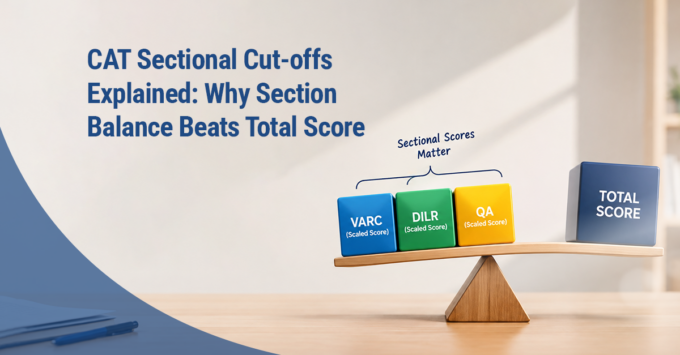
Your overall percentile hides your weakest section. If one of VARC, DILR or QA sits well below the other two, fixing it usually lifts your total faster than polishing a strong section further. It also protects you at schools that set sectional minimums.
A 7-week plan, week by week
If you are asking whether your mock vs actual results will line up, this plan gives you a way to find out by tracking your own trend. It assumes you start on Monday 12 October and work through to CAT on Sunday 29 November. Adjust the mock day to your own routine, and keep every review session at least as long as the mock itself.
| Week | Dates | Focus | Mock and review |
| 1 | 12-18 Oct | Baseline: take one full mock and log every error by type | Full mock plus a long review; pick your top three error types |
| 2 | 19-25 Oct | Fix the top error type; start weakest-section drills | One full mock; compare error log with week 1 |
| 3 | 26 Oct-1 Nov | Question selection practice in all three sections | One full mock; mark which questions you should have skipped |
| 4 | 2-8 Nov | Second error type; timed sectional sets | One full mock; check weakest section against your target |
| 5 | 9-15 Nov | Speed with accuracy: timed practice on strongest topics | One full mock; keep your attempt plan fixed |
| 6 | 16-22 Nov | Consolidate: revisit error log, no new topics | Light mock or two sectional tests; short review |
| 7 | 23-29 Nov | Rest, formula and shortcut recall, exam logistics | No heavy mock in the last few days; CAT on 29 Nov |
This is a suggested structure, not a verified formula. Adjust it to your strengths and your mock results.
With only seven weeks left, start analysing your CAT mock performance now rather than waiting for scores to improve on their own. Use each remaining week to target specific weaknesses, improve accuracy and speed, and track progress toward your 10 percentile goal.
How to review a mock so it actually moves your score
- Review before you check the score again. Redo the questions you got wrong, untimed, and write one line on why each went wrong.
- Tag every wrong answer with a type: concept, calculation, misread or guess. The tags are what turn a score into a plan.
- Note the questions you should have skipped and the ones you skipped that were easy. Both are selection errors.
- Track three numbers across weeks: sectional percentile, attempts, and accuracy. Watching these instead of a single mock percentile vs actual CAT percentile guess keeps you honest. A rise in accuracy at steady attempts is the cleanest sign of progress.
And if your final percentile lands between 60 and 90?
Whatever your mock percentile vs actual CAT percentile turns out to be, preparing hard does not mean putting everything on one outcome. Many good PGDM programs accept percentiles well below the IIM range, and they reward the same effort in their own way. FIIB’s PGDM, for example, asks for 60 percentile or above in a recognized exam such as CAT, along with a bachelor’s degree with at least 50 percent.
So prepare with focus, and look at your options early. You can read more about what the program offers on FIIB‘s PGDM page.
COMPARISON TABLE: MOCK PERCENTILE VS ACTUAL CAT PERCENTILE
| Aspect | Mock percentile | Actual CAT percentile |
| Who you are ranked against | Candidates who took that mock | All candidates who took CAT |
| How it is calculated | Provider’s own method and assumptions | CAT exam body, after the exam |
| Best use | Track your own trend and errors | Shortlisting by institutes |
| Reliable as a forecast? | No published evidence that it is | Final result |
Basis: 2IIM analysis of mock samples and percentile methods; CAT percentile calculation is by the CAT exam body.
Close the Gap: Join FIIB’s Weekly CAT Strategy Webinar
Reading your mock trend correctly is only useful if you act on it. FIIB runs a free CAT Test Strategy Webinar every Sunday, where faculty and alumni cover error-log review, question selection, and section balance to help you convert mock progress into exam-day results.
Register for the CAT Test Strategy Webinar →
FAQs
Is my mock percentile the same as my actual CAT percentile?
No. A mock percentile is calculated against the people who took that mock, and that group is not the CAT population. Mock providers also estimate percentiles from assumptions, so treat the number as a rough guide to direction, not a forecast. Official CAT percentiles are calculated by the CAT exam body after the exam.
What does a CAT mock percentile of 80 mean?
It means you scored higher than about 80 percent of the people who took that mock. It shows you are performing solidly against a serious test-taking pool, and it leaves room to grow. It does not tell you your actual CAT percentile.
Will my CAT percentile improve in the last 7 weeks?
It can, but no one can promise a specific gain. Improvement in the final weeks usually comes from fewer avoidable errors, better question selection and steadier time use, not from covering new syllabus. A 10 percentile target is a goal to work towards and track.
Is it easier to go from 70 to 80 or from 85 to 95?
Generally the lower jump is easier. Higher percentiles bunch many candidates into a narrow score range, so each extra percentile point asks more of you. Set your target with that in mind.
How many mocks should I take in the last 7 weeks?
There is no verified ideal number. A common pattern is one full mock per week with a long review, plus sectional practice on the other days. The review matters more than the count.
Which section should I fix first?
Start with the one that sits furthest below your other two or below the sectional minimum of your target schools, since a weak section can cost you a shortlist even if your overall percentile looks fine.
Which B-schools can I consider at 60 to 90 percentile?
Many AICTE-approved PGDM programmes accept scores in this range. FIIB’s PGDM, for instance, is reported to ask for 60 percentile or above in an exam such as CAT. Confirm each institute’s current criteria on its official admissions page.
















Leave a comment