
What a Consulting and Strategy PGDM Offers
A PGDM in Consulting and Strategy is a management program focused on structured problem solving, business analysis, and strategic decision-making for advisory and leadership roles. It matters because organizations hire graduates who can diagnose a problem and recommend an action. It suits aspirants of management consulting, strategy, and business development roles, including career switchers.
You enjoy breaking a messy problem into parts, and you want a career built on that skill. The question is whether a specialization will train it, and how to tell a program that does from one that only says so. The sections below cover what the specialization teaches, where it leads, and how to evaluate a program before you enroll.
Why Does Consulting and Strategy Matter in 2026?
AI now handles much of the research and first-draft analysis that junior roles once contained, so employers value people who frame the problem and judge the answer.
Data cleaning, market research summaries, and slide drafts are increasingly automated. What remains is choosing the right question, testing assumptions, and persuading a client to act. A consulting and strategy specialization trains those skills directly. Mordor Intelligence estimates India’s management consulting services market at about USD 9.36 billion in 2026, forecast to reach about USD 18.93 billion by 2032, driven by large companies’ digital-transformation spending and sustainability reporting rules.
The figures describe consulting market revenue, not job openings, which is why the flag stays open for hiring data. The figure is the post’s one market-size reference, so don’t reuse it elsewhere.
What Do You Study in a Consulting and Strategy Specialization?
The specialization combines analytical subjects with business functions, so you learn to solve problems across a company, not inside one department.
| Subject | Skill It Builds | Where You Use It |
| Corporate and business strategy | Choosing where and how a firm competes | Strategy and growth roles |
| Competitive and industry analysis | Reading markets and rivals | Market entry and positioning work |
| Business analytics | Turning data into evidence | Every consulting engagement |
| Financial analysis and valuation | Testing whether a decision pays off | Business cases and investment reviews |
| Operations and process design | Fixing how work gets done | Efficiency and transformation projects |
| Change management and leadership | Getting people to adopt a decision | Implementation and client management |
| Communication and storytelling | Presenting a clear recommendation | Client and leadership meetings |
Subjects vary by institute.
Core Skills the Specialization Builds
- Structured problem solving: breaking a problem into testable parts
- Quantitative analysis: using data to confirm or reject a hypothesis
- Synthesis: reducing findings to one clear recommendation
- Stakeholder communication: persuading people with different priorities
Consulting and Strategy vs General Management
Consulting and strategy trains you to diagnose and advise, while general management trains you to run and lead.
| Dimension | Consulting and Strategy | General Management |
| Focus | Diagnosing problems and recommending decisions | Running teams, operations, and functions |
| Core work | Project-based analysis and client advice | Ongoing planning, delegation, and delivery |
| Typical entry roles | Business analyst, associate consultant, strategy analyst | Management trainee, operations executive, functional associate |
| Skills emphasized | Analysis, synthesis, presentation | Leadership, coordination, execution |
| Best for | Students who enjoy analysis and problem solving | Students who enjoy leading people and processes |
What Are Management Consulting Careers After PGDM?
Management consulting careers after PGDM usually move from supporting analysis to owning the recommendation.
| Stage | Typical Roles | What You Do |
| Entry | Business analyst, associate consultant, strategy analyst, research analyst | Collect data, build models, support the team |
| Mid | Consultant, senior consultant, strategy manager | Own a workstream and present findings |
| Senior | Engagement manager, associate partner, head of strategy | Lead the engagement and advise leadership |
Employers include consulting firms, in-house strategy teams, banks, technology companies, and startups. Roles and hiring depend on the employer, and no program can guarantee a specific firm or role.
A Practical Career Roadmap
- Build an analytical base. Strengthen spreadsheet, statistics, and data skills.
- Practice case problems. Solve one structured business case each week.
- Do a consulting-style project. Take a live project or internship that ends in a recommendation.
- Build your network. Speak with alumni and professionals in advisory roles.
- Target your applications. Match your projects to the roles you apply for.
What Does a Consulting Project Look Like?
A consulting project turns a vague business worry into a tested recommendation.
This is a generic illustration. A retail chain’s margins fall for three quarters.
- Define the question. Why have margins fallen, and what should leadership do?
- Form hypotheses. Pricing, product mix, supplier costs, or store operations.
- Analyze. Split margin by category, store, and cost line. Two categories drive most of the decline.
- Recommend. Reprice one category, renegotiate supplier terms for another, and test the changes in a few stores before a full rollout.
How Is AI Changing Consulting?
AI automates routine research and drafting, and raises the value of problem framing and client judgment.
- What AI absorbs: data cleaning, market summaries, first-draft slides, and basic modeling
- What stays human: choosing the question, judging whether an output makes sense, managing clients, and guiding change
- What to build: the habit of checking AI output against evidence before you present it
FIIBX™ is FIIB’s curriculum framework that organizes the PGDM into six career pathways, with an AI learning thread through each, so students use AI tools inside projects instead of studying them in isolation.
Who Should Choose a PGDM in Consulting and Strategy?
Choose this path if you enjoy structured analysis, communicating a clear answer, and working on a different problem every few months. Whether you compare a PGDM or an MBA in Consulting and Strategy, the same fit questions apply.
A consulting and strategy specialization may fit you if you:
- Like breaking problems into parts and testing ideas with data
- Want advisory, strategy, or business development roles
- Are switching careers and want structured problem-solving training
- Prefer project-based work to long-running operational ownership
It may not fit if you prefer deep technical specialization or people management over analysis. In that case, compare it with a functional specialization or general management.
Which 7 Factors Matter Before You Enroll?
Judge any PGDM or MBA in Consulting and Strategy by how it trains you to solve problems, not by how it describes itself.
- Curriculum depth: Does it cover strategy, analytics, finance, and operations in detail?
- Faculty practice experience: Have faculty advised organizations on strategy or consulting?
- Industry immersion structure: Do you work on live business problems that end in a recommendation?
- Assessment rigor: Is work graded on the quality of the recommendation, not only recall?
- Placement process design: Can the college explain how it prepares and connects students to advisory employers?
- Alumni network reach: Are alumni present in consulting and strategy roles?
- Case and interview preparation: Does the program train you for structured case interviews?
Compare any two programs on these seven points, never on fees alone.
How Does FIIB Build Consulting-Ready Skills?
FIIB places consulting-style learning inside the program so you practice advising, not only studying.
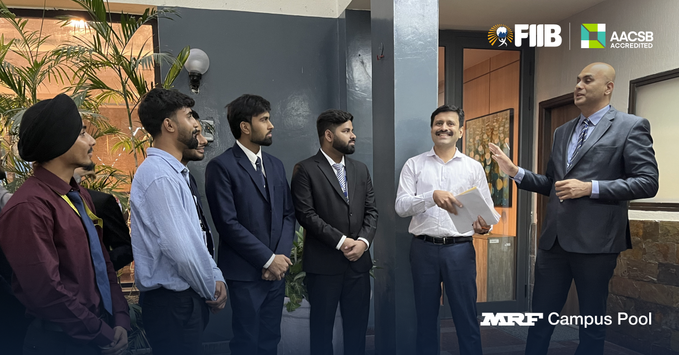
FIIB sits in New Delhi, close to consulting firms, multinationals, and policy bodies, which supports live projects and senior-leader access. The Corporate Internship Program (CIP) is FIIB’s corporate internship built into the PGDM and runs for 12 weeks.
FIIB is AACSB-accredited, and its alumni network spans 3,800+ graduates.
Finance-focused students can review the PGDM-FM curriculum and career paths. Others can explore the PGDM program.
Frequently Asked Questions
What is a PGDM in Consulting and Strategy?
A PGDM in Consulting and Strategy is a postgraduate management program that builds structured problem solving, business analysis, and strategic decision-making skills for advisory and leadership roles. It combines core management courses with analytics, industry analysis, and client-style projects. Specialization names and subject lists vary by institute, so review each program’s curriculum before you apply.
What jobs can I get after a PGDM in Consulting and Strategy?
Graduates typically start as business analysts, associate consultants, strategy analysts, or research analysts. Employers include consulting firms, corporate strategy teams, banks, technology companies, and startups. Later roles include consultant, strategy manager, engagement manager, and head of strategy. Roles and hiring depend on the employer, so no program can guarantee a specific job or firm.
What is the difference between consulting and strategy and general management?
Consulting and strategy focuses on diagnosing a specific business problem and recommending a decision, often through project-based work. General management builds broad skills across functions to lead teams and operations. Choose consulting and strategy if you enjoy analysis and problem solving, and general management if you prefer leading people, processes, and day-to-day business operations.
Is an MBA in Consulting and Strategy worth it?
An MBA in Consulting and Strategy can be worth it if you want structured problem-solving training, project exposure, and access to advisory recruiters. It is less useful if you want a purely technical or functional role. Weigh two years of time, the program’s industry projects, and how it prepares you for case interviews before deciding.
Do I need a specific background for a consulting and strategy specialization?
Most graduates from any discipline can pursue it, since programs value analytical thinking and communication more than a specific degree. Eligibility, entrance exams, and work experience requirements vary by institute, so check each program’s current criteria. Comfort with numbers, structured thinking, and clear writing helps you perform well from the first term.
How is AI changing management consulting jobs?
AI now automates research, data cleaning, and first-draft slides, which reduces routine junior work. Consultants add value by framing the problem, judging AI outputs, managing clients, and guiding change. Programs that teach AI tools inside real projects prepare you better than those that treat AI as a standalone elective.
Can working professionals switch to consulting and strategy through a PGDM?
Yes. Working professionals from finance, technology, operations, and marketing often move into strategy and consulting by adding structured problem-solving and business skills to their domain experience. Prior experience helps you frame problems and manage stakeholders. Check the schedule, project structure, and career support, and build a short portfolio of analyses before applying.















Leave a comment