

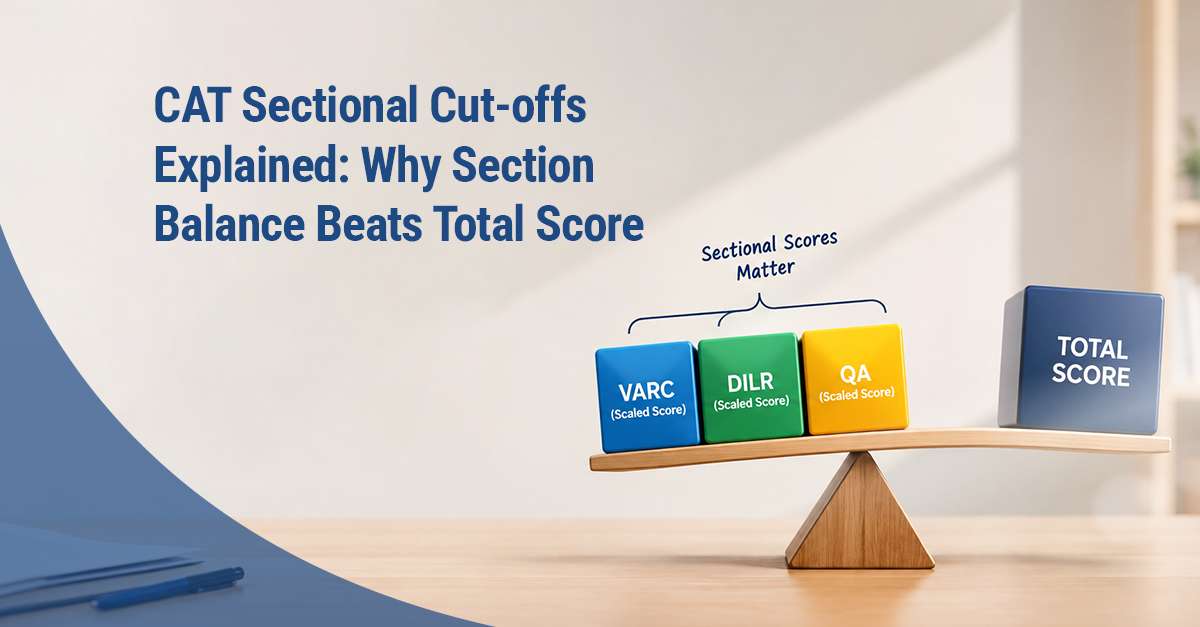
The overall percentile is not the only gate
Most CAT aspirants track one number: the overall percentile. It is the headline figure on the scorecard and the easiest to compare with friends. If you are searching for the CAT cutoff 2026, the first thing to know is that there is no single number to find. For several top institutes, it is only the second check. Before your total matters, you have to clear a minimum in each of the three sections, and a miss in one cannot be offset by strength in another.
That is what a CAT sectional cutoff is. Think of it as a floor under each section and a ceiling-free target on the total. If you want to be shortlisted at a school that uses both, your preparation plan needs both numbers, which most plans lack.
Who sets the cutoff, and what the numbers look like
CAT is conducted by an IIM on behalf of all of them, and the exam body does not publish a pass mark. Each institute decides its own criteria for shortlisting, and those criteria vary by programme and by category. So the sectional cut off CAT candidates hear about is really a set of separate rules, one per institute.
IIM Ahmedabad states its minimums openly. For the 2-year PGP, 2027-29 batch, General/EWS candidates need at least 95 overall and 85 in each of VARC, DILR and QA. NC-OBC candidates need 90 overall and 80 per section, SC candidates 85 and 75, and ST candidates 75 and 65. The institute adds that these can change with the applicant pool and score distribution.
IIM Ahmedabad’s official criteria are published here: https://www.iima.ac.in/academics/mba/admissions/indians
Do not assume other schools match this. Coaching websites report different sectional figures for the same institute and year, and none of them is official. Treat any number that does not come from the institute’s own page as an estimate, and confirm it before you build a target around it.
Source: iima.ac.in admissions page for Indian applicants, read October 2026.
A worked example: why 95, 95 and 60 does not work
Take two candidates applying to a General category seat where the floor is 85 in every section.
| Candidate | VARC | DILR | QA | Clears an 85 sectional floor? |
| A: lopsided | 95 | 95 | 60 | No. QA is 25 points short |
| B: balanced | 88 | 86 | 87 | Yes. All three at or above 85 |
| C: one dip | 99 | 90 | 84 | No. QA is 1 point short |
Candidate A has two outstanding sections and would almost certainly show a high overall percentile. It does not matter. At a school using this rule, the QA score ends the application before the total is read. Candidate B has lower peaks and still clears all three gates. Candidate C is the uncomfortable one: a single point under the floor in one section outweighs a 99 in another.
CAT publishes no official formula for combining sections into an overall percentile, so this post does not give an overall figure for any of these profiles. The point holds without it: the floor is a separate test.
Why this matters more than it seems
The usual mistake is to prepare for the section you like. A candidate comfortable with reading puts hours into VARC and mocks, sees a good total, and treats a weak QA as a footnote. Under a sectional rule that footnote is the whole story.
There is also a practical reason. Section difficulty shifts from year to year, and percentiles are relative to everyone who sat your slot. A section that felt easy in mocks can still produce a low percentile if the paper is easy for everyone. A cushion above the floor, rather than a number that just touches it, is the safer plan.
Tracking your own sectional targets
CAT 2026 is close, so set two targets now instead of one: a minimum percentile for each of VARC, DILR and QA, and an overall percentile goal. Spend the weeks you have left lifting your weakest section, and check after every mock that none of the three is falling behind.
- Write a floor for each section before you write a total target. Take it from the official page of the institutes you are aiming for, not from a coaching chart.
- Record sectional percentiles in every mock, not just the total. A mock series that shows one section lagging is telling you where to move your hours.
- Aim above the floor, not at it. A few percentile points of cushion absorbs the paper-to-paper variation described above.
- Decide in advance which section gets extra time each week, and revisit it after every second mock.
This is also a good time to confirm exam logistics. CAT 2026 registration closed on 22 September 2026, and the official CAT website is the place for admit card and exam-day updates.
Official CAT website: https://iimcat.ac.in
What this means for FIIB aspirants
Not every institute filters on sections. FIIB‘s PGDM admission criteria are reported as an overall percentile of 60 or above in a recognised exam such as CAT, alongside a bachelor’s degree with at least 50 percent. That is a far lower bar than the IIM floors above, and it gives candidates with an uneven profile a realistic route.
The sensible plan is to keep your options wide. Aim for balance because it protects you at schools with sectional floors, and know which of your shortlisted institutes use only the overall score.
COMPARISON TABLE: OVERALL-ONLY VS SECTIONAL CRITERIA
| Feature | Overall-percentile-only criteria | Overall plus sectional criteria |
| What is checked | One total percentile | A floor in VARC, DILR and QA, then a total |
| Effect of a weak section | Absorbed into the total | Can end the application by itself |
| Preparation priority | Maximise the total | Clear every floor, then maximise the total |
| Example | FIIB PGDM: 60+ overall | IIM Ahmedabad PGP 2027-29: 95 overall, 85 per section (General/EWS) |
Put This Into Practice: Join FIIB’s Weekly CAT Strategy Webinar
Balancing three sections against separate floors takes more than planning on paper. FIIB runs a free CAT Test Strategy Webinar every Sunday, where faculty and alumni cover sectional strategy, mock-test tracking, and how to build the cushion above each floor discussed here.
Register for the CAT Test Strategy Webinar →
FAQs
What is a CAT sectional cutoff?
It is a minimum percentile you must score in each of VARC, DILR and QA, on top of an overall percentile requirement, to be considered by an institute. CAT itself publishes no cutoff. Each IIM sets its own criteria, and they differ by programme and category.
What are the IIM Ahmedabad sectional cutoffs?
For the PGP 2027-29 batch, IIM Ahmedabad lists a minimum of 95 overall and 85 in each section for General/EWS candidates. NC-OBC is 90 overall and 80 per section, SC is 85 and 75, and ST is 75 and 65. The institute notes these can change with the applicant pool.
Can a high overall percentile make up for a weak section?
Not where a sectional minimum applies. A candidate with 95, 95 and 60 across VARC, DILR and QA falls below an 85 sectional floor in QA, so a strong overall percentile does not rescue the application at that institute.
Do all B-schools use sectional cutoffs?
No. Policies differ by institute. Some set per-section minimums and some look only at the overall percentile. Check each target institute’s official admissions page for its current criteria.
Does FIIB have a sectional cutoff for CAT?
FIIB’s published PGDM criteria are expressed as an overall percentile of 60 or above in a recognised exam such as CAT. Confirm on FIIB’s official admissions page whether any sectional filter applies for your cycle.
How should I balance preparation across VARC, DILR and QA?
Set a floor for each section first, then a total target. Track sectional percentiles in every mock test, and shift weekly hours toward whichever section sits closest to or below your floor.
















Leave a comment