

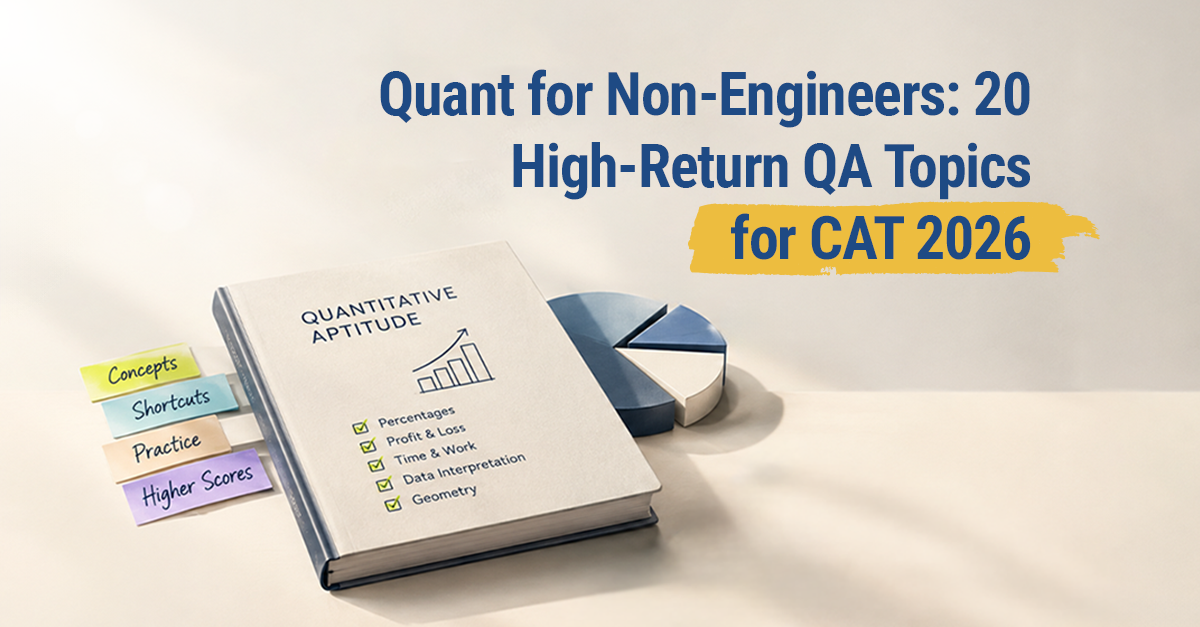
CAT quant for non engineers: why you should not copy an engineer’s plan
If you come from B.Com, BBA, Arts or Science, you have probably looked at a CAT Quant syllabus list and felt the whole thing land on you at once. That reaction is reasonable, and it points to the wrong fix. The usual advice, cover every quant topic CAT lists equally, is built for people who already have the algebra and number sense to move fast through all of it. You are better served by picking the topics that pay back the most for the hours you have left.
There is encouraging evidence that this works. The IIM Kozhikode toppers list for CAT 2025 shows that 9 of the 12 candidates at 100 percentile came from non-engineering backgrounds. Among the 64 candidates at 99.98 percentile and above, 41 were non-engineers. That is a statement about the top of the distribution, not about the average test-taker. Estimates of how many aspirants overall are engineers vary: some coaching institutes put the figure at 70 to 80 percent, though that number has no published source, and the official CAT body does not release it. The honest takeaway is narrower and more useful: the section does not require an engineering degree to score at the very top.
What CAT QA actually tests
For anyone starting CAT quant for non engineers, the useful fact is that the section is school mathematics, up to roughly Class 10, applied under time pressure. Recent papers have carried 22 QA questions inside a 68-question, 120-minute exam, with each section timed separately at 40 minutes. Marking is +3 for a correct answer and -1 for a wrong MCQ, with no penalty on TITA questions. Confirm the exact 2026 pattern on the official CAT website before you finalise a plan.
Official CAT 2026 information (registration closed 22 September 2026; exam on 29 November 2026): https://iimcat.ac.in
The mix of topics matters more to your plan than the format. Careers360 counted 330 QA questions from the 15 slots held between 2021 and 2025. Arithmetic accounted for 139 of them (42.1%), algebra 105 (31.8%), geometry and mensuration 48 (14.5%), number system 31 (9.4%) and modern maths 7 (2.1%). In CAT 2025 specifically, arithmetic had 27 of 66 questions across the three slots. These counts come from an unofficial analysis whose authors say it shows trends and should not be used to predict the 2026 paper. Use it to decide where to start, not to bet the exam on.
Source: Careers360, CAT Arithmetic vs Algebra vs Geometry Analysis, Quant Weightage 2021-2025.
The 20 topics, ranked for a non-engineering starter
The table below lists the 20 quant topics CAT aspirants from non-engineering backgrounds should work through, in the order a non-engineer should approach them. Frequency tiers follow the category counts above and the topics the same analysis names as dominant in arithmetic and algebra. Difficulty ratings are our editorial view of how steep the climb is if your last serious maths was in school. Both are guides for planning. Neither is an official weightage.
| # | Topic | Category | Frequency tier | Difficulty for non-engineers |
| 1 | Percentages | Arithmetic | High | Easy |
| 2 | Ratio and proportion | Arithmetic | High | Easy |
| 3 | Profit, loss and discount | Arithmetic | High | Easy |
| 4 | Time, speed and distance | Arithmetic | High | Moderate |
| 5 | Time and work | Arithmetic | High | Moderate |
| 6 | Mixtures and alligation | Arithmetic | High | Moderate |
| 7 | Averages | Arithmetic | Medium | Easy |
| 8 | Simple and compound interest | Arithmetic | Medium | Easy |
| 9 | Partnership and investment | Arithmetic | Medium | Easy |
| 10 | Linear equations | Algebra | High | Easy |
| 11 | Quadratic equations | Algebra | High | Moderate |
| 12 | Inequalities | Algebra | High | Moderate |
| 13 | Functions and greatest integer | Algebra | High | Hard |
| 14 | Logarithms and exponents | Algebra | High | Moderate |
| 15 | Progressions and sequences | Algebra | Medium | Moderate |
| 16 | Factors, remainders and divisibility | Number system | Medium | Moderate |
| 17 | Triangles and circles | Geometry | Medium | Moderate |
| 18 | Mensuration | Geometry | Medium | Easy |
| 19 | Coordinate geometry | Geometry | Low | Moderate |
| 20 | Permutation, combination and probability | Modern maths | Low | Hard |
Frequency tier is a planning label derived from published category counts and the dominant-topics list in the Careers360 analysis. Difficulty is editorial. Neither is an official IIM figure.
Three tiers, three study phases
Tier 1: topics 1 to 9, the arithmetic core
The first nine topics are all arithmetic, and arithmetic CAT questions are where most of your marks sit. They are also the most forgiving for non-engineers, because they rest on percentages, ratios and everyday reasoning you have used in commerce or economics classes. Make this the first phase of your QA preparation CAT plan, and stay until you can solve a standard question in under two minutes without reaching for a formula sheet. That speed is what makes the rest of QA workable.
Strong arithmetic CAT preparation starts with spotting that these questions often hide a simple structure inside a long word problem. The practical skill is translating the story into one clean equation or ratio. Practise that translation deliberately: read a problem, write the setup, and only then calculate.
Tier 2: topics 10 to 16, algebra and number system
This is where non-engineers typically lose the most ground, and where a short, focused effort pays off most. Linear and quadratic equations, inequalities, logarithms and exponents all lean on the same few manipulation skills. Rebuild those skills first, then move to functions, which are the hardest topic in this tier and the one worth reaching last. Number system questions reward pattern recognition, so a few weeks of regular practice on remainders and divisibility goes further than long theory sessions.
Tier 3: topics 17 to 20, geometry and modern maths
Geometry and mensuration were about 14% of questions from 2021 to 2025, and modern maths about 2%. Learn the standard results for triangles, circles and mensuration, since those questions can be quick once you know them. Treat coordinate geometry, and permutation, combination and probability, as optional extras for the weeks after your core is steady. Skipping a hard set here costs you far less than skipping a percentage or ratio question.
Building speed and accuracy in QA preparation for CAT
Knowing which quant topics CAT rewards is half the job. The other half is converting that knowledge into marks within 40 minutes. Three habits help most for QA preparation CAT aspirants from non-engineering backgrounds.
- Work topic-wise in timed blocks. Set a timer for ten questions on one topic, then review which ones took too long and why. Speed comes from recognising question types, not from rushing.
- Keep an error log. Note whether each wrong answer was a concept gap, a calculation slip or a misread question. Concept gaps send you back to the topic. Calculation slips need drills. Misreads need slower first reads.
- Learn when to leave a question. In a 40-minute section, a question that has not yielded in about two and a half minutes is usually a trap. Mark it and move on.
These habits matter more than extra hours. A non-engineer who solves arithmetic and algebra cleanly and skips two hard questions will usually outscore a candidate who attempts everything and gets half of it wrong.
Start now, and choose your topics
With CAT 2026 approaching, start prioritising the highest-return Quant topics now instead of trying to cover the entire QA syllabus equally. Use the remaining preparation time to strengthen these topics through timed practice, revision and mock-test analysis. Registration for CAT 2026 closed on 22 September 2026, so if you registered, your focus now belongs on preparation, and the official CAT website is the place to check for admit card and exam-day updates.
Check admit card and exam-day updates at the official CAT website: https://iimcat.ac.in
COMPARISON TABLE: WHERE THE QA MARKS SIT (2021-2025)
| Category | Questions (330 total) | Share | Priority for non-engineers |
| Arithmetic | 139 | 42.1% | Start here |
| Algebra | 105 | 31.8% | Second |
| Geometry and mensuration | 48 | 14.5% | Third |
| Number system | 31 | 9.4% | Alongside algebra |
| Modern mathematics | 7 | 2.1% | Last, optional |
Source: Careers360 analysis of 15 CAT slots, 2021-2025. Unofficial; trend only, not a prediction for CAT 2026.
Keep the Momentum Going: Join FIIB’s Weekly CAT Strategy Webinar
Picking the right Quant topics is only part of the plan. FIIB runs a free CAT Test Strategy Webinar every Sunday, where faculty and alumni cover section-wise strategy, time allocation, and how to turn a topic priority list like this one into exam-day execution.
Register for the CAT Test Strategy Webinar →
FAQs
Can a non-engineer crack CAT Quant?
Yes. CAT QA tests school-level mathematics under time pressure, not engineering maths. Of the 12 candidates who scored 100 percentile in CAT 2025, 9 were non-engineers, according to the discipline-wise toppers list released by IIM Kozhikode.
Which topic carries the most weight in CAT Quant?
Arithmetic. Across 330 QA questions from the 2021 to 2025 slots it accounted for 139 questions, about 42%, followed by algebra at 105, about 32%. These figures come from an unofficial analysis and describe trends, not what CAT 2026 will contain.
How many QA questions are in CAT?
Recent papers have carried 22 QA questions each, within a 68-question, 120-minute exam where each section is timed at 40 minutes. Confirm the 2026 pattern on the official CAT website.
Should I skip geometry and modern maths as a non-engineer?
Deprioritise them, but do not ignore them. Geometry and mensuration were about 14% of QA questions and modern maths about 2% from 2021 to 2025. Finish the arithmetic, algebra and number system core first, then add the standard geometry results.
How long does QA preparation for CAT take for a non-engineer?
It depends on your starting point and weekly hours, and no source gives a reliable universal figure. A practical test: if you can solve standard arithmetic questions in under two minutes each with high accuracy, move on to algebra. If not, stay in Tier 1 a little longer.
Are arithmetic CAT questions really easier than algebra?
For most non-engineers, the entry point is easier because the concepts rest on percentages, ratios and everyday reasoning. Easier does not mean automatic: arithmetic questions are often long word problems, so the skill to practise is translating the story into a clean setup.















Leave a comment