

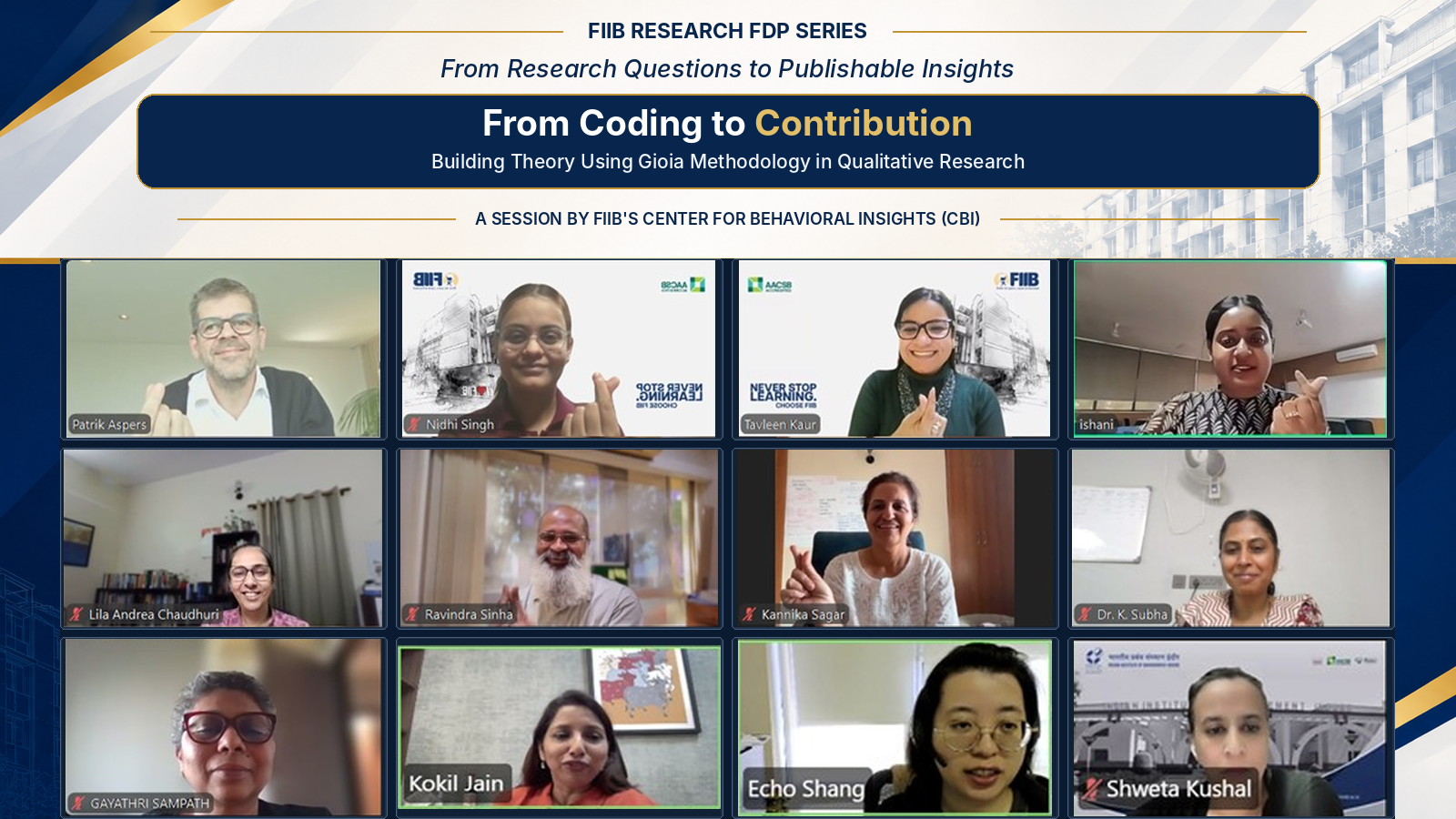
New Delhi, 13 November 2026Qualitative research often stalls at the same point. Researchers collect rich interviews and field notes, then struggle to turn them into a theoretical contribution that is systematic, rigorous and publishable. The Center for Behavioral Insights (CBI) at Fortune Institute of International Business (FIIB) built its latest Faculty Development Programme around that gap.
The two-day FDP, “From Coding to Contribution: Building Theory Using Gioia Methodology in Qualitative Research”, was held on 12 and 13 November 2026. It was the second programme in the FIIB Research FDP Series, “From Research Questions to Publishable Insights”: three FDPs, led by three FIIB research centres, forming one research journey. It brought together doctoral scholars and faculty members from institutions across India, including XIM University Bhubaneswar, IIM Indore, XLRI and K J Somaiya Institute of Management. Many of them are engaged in doctoral research, teaching and research supervision.
Three distinguished resource persons from three countries shaped the programme. Prof. Patrik Aspers (University of St. Gallen, Switzerland) set out the foundations of qualitative inquiry and what makes it distinctive. Prof. Shang Liang (The Education University of Hong Kong) led participants through first and second order coding, bridging what informants say with what researchers interpret. Dr. Rajasekhar David (IIM Ranchi) facilitated hands-on coding.
Learning by working with data
The programme was designed so participants practised the method rather than only hearing about it. On Day 1, they coded live qualitative data by hand, moving from first order concepts to second order themes and aggregate dimensions using the Gioia methodology. On Day 2, they carried the same analytical logic into NVivo and experienced how software supports, but does not replace, the researcher’s judgement in organising and coding data.
What participants take back
By the close of the programme, participants had walked the complete path from raw transcript to a structured data structure, which is the backbone of a credible qualitative paper. They left with a clearer grasp of the rigour, reliability and reporting standards that reviewers expect, and practical guidance on conducting better research interviews. They also gained the confidence to move between manual and software-assisted analysis. For doctoral scholars, this means a more defensible method chapter. For supervisors and faculty, it means a shared language to guide the researchers they mentor.
Building a research culture at FIIB
The FDP reflects how FIIB approaches research: as a practice to be developed, not a box to be ticked. Through its research centres, FIIB creates spaces where scholars can question, experiment and refine their methods alongside international experts and peers from leading institutions. The same commitment shapes FIIB’s own academic community, where 85% of core faculty hold doctorates.
“Research development must go beyond familiarising scholars with methodologies. It must create opportunities to question, experiment, practise and develop the confidence to produce rigorous research,” said Dr. Tavleen Kaur, Chair, Center for Behavioral Insights, FIIB. “At the heart of good research is not just the ability to collect data, but the ability to make sense of it, build theory and contribute knowledge.”
—————–
Coming next: The series concludes with FDP III, “Designing Human–AI Behavioural Experiments: From Experimental Design to a Deployed Study”, organised by FIIB’s Center for Innovation, Entrepreneurship & Technology (CIET) on 18–19 December 2026. Faculty, doctoral scholars and researchers can register here.















Leave a comment