

New Delhi, 9 October 2026
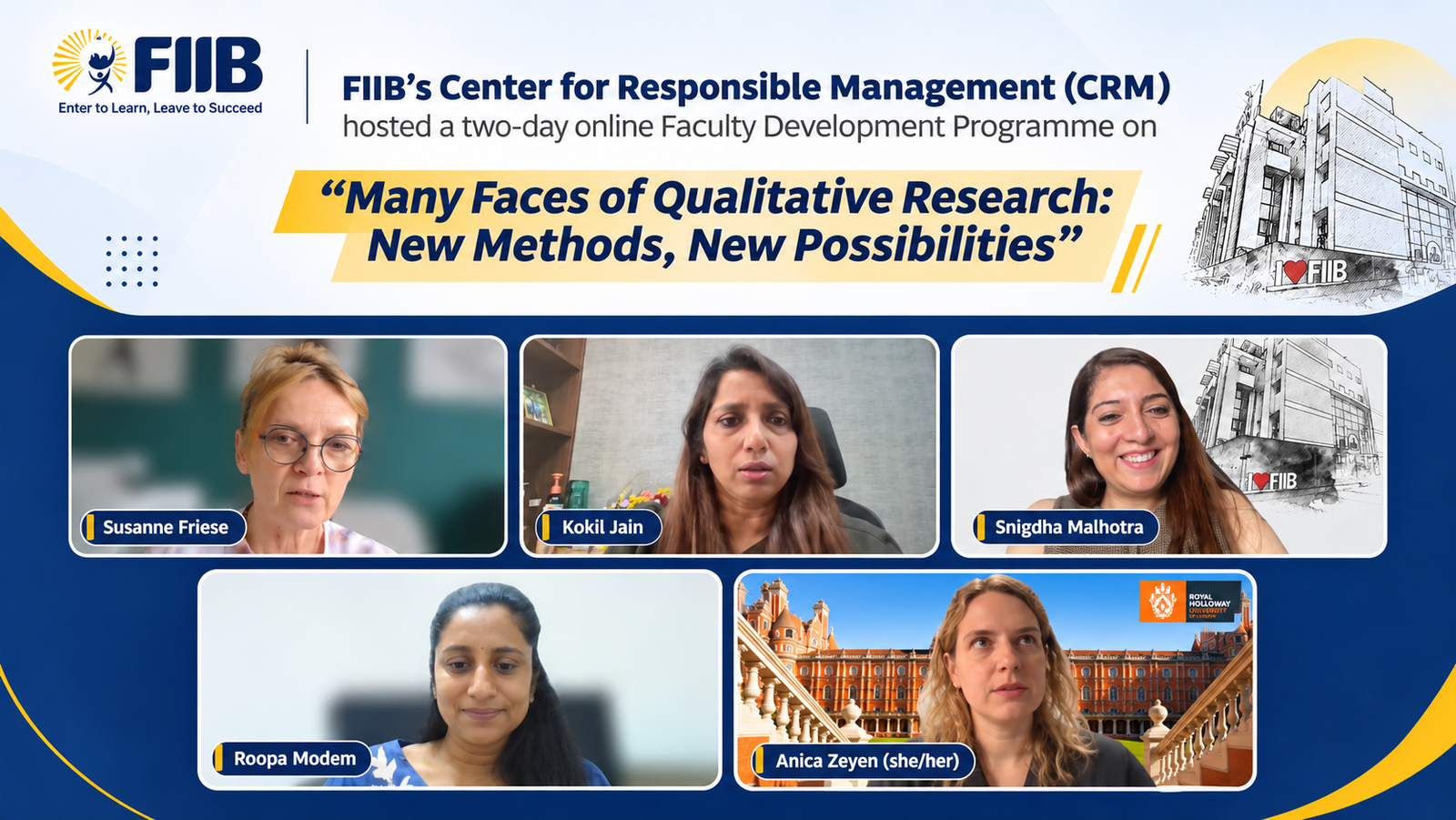
The Center for Responsible Management (CRM) at Fortune Institute of International Business (FIIB), New Delhi, hosted a two-day online Faculty Development Programme, “Many Faces of Qualitative Research: New Methods, New Possibilities”, on 8 and 9 October 2026. The programme brought together 12 faculty members and doctoral researchers from 11 institutions across India and the UAE to explore methods built to catch what the standard interview misses, and to put AI auto-coding side by side with their own manual coding.
Its focus reflects a growing pressure on qualitative research. Journal editors now look harder at the path from raw data to a claim a researcher can defend. Much of what management scholars most want to explain, such as identity, emotion and decisions made in the moment, still slips past surveys and single-sitting interviews.
The FDP was built around that gap and opened the FIIB Research FDP Series, “From Research Questions to Publishable Insights”, three programmes led by three FIIB research centres.
The cohort of five faculty members and seven doctoral and research scholars came from IIM Indore, IMT Hyderabad, XIM University, MNNIT Allahabad, BITS Pilani, University of Madras, Symbiosis International University (including its Dubai campus), SRM University–AP, Galgotias University, the Academy of HRD Ahmedabad and Dayalbagh Educational Institute.
Day 1 widened the toolkit. Prof. Anica Zeyen, Professor of Entrepreneurship & Inclusion, Royal Holloway University, took participants through participatory and photo-based methods, then diaries and art-based methods, from choosing a method to designing prompts and interpreting what comes back. Prof. Malcolm Higgs, Emeritus Professor (OB & HRM), University of Southampton, and Professor of Leadership & Strategy, Birmingham City University, closed the day on why qualitative rigour is being re-litigated, and what reflexivity and positionality now demand of researchers.
Day 2 was hands-on. Prof. Roopa Modem, Assistant Professor, School of Innovation & Management, led participants from data to codes and from codes to themes in qualitative data analysis software. Prof. Susanne Friese, Founder & Director, Qeludra Consultancy, had them compare AI-assisted auto-coding with manual first-pass coding, showing where AI helps and where it puts methodological integrity at risk. Prof. Kokil Jain, Dean, Research & Outreach, FIIB, showed how to turn analysis into a findings narrative with a visible theoretical contribution.
The programme closed with each participant presenting a Mini-Method Brief: one method, tool or principle from the FDP, applied to their own research, in answer to “What will change in my research practice?” They are left able to choose and design diary, photo-based and art-based studies, code and build themes in software while keeping interpretation in the researcher’s hands, use AI in analysis responsibly, and write qualitative findings that hold up with high-impact journals.
“Business schools are asking their faculty and doctoral scholars to publish work that speaks to the lived realities of organisations. That calls for methods that reach beyond the single interview, and analysis that stands up to scrutiny,” said Prof. Snigdha Malhotra, Head, Center for Responsible Management, FIIB.
For CRM, the programme carries FIIB’s commitment to responsible management into research practice, with close attention to consent, co-authorship, positionality and the ethical use of AI. Across its research centres, FIIB India is building a research community that reaches well beyond its own campus.
Coming next: The series concludes with FDP III, “Designing Human–AI Behavioural Experiments: From Experimental Design to a Deployed Study”, organised by FIIB’s Center for Innovation, Entrepreneurship & Technology (CIET) on 18–19 December 2026. Faculty and doctoral researchers can register here.









Leave a comment