
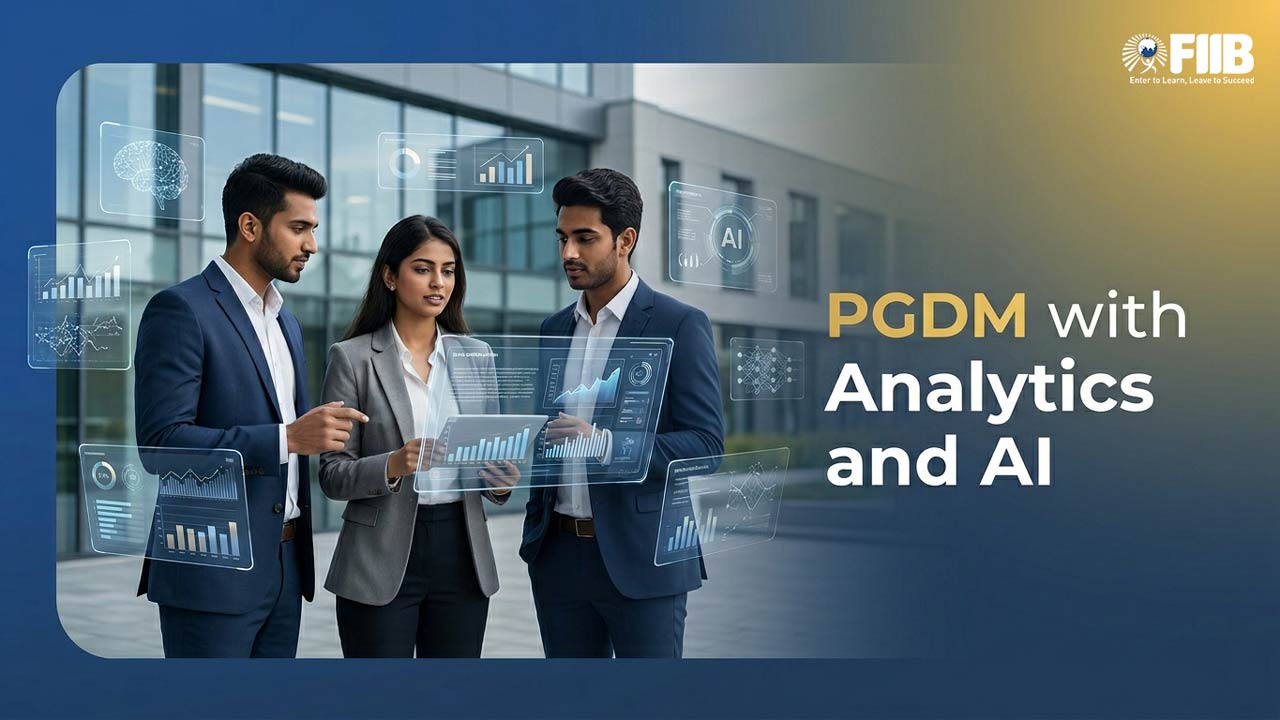
PGDM with Analytics and AI is becoming one of the most relevant management specializations for students who want to build careers at the intersection of business, data, and technology. As companies increasingly depend on data-backed decisions, automation, forecasting, and intelligent systems, they need managers who can understand both business strategy and analytical thinking.
This program is designed for students who do not want to choose between management education and future-ready technical exposure. A PGDM with Analytics and AI combines core business subjects such as marketing, finance, operations, and strategy with modern areas like business analytics, machine learning, artificial intelligence, data visualization, and decision science. The result is a course that prepares graduates for roles that demand commercial understanding as well as analytical problem-solving.
| Program Element | What It Covers |
|---|---|
| Management Foundation | Marketing, finance, HR, operations, strategy |
| Analytics Exposure | Business analytics, data interpretation, dashboards |
| AI Integration | AI applications in business, automation, predictive models |
| Practical Learning | Internships, case studies, projects, capstone |
| Career Outcome | Analyst, consultant, strategist, transformation roles |
What is PGDM with Analytics and AI?
PGDM with Analytics and AI is a postgraduate diploma in management that adds a strong specialization in data analytics and artificial intelligence to the traditional management curriculum. Instead of focusing only on theory-heavy management education, this program prepares students to solve business problems through structured analysis, technology adoption, and intelligent decision-making.
In today’s business environment, organizations are not only looking for managers who can lead teams or handle operations. They also want professionals who can interpret customer data, improve business processes, identify trends, and use AI-enabled tools to make faster and better decisions. That is where this specialization becomes valuable, because it builds a bridge between management thinking and data-driven execution.
How this program differs from a traditional PGDM
A traditional PGDM focuses largely on management fundamentals such as accounting, organizational behavior, human resources, business communication, and strategic planning. While these subjects are still important, a PGDM with Analytics and AI goes a step further by introducing specialized learning in data handling, analytical models, and AI-based business applications.
This difference matters because the business world has changed. Managers today are expected to understand dashboards, data patterns, customer behavior metrics, and digital systems. A traditional PGDM may build leadership and managerial competence, but a PGDM with Analytics and AI adds the ability to work with business intelligence, predictive tools, and technology-led strategy.
Why the specialization is relevant today
The relevance of this specialization comes directly from the way companies now operate. Businesses across banking, retail, healthcare, consulting, e-commerce, logistics, and manufacturing are using analytics and AI to optimize pricing, customer targeting, demand forecasting, fraud detection, and operational efficiency.
That means graduates with this specialization are entering a market where their skill set already matches industry demand. Instead of learning management first and then trying to upskill separately in analytics or AI, students get both as part of a structured program. This makes them more competitive, more adaptable, and better aligned with future roles in a fast-changing digital economy.
Why Choose PGDM with Analytics and AI?
Choosing PGDM with Analytics and AI is a smart move for students who want a management degree that stays relevant beyond the classroom. This specialization is not just about adding a trendy subject to a business program. It is about preparing for an economy where decisions are increasingly driven by data, algorithms, and intelligent systems.
For students who want broader career options, this course offers a practical advantage. It opens doors not only to traditional business functions like marketing, finance, and operations, but also to modern roles in analytics, consulting, product strategy, and digital transformation. That kind of flexibility is especially useful at a time when industries are evolving quickly and job roles are becoming more interdisciplinary.
Industry demand for analytics and AI professionals
Companies today are collecting more data than ever before, but raw data alone does not create value. They need professionals who can understand what the numbers mean, connect those insights to business goals, and recommend action. That is why analytics and AI roles are expanding across sectors and not just within technology companies.
This demand is also not limited to highly technical coding roles. Many employers are hiring business-focused professionals who can interpret data, work with analytical tools, collaborate with technical teams, and translate insights into strategic decisions. A PGDM with Analytics and AI helps students fit exactly into this growing category of business-ready analytics talent.
A future-ready management education
One of the strongest reasons to choose this specialization is that it prepares students for the future of management itself. Business leadership is no longer separate from technology. Marketing now relies on customer analytics, finance uses predictive models, HR depends on workforce data, and operations increasingly uses automation and AI-based planning.
A future-ready management education must therefore go beyond classic classroom theory. It should train students to understand the business impact of technology, the practical use of data, and the ethical and strategic role of AI in organizations. That is exactly why PGDM with Analytics and AI stands out as a modern and forward-looking choice.
Key Highlights of the Program
A PGDM with Analytics and AI typically combines a broad management foundation with a focused specialization that supports real-world business use cases. Students are usually introduced to core subjects in the first phase of the course and then move into advanced analytics and AI-related topics as the program progresses. This approach helps them first understand how businesses work before learning how analytics can improve decision-making within those functions.
Another important highlight is the practical structure of the course. Most institutes design the program around projects, internships, case-based learning, workshops, and industry interaction. This ensures that students do not just learn concepts in isolation. Instead, they apply those concepts to business situations, which improves both confidence and employability.
Program structure and duration
In most cases, the program runs for two years and is divided into multiple terms or semesters. The first year usually focuses on management fundamentals, while the second year goes deeper into specialization subjects such as business analytics, machine learning for managers, AI applications in business, and data-driven strategy.
This structure is helpful because it gives students time to build context. They first learn how organizations function, how decisions are made, and how different business departments operate. Once that base is clear, they are better prepared to understand how analytics and AI can improve those areas in practical ways.
Practical exposure and industry learning
A major strength of this program is that it often goes beyond classroom lectures. Institutes may include internships, capstone projects, live assignments, business simulations, workshops, and guest lectures from industry professionals. These elements bring academic learning closer to real workplace expectations.
Practical exposure matters because analytics and AI are best understood through application. Students learn more effectively when they work with business data, solve case problems, create dashboards, or participate in project-based evaluations. This also helps them build portfolios and interview-ready examples that strengthen placement outcomes.
Common practical components in the program include:
- Summer internships
- Live industry projects
- Capstone assignments
- Case study analysis
- Business simulations
- Tool-based learning sessions
- Corporate guest lectures
Subjects and Curriculum in PGDM with Analytics and AI
The curriculum of a PGDM with Analytics and AI is designed to create a balance between managerial understanding and technical awareness. Students are not expected to become pure software engineers, but they are trained to become managers and professionals who can work effectively with analytics tools, data-driven systems, and AI-enabled business processes.
This balance is what makes the course attractive to a wide range of learners. It serves students who want strong business fundamentals while also giving them exposure to analytical thinking, forecasting methods, machine learning concepts, and digital decision-making frameworks. The curriculum is usually structured so that the technical subjects remain business-oriented rather than overly abstract.
Core management subjects
Core management subjects remain central to the program because analytics and AI only become useful when applied to business realities. Students are therefore taught areas such as marketing management, financial management, operations, human resource management, business economics, strategy, organizational behavior, and communication.
These subjects help students understand the context in which data is used. For example, customer analytics becomes more meaningful when a student already understands marketing strategy. Similarly, operational analytics becomes more useful when the student knows how supply chains, process efficiency, and performance metrics work in actual business settings.
Analytics and AI specialization subjects
The specialization side of the curriculum usually includes business analytics, data visualization, predictive analytics, data mining, machine learning for managers, artificial intelligence in business, and decision science. Some institutes may also include Python, R, SQL, big data analytics, business intelligence tools, and AI strategy modules.
These subjects are not simply added for technical depth. Their real value lies in helping students understand how organizations use data to forecast demand, reduce costs, personalize customer experiences, detect risks, and improve decision-making. The focus is generally on business use, business interpretation, and business outcomes rather than only on programming complexity.
Typical subject mix in the course:
| Core Management Subjects | Analytics and AI Subjects |
|---|---|
| Marketing Management | Business Analytics |
| Financial Management | Data Visualization |
| Operations Management | Predictive Analytics |
| Human Resource Management | Machine Learning for Managers |
| Strategic Management | Artificial Intelligence in Business |
| Business Communication | Data Mining |
| Organizational Behavior | Business Intelligence Tools |
Tools and technologies students may learn
Many institutes now include tool-based learning to improve practical competence. Students may get exposure to spreadsheet modeling, visualization tools, statistical software, dashboard platforms, and beginner-friendly programming environments used in analytics projects. These tools help them move from theoretical understanding to practical execution.
The goal here is not always to turn every student into a deep technical specialist. Instead, it is to ensure that graduates understand how analytical tools are used in organizations, how to interpret outputs, and how to collaborate with technical teams. That kind of working knowledge is extremely valuable in management, consulting, and analyst roles.
Eligibility and Admission Process
The eligibility for PGDM with Analytics and AI is generally similar to other PGDM programs, but students with strong analytical aptitude often have an advantage during the selection process. Most institutes require a bachelor’s degree from a recognized university, and they may also ask for a minimum percentage or grade depending on institutional standards.
Admission is usually based on a combination of entrance exam performance, academic profile, communication ability, and interview performance. Some colleges also value work experience, especially if the applicant can show interest in data, digital business, problem-solving, or technology-led management roles.
Basic eligibility criteria
The first requirement is usually graduation in any discipline from a recognized institution. Many colleges accept students from commerce, science, engineering, management, economics, and even humanities backgrounds, provided they meet the academic threshold and demonstrate the potential to succeed in a management program.
A technical background is often helpful but not mandatory. This is important because many students assume they need advanced coding knowledge before entering the course. In reality, most good programs are designed to teach analytics and AI concepts in a way that business students can understand and apply. Curiosity, logic, and willingness to learn matter more than prior technical mastery.
Step-by-step admission process
The admission process generally begins with filling out the application form and submitting academic details. Institutes may then shortlist candidates based on entrance exam scores, past academics, and profile strength. Shortlisted applicants are often invited for further evaluation through group discussions, written assessments, or personal interviews.
The final selection usually depends on multiple factors rather than one score alone. Colleges often look for communication skills, problem-solving ability, motivation for the specialization, and career clarity. This makes it important for applicants to not only prepare for exams but also understand why they want to pursue PGDM with Analytics and AI.
A common admission journey looks like this:
- Check eligibility criteria and accepted entrance exams
- Fill out the application form
- Submit academic and profile details
- Appear for entrance test or provide accepted score
- Attend group discussion, written test, or interview
- Receive admission decision
- Complete fee payment and enrollment formalities
Skills You Gain Through the Program
A PGDM with Analytics and AI develops both business-oriented and analytical skills, which is one of its biggest advantages. Students are trained to approach problems systematically, interpret data in a business context, and understand how technology can support growth, efficiency, and competitive decision-making.
The program also builds skills that are useful beyond purely analytics-focused roles. Communication, collaboration, presentation, strategic thinking, and decision-making remain central because analytical insights only create value when they are clearly understood and effectively acted upon inside an organization.
Analytical and problem-solving skills
One of the most important outcomes of this program is the development of analytical thinking. Students learn how to break down business problems, identify measurable variables, read patterns in data, and evaluate possible solutions based on evidence instead of assumptions.
This way of thinking is valuable across departments and job roles. Whether a graduate works in marketing, finance, consulting, operations, or product strategy, the ability to think critically and solve problems with structured logic becomes a major professional strength. That is why this course can support diverse career paths rather than only one narrow specialization.
Business and leadership skills
While the analytics and AI components receive a lot of attention, the management side of the course remains equally important. Students are trained in communication, teamwork, leadership, negotiation, presentation, and strategic planning. These skills help them function effectively in business environments where decisions involve multiple stakeholders.
Leadership in modern organizations also requires the ability to use data responsibly and intelligently. A manager must know when to trust data, how to question assumptions, how to explain analytical findings to non-technical teams, and how to align insights with business goals. This program helps students build exactly that kind of balanced professional judgment.
Key skills developed during the course:
- Data interpretation
- Analytical reasoning
- Strategic thinking
- Business communication
- Decision-making
- Team collaboration
- Problem-solving
- Technology awareness
- Presentation and reporting
- AI application understanding
Career Opportunities After PGDM with Analytics and AI
Career opportunities after PGDM with Analytics and AI are broad because the program prepares students for both business roles and data-driven roles. Graduates are not limited to one niche path. Depending on their interests, skills, internship exposure, and chosen electives, they may enter analytics, consulting, strategy, operations, marketing, business intelligence, or transformation-oriented positions.
This flexibility is especially important in a changing job market. Many organizations no longer hire only for traditional department-based roles. Instead, they look for professionals who can work across teams, understand business problems, and support decisions through data-backed insights. This makes PGDM with Analytics and AI graduates attractive across industries.
Popular job roles
Graduates may begin their careers as business analysts, data analysts, marketing analysts, financial analysts, product analysts, operations analysts, or business intelligence associates. Some may also move into consulting, digital transformation, growth strategy, or AI-enabled business support roles depending on the depth of their skill set.
These roles differ in function, but they share a common requirement: the ability to understand business objectives and work with data to improve outcomes. That is why this specialization has broad utility. It does not prepare students only for technical jobs, but for business jobs that increasingly rely on analytics and intelligent systems.
Common roles after graduation include:
- Business Analyst
- Data Analyst
- Product Analyst
- Marketing Analyst
- Operations Analyst
- Financial Analyst
- Business Intelligence Analyst
- Strategy Associate
- Digital Transformation Consultant
- AI Strategy Analyst
Industries that hire these graduates
The demand for graduates from this specialization extends across sectors because nearly every industry now relies on data and technology for business decisions. Banking and financial services use analytics for risk modeling and customer segmentation. Retail and e-commerce use it for recommendation systems, pricing, and demand forecasting. Healthcare uses it for efficiency, planning, and service optimization.
Consulting firms, IT companies, telecom, logistics, manufacturing, edtech, and startups also actively seek talent that understands both management and analytics. This cross-industry relevance gives graduates more options compared to narrowly specialized programs. It also makes the course a good fit for students who want long-term adaptability in their careers.
Salary Scope and Growth Potential
Salary after PGDM with Analytics and AI depends on several factors, including institute reputation, academic performance, technical competence, internship exposure, industry demand, and the specific role offered. Entry-level salaries can vary widely, but candidates with strong project work, good communication, and solid analytical understanding often have an advantage during placements.
The long-term growth potential is one of the strongest reasons to pursue this specialization. As professionals gain experience, they can move from analyst positions into consulting, strategy, product leadership, transformation management, and decision science roles. Because analytics and AI influence multiple functions, career progression can become both vertical and cross-functional over time.
Factors that influence salary
Salary does not depend only on the course title. Recruiters usually assess how well the student can apply concepts, use tools, solve business problems, and communicate findings. A candidate from a strong institution with relevant internship experience and project-based exposure may receive better offers than someone who has only theoretical understanding.
Location and industry also play a major role. Consulting, financial services, e-commerce, and tech-driven sectors may offer stronger starting packages for analytics-linked roles. At the same time, students who continue building their skills after graduation often improve earning potential significantly over the first few years of work.
Long-term career growth
The long-term value of this specialization lies in its relevance to future business leadership. As organizations become more data-centric, professionals who can combine analytical understanding with managerial decision-making are likely to remain in demand. This creates room for strong growth beyond entry-level analyst roles.
Over time, graduates may move into roles involving strategy, transformation, customer intelligence, product planning, and business leadership. The course can also serve as a strong foundation for professionals who later want to specialize further in analytics, AI applications, consulting, or technology-enabled management functions.
| Career Stage | Typical Focus |
|---|---|
| Entry Level | Analysis, reporting, dashboards, business support |
| Early Growth | Functional ownership, stakeholder coordination, deeper tools |
| Mid Career | Strategy, consulting, planning, team leadership |
| Long Term | Transformation, product leadership, business decision roles |
PGDM with Analytics and AI vs MBA in Business Analytics
Many students compare PGDM with Analytics and AI to MBA in Business Analytics because both sound similar on the surface. The real difference often depends on the structure, flexibility, curriculum design, and institutional approach. PGDM programs are generally offered by autonomous institutes, which may allow them to update curriculum more quickly based on industry needs.
MBA programs, on the other hand, are usually university-affiliated and may follow a more standardized academic structure. That does not automatically make one better than the other. The better choice depends on the institute quality, industry exposure, practical learning model, placement support, and how well the curriculum is aligned with real business applications.
Curriculum and flexibility
A PGDM program can sometimes respond faster to emerging trends because autonomous institutions may revise modules more frequently. This can be useful in fast-moving areas like analytics, AI tools, business intelligence platforms, and digital transformation topics. In a field changing this quickly, updated curriculum matters.
An MBA in Business Analytics can still be highly valuable, especially when offered by a strong university or reputed school. However, students should carefully compare the balance between theory and application. The real question is whether the program teaches students how to use analytics in business settings, not just whether the title includes analytics.
Which option is better for students?
The better option depends on career goals. If a student wants a strong industry-aligned program with practical exposure, modern modules, and hands-on learning, a well-designed PGDM with Analytics and AI may be a strong choice. If the student prefers a more conventional university route, an MBA can also be suitable.
What matters most is not the label alone but the substance of the program. Students should compare faculty quality, project opportunities, recruiter profile, curriculum depth, alumni outcomes, and internship support before making a decision. A poorly designed program with a modern name is still weaker than a strong program with real academic and industry substance.
| Comparison Area | PGDM with Analytics and AI | MBA in Business Analytics |
|---|---|---|
| Academic Structure | Autonomous institute-led | University-affiliated in many cases |
| Curriculum Updates | Often faster and industry-oriented | May be more standardized |
| Learning Style | Frequently practical and project-based | Varies by university |
| Focus | Management + analytics + AI applications | Management + business analytics |
| Best For | Students seeking flexibility and industry exposure | Students preferring university structure |
Who Should Pursue This Program?
PGDM with Analytics and AI is suitable for students who want to work in modern business environments where data, technology, and strategy are deeply connected. It is especially relevant for those who enjoy problem-solving, decision-making, business analysis, or using structured thinking to improve outcomes.
It is also a strong option for learners who want career versatility. A student may enter the program with interest in marketing, finance, consulting, operations, or product roles and still benefit from the analytics and AI specialization because these areas increasingly depend on data-driven methods and technology-enabled decisions.
Fresh graduates
Fresh graduates can benefit from this course because it gives them early exposure to a future-ready mix of management and analytics. Instead of entering the job market with only general business knowledge, they graduate with a more differentiated profile that is aligned with current employer expectations.
For freshers, this specialization can also build confidence in using data and technology without requiring them to start from an advanced technical background. When taught well, the program helps them develop a practical understanding of business analytics and AI applications in a structured and accessible way.
Working professionals and career switchers
Working professionals who want to move into more strategic or data-oriented roles may also find this program valuable. It can help them shift from routine operational work into higher-value functions involving analysis, planning, optimization, reporting, and decision support.
For career switchers, the course acts as a bridge. It helps them reposition themselves in a job market that increasingly rewards digital awareness and analytical capability. With the right combination of classroom learning, projects, and placement support, it can support a meaningful transition into stronger business roles.
How to Choose the Right College for PGDM with Analytics and AI
Choosing the right college is just as important as choosing the specialization itself. Many institutes may use attractive keywords in their brochures, but students should look deeper into curriculum quality, faculty expertise, practical training, industry exposure, and placement support before making a decision.
A good college will not only teach subjects but also create an environment where students can apply them. That includes strong internships, updated coursework, live projects, corporate interaction, and access to placement opportunities that reflect the promise of the specialization. Without these elements, even a good-looking program may fail to deliver real career value.
What to evaluate before applying
Students should carefully review the course structure, specialization depth, institute approvals, faculty background, internship model, recruiter network, and alumni outcomes. These factors reveal whether the program is designed for real career preparation or mainly for marketing appeal.
It is also useful to check whether the curriculum is genuinely aligned with analytics and AI or whether it only includes a few surface-level subjects. The strongest programs usually show a clear balance between core business education, tool-based learning, case-based teaching, and industry-oriented projects.
A practical checklist for students
Before applying, students should compare multiple colleges on specific criteria instead of relying only on rankings or advertisements. A practical checklist makes the decision process clearer and helps avoid costly mistakes based on brand perception alone.
The best choice is usually the college that offers the strongest overall fit for the student’s goals, budget, learning style, and career plans. A balanced evaluation can make a major difference in the value a student gets from the program.
Checklist to compare colleges:
- Accreditation and approvals
- Updated curriculum
- Faculty with industry and academic experience
- Internship and project opportunities
- Placement record in analytics-related roles
- Corporate partnerships
- Alumni outcomes
- Tool and lab exposure
- Fee vs return on investment
- Student support and career services
Frequently Asked Questions
Is PGDM with Analytics and AI a good career option?
Yes, it is a strong career option for students who want to combine management knowledge with analytical and technology-oriented skills. The program is especially relevant because companies increasingly want professionals who can understand business challenges and use data-backed thinking to solve them.
It is also a flexible career option because graduates can work across sectors and functions. Instead of being limited to one narrow technical domain, they can explore roles in analytics, consulting, marketing, finance, operations, and strategy depending on their strengths and interests.
Do I need coding knowledge before joining?
No, advanced coding knowledge is usually not required before joining the program. Many institutes design the course so that students from different academic backgrounds can understand the concepts and gradually build familiarity with analytical tools and data-driven methods.
That said, a willingness to learn is important. Students who are open to working with numbers, tools, and structured problem-solving often perform better. Even if a student starts without technical confidence, the right program can help build that capability step by step.
What kind of jobs can I get after this course?
After completing the course, students may work in roles such as business analyst, data analyst, product analyst, operations analyst, business intelligence analyst, or consultant. The exact role depends on the institute, projects completed, skills gained, and the student’s own career direction.
The important point is that the course supports both specialist and generalist paths. A graduate can begin in an analytics-heavy role or use the same foundation to grow into broader business and strategy roles later in the career.
Conclusion
PGDM with Analytics and AI is more than a management specialization with a modern label. It is a career-oriented program built for a business environment where data, technology, and decision-making are deeply connected. For students who want to stay relevant in a rapidly changing market, this course offers a strong mix of management education and analytical capability.
The real value of the program lies in its ability to prepare students for practical, high-demand roles across industries. It supports career growth not only in analytics-focused jobs but also in consulting, strategy, operations, and digital transformation. For students looking for a future-ready business education, PGDM with Analytics and AI can be a highly worthwhile choice.
















Leave a comment