
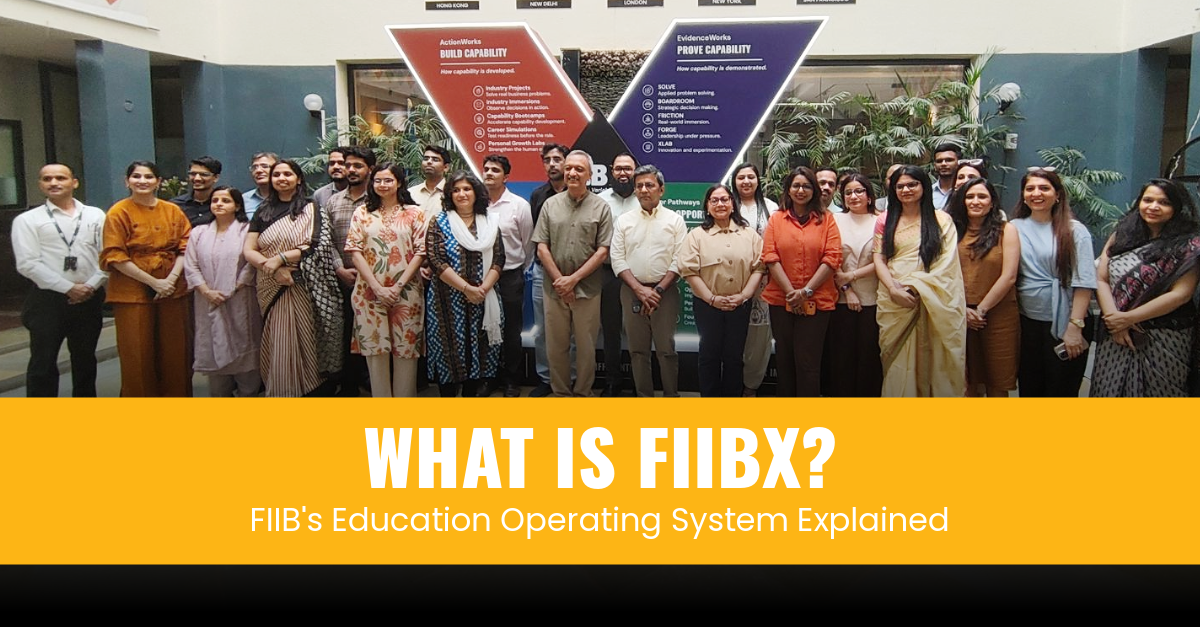
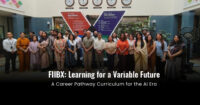
FIIBX™ is FIIB‘s education operating system. Instead of teaching fixed subjects and hoping they stick, it builds adaptable skills through career pathways, live industry work, and real assessment, so students are ready for jobs that haven’t finished changing shape yet. And that’s the real question behind all of this: careers don’t look like they used to, so what do you actually prepare for when the job itself might not exist in five years?
That’s the question FIIBX™ is built to answer. It’s FIIB’s model for getting students ready for work that keeps changing shape, and it does that by building adaptable skills instead of just teaching fixed subjects.
Here’s how it works, in five connected stages. You pick a career direction that interests you. You build up the strengths that support it, things like AI comfort and industry connections. You get hands-on practice through real projects with real companies. You prove what you can actually do through practical tests, not just exams. And you come out the other side as someone employers can trust to adapt, not just someone holding a degree.
So what’s actually different here? You’re not memorizing theory and hoping it transfers to a real job later. You’re working on live problems for actual companies, sitting in decision-making exercises where your choices have real consequences, and building a portfolio of what you’ve done instead of what you’ve studied. By the time you graduate, you’ve already practiced the pressure, the uncertainty, and the problem-solving that real jobs throw at you. You’re not catching up on day one. You’re contributing.
How FIIBX Prepares Future Leaders
Hiring has moved faster than most curriculums can keep up with. Employers aren’t grading solved problems anymore, they’re screening for judgment under ambiguity.
Think about what recruiters actually ask: what have you done, not just what have you studied. AI has taken over a lot of the analysis work that used to anchor management coursework, which means judgment, framing, and decision ownership matter more than ever. And here’s the problem: a course-based curriculum updates slowly. It can’t keep pace. An operating system built on named, swappable formats can.
If you can explain a framework but you’ve never been tested on applying one with incomplete information, that’s a gap. Employers notice it. FIIBX exists to close that gap directly.
FIIBX™: What the Operating System Replaces
A regular course delivers content, then tests you on recall within that course. FIIBX throws out that sequence entirely. Instead, it organizes the program into five operating layers that run in parallel across your whole degree.
Layer 1: Career Pathways
You don’t build capability by studying it in the abstract, you build it inside a professional domain. That’s why FIIBX structures everything around six pathways:
- Consulting & Strategy
- Marketing & Growth
- Finance & Fintech
- Operations & Analytics
- People & Organisation
- Founders & Venture
Each pathway opens into one or more focused tracks. You choose a pathway, then a track, and from there you see exactly where it leads: the roles it opens up, what employers look for, and how you build and prove that capability along the way.
Layer 2: Multipliers
Multipliers aren’t electives, and they’re not add-ons either. They run underneath every track, project, and learning experience in FIIBX, all the time.
Take AI Readiness. It’s not a bolt-on tool you’re handed for one assignment, it’s built into every course and project. You use AI for real analysis, real ideation, real automation, real decisions.
Then there’s Network Advantage. You’re not networking with one group, you’re plugged into three at once: industry mentors and live project partners, a 31-year alumni community, and international exchange and immersion experiences.
And Responsible Mindset. This isn’t a values poster on the wall. It builds ethical decision-making, inclusion and empathy, and impact-driven leadership, and it’s proven through SIP outcomes and reflection portfolios, not asserted through a mission statement.
Layer 3: ActionWorks™
You don’t study business here, you practice it. Five ways, to be exact:
- Live Industry Projects, real briefs from real companies with real deliverables
- Industry Immersions, structured time embedded inside working organisations
- Bootcamps, intensive sprints built around one capability
- Career Pathway Simulations, where you work the actual tasks of a target role
- Personal Growth Labs, built around communication, judgment, and self-awareness
Delivery happens through discussion questions, decision simulations, live cases, and AI-as-co-pilot exercises. And that last one matters: you’re trained to critique and correct AI output, not just accept whatever it hands you.
Layer 4: EvidenceWorks™
Five real-world assessment formats. The point isn’t to prove you’re prepared, it’s to prove you’re ready.
- SOLVE™ tests business fluency and problem solving through applied problem diagnosis.
- BOARDROOM™ tests judgment and leadership through strategic decision-making under pressure.
- FRICTION™ tests adaptability and resilience through real-world immersion.
- FORGE™ tests build and execution capability through tangible delivery.
- XLAB™ tests foresight and future readiness through innovation work.
Pass all five and you’re building toward a career destination. Every project, internship, simulation, certification, and challenge along the way feeds into a professional portfolio, a record of what you’ve done, not just what you sat through.
Layer 5: The FIIBX Graduate
Five capabilities define what comes out the other end: Business Fluent, Interdisciplinary Thinker, AI Enabled, Responsible Leader, and Adaptable Professional.
How FIIBX Connects to the PGDM Structure
FIIBX isn’t something PGDM students sign up for separately. It’s the thinking already built into how the course runs. The internships, live projects, and simulations students go through are working toward the same goals FIIBX talks about, building AI skills, sharper judgement, and stronger industry connections. Students may not hear the name in their day-to-day coursework, but the substance behind it is already woven into how they’re being trained.
Who Should Choose a Program Built on FIIBX?
This isn’t built for everyone. It’s built for:
- Corporate L&D buyers who want structured proof of capability, not a list of course titles
- Aspirants who want their coursework tested against live organizational problems, not just talked through in a case discussion
- Working professionals who need judgment treated as a skill you can actually demonstrate, not just claim
What to Evaluate When Comparing Programs
Here’s how FIIBX stacks up against a conventional course-based curriculum:
| Dimension | Course-Based Curriculum | FIIBX Operating System |
| Learning unit | Fixed course syllabus | Named, layered mechanism (ActionWorks, EvidenceWorks) |
| Problem format | Pre-solved case study | Live brief, incomplete information |
| Assessment | End-of-course exam | Structured, ongoing capability proof |
| Industry contact | Guest lecture or single project | Continuous through FIIB ARC™ partner network |
If you’re weighing two PGDM programs against each other, look at curriculum depth, faculty practice experience, industry immersion structure, assessment rigor, placement process design, and alumni network reach.
Frequently Asked Questions
Is FIIBX a specialization within the PGDM?
No. It’s not an elective or a track you opt into. It runs across the entire program, no matter which specialization you choose.
How is FIIBX different from a standard case-method MBA?
A standard case method hands you pre-solved cases with known outcomes. FIIBX’s ActionWorks™ layer gives you live briefs from industry partners where nobody knows the outcome yet, paired with EvidenceWorks™ formats built to test decision-making, not recall.
Is a program built on an operating system like FIIBX worth it for working professionals?
If you’re a working professional weighing programs, ask yourself how much of the curriculum is built around applied, assessed judgment versus content you just sit and absorb. FIIBX makes that judgment demonstrable, which matters if your next role depends on proof of capability and not just a transcript.
How long does it take to move through the FIIBX structure?
It’s not a standalone module you finish early. FIIBX runs across the full PGDM program, so it follows the same academic calendar as everything else.
What is the risk of a program without a structured operating layer like FIIBX?
Without something comparable, applied skill usually gets assessed only within individual courses. That can leave a gap between what you were taught and what you’re actually tested on under real conditions. This is a structural comparison, not a claim about any one competing school.













Leave a comment