


Where does AI actually belong in a business? Someone has to answer that question, then build the plan to make it real. That’s the AI strategy analyst sitting between the data team and the leadership table, translating one language into the other.
Right now, companies are moving beyond AI experimentation and turning it into revenue-generating initiatives. That shift needs a specific kind of person to drive it. PGDM graduates, working professionals thinking about a pivot, and corporate L&D buyers are all sizing up this path at the same time. Compensation is climbing, demand is climbing faster, and an AI Strategy Analyst career after PGDM in India is turning into one of the fastest-growing routes open to business graduates.
Why This Role Matters Right Now
The AI experimentation phase is ending as companies scale AI into core operations, and most organizations do not yet have anyone who can bridge technical capability and business decision making.
Employers hiring for this role prioritize AI strategy analyst skills over a technical degree. Judgment beats tooling knowledge in this function.
Business graduates who skip this skill set stay boxed into generic strategy or operations roles while the fastest-growing category moves past them. For PGDM graduates specifically, an AI Strategy Analyst career in India has become a distinct, well-paying alternative to the traditional consulting track.
The analysts pulling ahead are neither pure technologists nor pure generalists. They are the ones who understand both AI’s limits and the business’s constraints at the same time.
What Does an AI Strategy Analyst Actually Do?
An AI strategy analyst evaluates where AI can create business value and manages the plan to get it deployed, operating closer to a management consultant’s day than a data scientist’s.
The core responsibilities:
- Assess where AI reduces cost, unlocks revenue, or cuts risk, then rank the opportunities
- Build the business case for a proposed AI initiative: cost, expected return, failure modes
- Translate business requirements into a project brief for technical teams, without writing the model themselves
- Monitor deployed AI systems for business-level performance, not just technical accuracy
- Present findings to leadership, in the language leadership actually uses
The Skills That Separate a Strong Candidate From the Rest
AI strategy analyst skills cluster around three things: applied judgment, communication under scrutiny, and just enough technical fluency to ask the right question.
- Structured problem framing : turning a vague mandate like “use AI in supply chain” into something testable
- Working knowledge of what AI models can and can’t reliably do, without needing to build one yourself
- Financial modeling for cost-benefit and risk-adjusted return
- Stakeholder communication that presents uncertainty honestly, no overselling, no underselling
- Case-based reasoning, built through repeated exposure to real business decisions, not theory alone
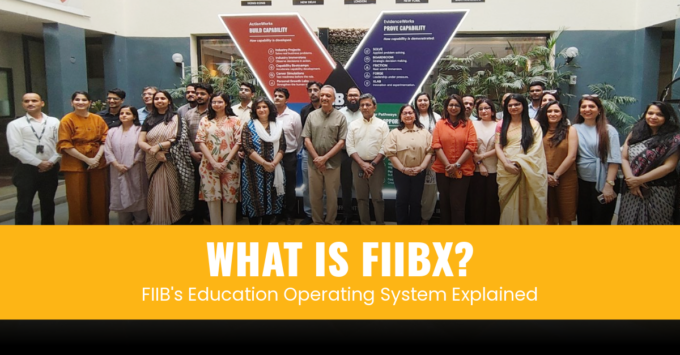
That last point is exactly what FIIB‘s FIIBX™ curriculum architecture is built to deliver. ActionWorks™, one of FIIBX‘s core layers, puts students inside live business problems, where a recommendation has to survive scrutiny from an industry panel, not just a professor.
Where Does the Role Actually Sit in an Organization?
An AI strategy analyst typically reports into strategy, corporate development, or a dedicated AI or digital transformation office, working cross-functionally with data science, operations, and finance.
At FIIB, students get a direct run at this cross-functional orientation through ActionWorks™, a curriculum layer built on live business problems set by industry partners, not case studies alone.
How Much Does an AI Strategy Analyst Earn in India?
Pay varies by industry, city, and what you specialized in before this. Here’s the current indicative breakdown:
| Experience Level | Indicative Annual Salary |
| Entry-level (0–2 years) | ₹7–12 LPA |
| Early-career (2–4 years) | ₹12–20 LPA |
| Experienced (4–7 years) | ₹20–35 LPA |
| Senior strategy or consulting roles | ₹35–50+ LPA |
Three things move your pay within that band:
- Industry. Financial services and tech-heavy sectors pay more for this role than traditional manufacturing does.
- Prior specialization. A finance, marketing, or operations lens layered on top of AI literacy beats a generalist profile.
- Employer sophistication. Companies further along in AI adoption pay more for someone who moves initiatives forward, not just evaluates them.
How Do You Actually Become an AI Strategy Analyst After a PGDM?
Becoming an AI strategy analyst after a PGDM follows a fairly predictable sequence: analytical grounding, applied exposure, a case portfolio, then the right entry role.
Step 1: Build the Analytical Foundation
Coursework in business analytics, decision sciences, or strategy provides the base. A PGDM’s cross-functional structure serves this better than a narrow technical degree, because the role demands speaking to both data teams and business leaders.
Step 2: Get Applied Exposure, Not Just Theory
Employers want evidence of judgment, not a transcript. FIIB’s Corporate Internship Program (CIP) puts students inside live organizational projects. The AI Maturity Index, a framework that assesses how ready a business function is to adopt AI, gives students direct practice at the exact assessment this role performs every day.
Step 3: Build a Portfolio of Business Cases
Two or three worked examples of AI opportunity assessment, even from academic projects, will outweigh a resume full of tool names.
Step 4: Target the Right First Role
Look at AI/digital strategy analyst roles inside consulting firms, corporate strategy teams, or dedicated AI centers of excellence within large enterprises.
Can PGDM Graduates Actually Become AI Strategy Analysts?
Yes. The role rewards business judgment paired with technical literacy, which is exactly the design intent behind a PGDM curriculum built around applied problem-solving rather than technical depth alone. A coding background is not required; structured business-case thinking is the real hiring filter most employers apply.
What Skills Are Required for an AI Strategy Analyst?
| Skill Area | What It Covers | How It’s Typically Built |
| Business case development | Cost-benefit modeling for AI initiatives | Strategy and analytics coursework, applied projects |
| AI literacy | Understanding model capability and limitation, not building models | Electives, workshops, cross-functional exposure |
| Stakeholder translation | Converting technical output into decisions leadership can act on | Live projects with industry partners |
| Change management | Sequencing AI rollout without disrupting operations | Applied internships, capstone projects |
| Data interpretation | Reading model output critically, not just using dashboards | Analytics coursework |
Who Should Consider This Career Path?
This path best suits three kinds of candidates:
- PGDM graduates with a strategy, analytics, or operations specialization
- Working professionals pivoting from a traditional business role into a growth function
- Candidates comfortable operating between technical and business teams
What Should You Evaluate When Choosing a Program?
- Curriculum depth in analytics and strategy, not just “AI” showing up in the program name
- Faculty with active industry practice in AI-linked business functions
- How industry immersion is structured: project-based, internship-based, or classroom-only
- Rigor of applied assessment, real business cases, or just exams
- How the placement process handles emerging, non-standardized roles like this one
- Reach and relevance of the alumni network in AI-adjacent functions
Frequently Asked Questions
Is an AI strategy analyst role different from a data scientist role?
Yes. A data scientist builds and trains models. An AI strategy analyst figures out where those models create business value and manages the plan to deploy them. The two roles work together, but they need different skill emphasis.
Do I need a technical or coding background to become an AI strategy analyst?
No. You need a working knowledge of AI capability and limitation, plus structured business judgment. That matters more than deep coding ability.
How long does it take to become job-ready for this role after a PGDM?
It comes down to the applied exposure you got during the programs, live projects, internships, analytics coursework, not just time elapsed.
What’s the difference between AI strategy and digital transformation roles?
AI strategy roles zero in on artificial intelligence use cases and their business impact. Digital transformation roles are broader, covering technology adoption generally, of which AI is just one piece.
Is this career path worth pursuing over a traditional strategy or consulting role?
Depends on you. Weigh your own strengths in analytics versus general business strategy, and factor in sector demand before deciding.

















Leave a comment